

The best sleep routine for IB students starts with a quiet truth
At some point in the IB, you realize the hardest part of studying is not the content. It's the management. The management of time, stress, deadlines, and that strange 11:47pm feeling that says: If I don't keep going, I'll fall behind.
Here's the uncomfortable twist: the nights you steal from sleep don't usually become extra progress. They become slower reading, weaker recall, and more careless mistakes the next day. In the IB, sleep isn't self-care in the "nice-to-have" category. Sleep is part of your exam technique.
If you want a sleep routine that holds during revision season, it has to be simple enough to repeat. Not perfect. Repeatable.
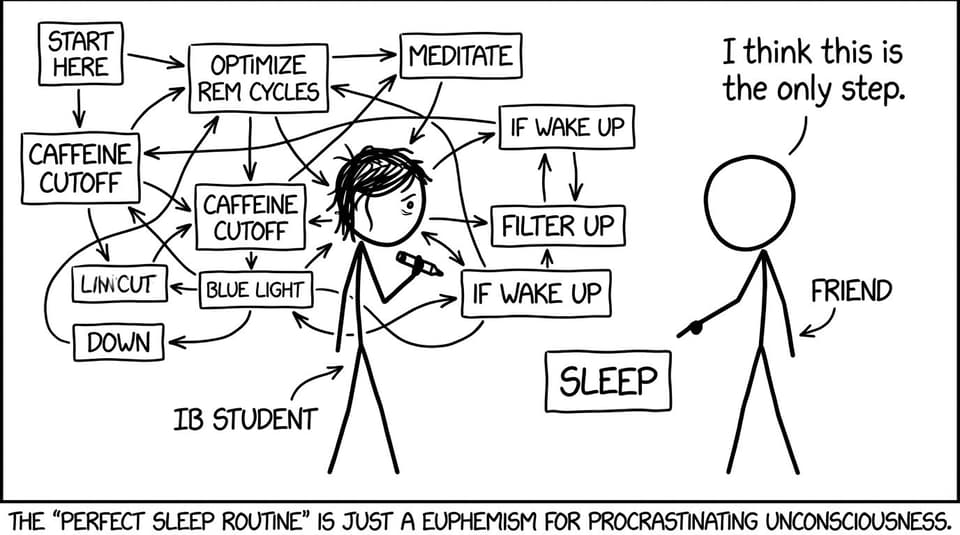
IB sleep routine checklist (copy this)
Use this as your baseline IB sleep routine during exam prep:
- Choose a fixed wake-up time (yes, even weekends)
- Protect 7-9 hours of sleep most nights
- Set a hard stop for heavy studying (usually 60-90 minutes before bed)
- Do a short "shutdown" routine: pack bag, list tomorrow's top 3, clear desk
- Screens off (or heavily dimmed) 30-60 minutes before sleep
- Keep the room cool, dark, and boring
- If you can't sleep after ~20 minutes: get up, low light, do something dull, then return
A routine is just a promise you don't renegotiate nightly.
Why IB students sabotage sleep (and why it feels logical)
The IB trains you to be responsible. That's good. But responsibility has a shadow side: you can start treating rest like a reward for finishing. And in exam season, you never "finish."
So sleep gets traded for certainty.
The problem is that certainty doesn't arrive at midnight. It rarely arrives at all. What you get instead is a tired brain trying to do high-precision work. The IB punishes that with lost marks you can't quite explain later: misread command terms, skipped units, messy structure, half-answered parts.
Sleep is the invisible revision block where memory consolidates and emotional control stabilizes. Without it, studying becomes louder but not better.
Build your IB sleep routine by anchoring the morning first
Most students try to fix sleep by forcing a bedtime. It's usually easier to anchor the wake-up time.
Pick a wake-up time you can keep for the next 2-3 weeks of IB prep. Work backwards:
- Wake: 7:00am
- Lights out: 11:00pm
- Wind-down begins: 10:15pm
- Heavy study cutoff: 9:30-10:00pm
This is where many IB students feel resistance: "But I'm behind." The calmer answer is: being behind with a functioning brain beats being behind with a foggy one.
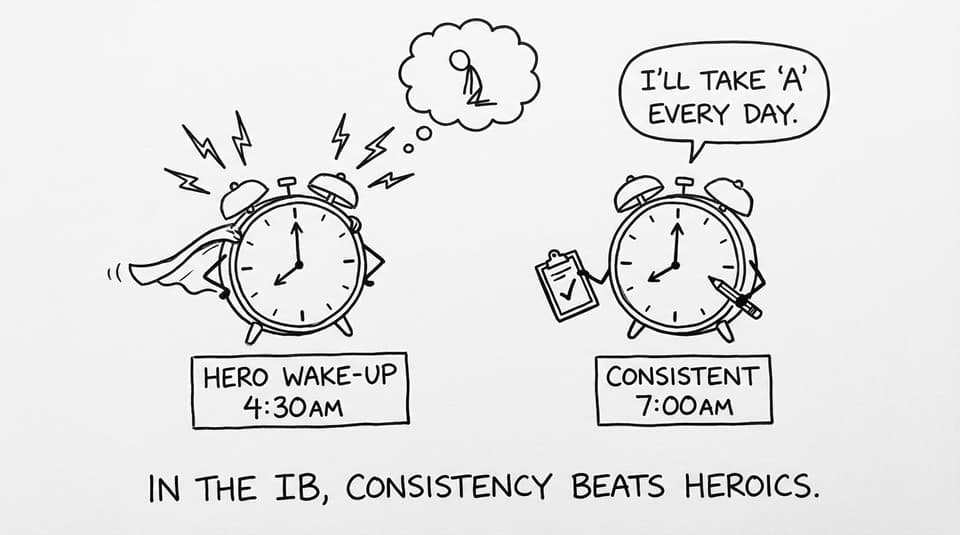
The IB evening routine that protects both grades and sleep
A good IB sleep routine is not "no studying at night." It's "studying that ends cleanly."
The 3-part evening plan
Earlier evening: do your hardest work while your brain still works
If you're going to do heavy IB revision, do it earlier. Use RevisionDojo to make that session efficient:
- Read one section of Study Notes to rebuild understanding fast.
- Immediately prove it with 10-25 targeted questions from the Questionbank.
- Log the mistake pattern (one sentence each). This is where marks come from.
This loop matters because it reduces the late-night panic of "I studied but I'm not sure it worked." Evidence calms you.
Late evening: switch to light review only
Light review for IB does not mean rereading 40 pages. It means active recall in a small time box:
- 10-20 minutes of Flashcards
- A tiny set of questions you already know how to do (confidence loop)
- One clarification using RevisionDojo's AI Chat (keep it to one specific block)
If you need a structured version of this night approach, borrow the rhythm from IB Exam Night Checklist: 15 Things Before Sleeping or IB Exam Night Routine: What Actually Works.
Wind-down: reduce decisions to reduce anxiety
Most IB sleep problems are partly logistics problems. Your brain stays awake because tomorrow feels unfinished.
Do a 7-minute shutdown:
- Pack your bag
- Put your calculator/chargers where you can't forget them
- Write tomorrow's top 3 tasks (not 12)
- Clear your desk surface (yes, it helps)
Then you've told your brain: "We have a plan."
Caffeine, screens, and the three quiet sleep thieves in IB season
The IB workload makes it tempting to use quick fixes. These are the ones that quietly steal sleep.
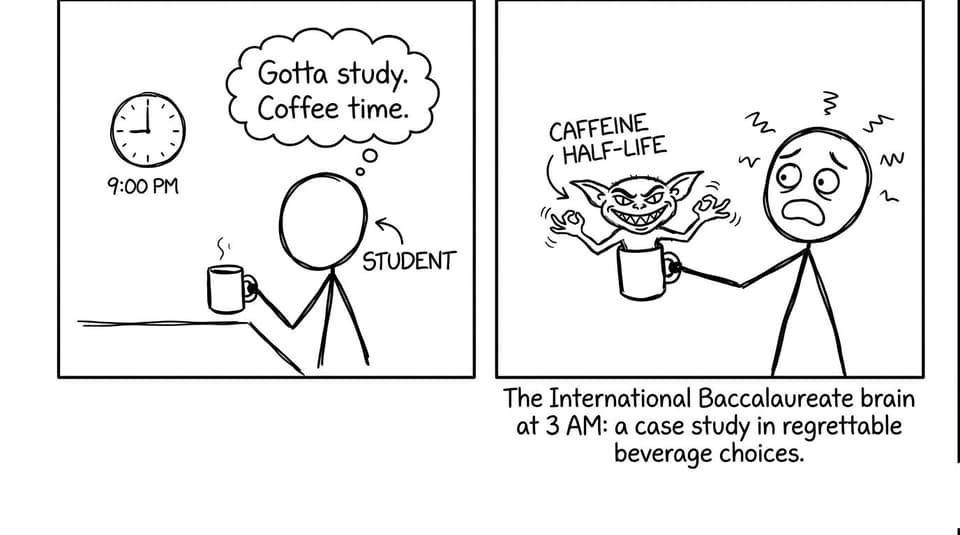
Caffeine cutoff: pick a time and defend it
A simple rule many IB students find workable: no caffeine after 2-3pm. If you're sensitive, move it earlier.
The point isn't moral purity. It's that even when you feel "fine," caffeine can keep your sleep lighter and more fragmented.
Screens: the "one more thing" trap
Screens don't just delay sleep. They keep your brain in input mode. And the IB already gives you too much input.
If you can't go fully screen-free:
- dim brightness aggressively
- use night mode
- put your phone across the room after setting one alarm and one backup
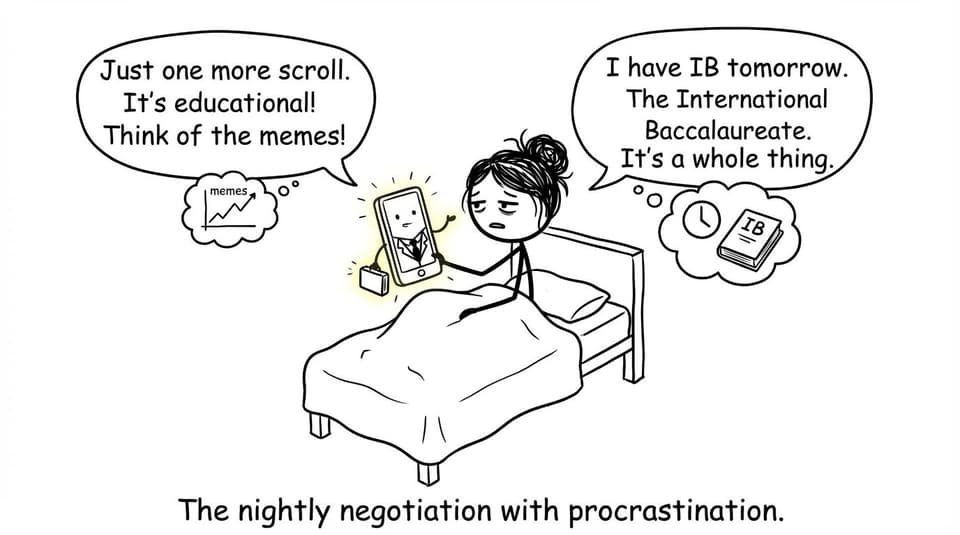
Late-night "new learning" is the fastest way to lose sleep
New learning late at night creates open loops: you feel unfinished, so you keep going. In the IB, this becomes a spiral.
Rule: if it's new, it's too late. If it's reinforcement, it's fine.
For a deeper guide built around this mindset, read How to Sleep Properly During the IB Exam Period.
How RevisionDojo helps IB students sleep better (by studying cleaner)
The best sleep routine for IB students isn't only about bedtime habits. It's also about building days that don't end in panic.
RevisionDojo works well here because it reduces decision fatigue:
- Study Notes replace endless rewriting with faster clarity.
- Flashcards make daily recall small enough to do even on bad days.
- Questionbank turns "I revised" into measurable proof.
- AI Chat (Jojo) shortens the time you spend stuck.
- Grading tools reduce coursework uncertainty earlier, so it doesn't leak into midnight.
- Predicted Papers and Mock Exams create realism earlier in the week, so the night stays light.
- Coursework Library gives examples when you need models, not more guessing.
- Tutors add a human voice when you're overwhelmed and need strategy, not more content.
If you want the full "one place for everything" overview, bookmark RevisionDojo App: The Smarter Way to Prep for IB Exams.
A simple 7-day IB sleep reset plan (without perfection)
If your sleep is already messy, don't try to fix everything at once. Use a one-week reset.
Days 1-2: stabilize wake-up time
Wake up at the same time both days. Even if sleep was rough. This anchors the body clock.
Days 3-4: add a hard stop time
Choose a cutoff for heavy IB work (example: 9:30pm). After that, only light review.
Use RevisionDojo to make the last block clean and short: a flashcard sweep, a tiny Questionbank set, then off.
Days 5-7: protect a full sleep window
Now aim for 7-9 hours by shifting bedtime earlier. Keep the wake-up time fixed.
If anxiety shows up, don't fight it with more studying. Use structure instead. This guide helps: How to Stay Sane During IB Exam Season.
Closing: treat sleep like an IB study method
The best sleep routine for IB students isn't glamorous. It's a few decisions you stop renegotiating: a stable wake-up time, a hard stop for heavy work, and a wind-down that closes loops.
If you want this to feel easier, don't rely on willpower. Build a cleaner workflow so your day ends with proof, not panic. Use RevisionDojo as your calm control panel for IB prep: Study Notes, Flashcards, Questionbank, AI Chat, Grading tools, Predicted Papers, Mock Exams, the Coursework Library, and Tutors when you need a human strategy.
Your goal isn't perfect sleep. It's a brain that shows up and works when the exam starts. That's what a real IB sleep routine is for.