

Confidence in history rarely arrives before you begin. It usually appears afterward: after you explain one cause clearly, analyse an unfamiliar source, or improve a paragraph using feedback.
That is the practical answer to building confidence in MYP History. Do not wait until you feel ready. Break the subject into visible skills, practise one skill at a time, and collect evidence that you are improving.
MYP History asks for more than remembered facts. You may need to investigate questions, evaluate evidence, compare perspectives, communicate ideas, and make supported judgements. Fortunately, each ability can be trained.
A quick confidence-building checklist
- Identify which MYP criterion the task assesses
- Learn a small amount, then retrieve it without notes
- Practise one source-analysis or writing skill at a time
- Compare your response with the instructions and descriptors
- Convert feedback into one specific action
- Repeat a similar task to apply the correction
- Record progress by skill, not only by grade
The aim is not to feel fearless. It is to know what to do next when a question looks difficult.
Building confidence in MYP History starts with clarity
Uncertainty often feels like inability. They are not the same thing.
If you see the instruction evaluate the significance of an event but do not understand what evaluate requires, more notes may not solve the problem. You first need a clear picture of the required action.
MYP Individuals and Societies uses four broad assessment criteria:
| Criterion | What you are developing |
|---|---|
| A: Knowing and understanding | Knowledge, terminology, explanations, and examples |
| B: Investigating | Questions, research planning, information gathering, and reflection |
| C: Communicating | Structure, presentation, and source documentation |
| D: Thinking critically | Analysis, source evaluation, perspectives, and arguments |
Expectations depend on your MYP year and the task set by your school, so your teacher's instructions and criterion descriptors remain the main guide. Revision becomes easier when you replace “improve at history” with a narrower target, such as explaining source limitations.
The MYP Individuals and Societies resource hub brings together Study Notes, Flashcards, lessons, and questions for targeted practice.
Replace vague revision with proof
Reading a familiar page can create a comforting feeling: I know this. Recognition, however, is not the same as producing an answer independently.
Use a three-step routine:
- Study one small topic for 10 minutes.
- Close the notes and write what you remember for three minutes.
- Check what was accurate, missing, or confused.
Retrieval should cover more than dates. Recall causes, consequences, key concepts, contrasting perspectives, and precise examples. RevisionDojo's Study Notes can clarify unfamiliar material, while Flashcards support short retrieval sessions. The MYP Individuals and Societies Questionbank then tests whether you can apply that knowledge.
Keep a brief evidence log:
- What I could do: explain two causes without notes
- What broke down: confused consequence with significance
- Next action: compare the importance of two consequences
Confidence becomes more accurate when it rests on evidence rather than mood.
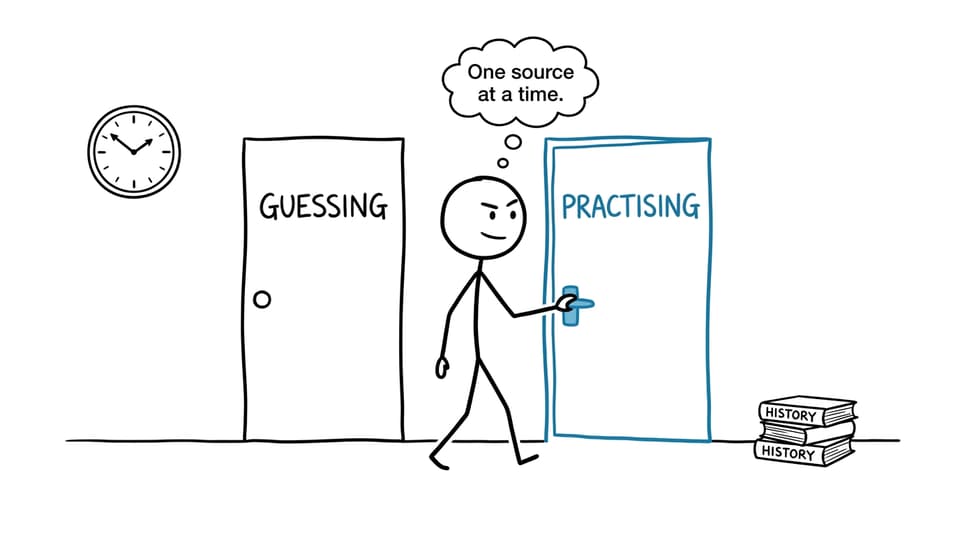
Build confidence with source analysis
Historical sources can seem unpredictable because every document, photograph, speech, or cartoon looks different. The thinking process can remain stable.
Establish what the source communicates. Then examine its origin, purpose, audience, context, value, and limitations. OPVL can help organise this process, but it should support reasoning rather than become a mechanical list.
Avoid writing, “The source is limited because it is biased.” Bias does not automatically make evidence useless. Ask instead: What can this source reveal, and what can it not establish confidently?
A political speech may reveal the message a leader wanted the public to accept, yet provide limited evidence of what the whole population believed. Practise this distinction with a five-minute drill:
- Identify the main message
- Add relevant historical context
- Explain one specific value
- Explain one specific limitation
- Name evidence that could confirm or challenge it
The guide to analysing historical sources for MYP History explores the process in greater depth.
Strengthen your MYP History mindset through writing
Before writing, underline the command term and translate it into a job:
- Describe: provide an accurate account
- Explain: show how or why
- Analyse: examine relationships, causes, or effects
- Evaluate: weigh evidence and reach a supported judgement
Then use a dependable sequence: Point -> Evidence -> Explanation -> Link to the question.
If a question asks why a movement succeeded, do not merely narrate events. Name one factor, support it with precise evidence, explain its connection to success, and judge its importance relative to another factor.
Adding the invisible words because and therefore after factual statements can push your writing from description toward reasoning. The guide to common errors in MYP Geography and History responses helps identify where explanations commonly stop.
Turn feedback into a repeatable rule
A disappointing result is more useful as a diagnosis than a verdict. Convert “needs more analysis” into an action such as: After every piece of evidence, I will explain how it supports my argument.
Apply the rule by rewriting one paragraph. Then answer a similar question under a short time limit. This second attempt matters because understanding feedback is not the same as applying it independently.
RevisionDojo's AI Chat can question vague reasoning, while Grading tools help you inspect responses. The Coursework Library offers useful calibration, and Tutors provide human guidance when a problem persists. Use these tools to strengthen your decisions, never to replace your thinking or authorship.
Protect motivation with a small routine
Large goals weaken MYP History motivation. “Revise the revolution” is vague; “recall three causes and write one comparison paragraph” is actionable.
Try this weekly pattern:
- Monday: Flashcards and retrieval
- Wednesday: one source-analysis drill
- Friday: one timed Questionbank paragraph
- Sunday: review feedback and create one error rule
The MYP revision guide and study routine can help you adapt this structure. Mock Exams support timing once the underlying skills are secure, while Predicted Papers, where relevant and available, provide structured rehearsal.
Begin with your teacher's unit plan and use the overview of topics covered in MYP History as supporting guidance. Schools may organise the subject differently, so alignment matters more than trying to learn everything.
Your concrete next step
Choose one recent task. Identify its criterion and convert one teacher comment into an action. Spend 20 minutes completing a similar question while applying that action deliberately.
This is how confidence becomes a record of progress: one source examined carefully, one argument explained clearly, and one mistake turned into a better method. RevisionDojo provides the complete environment for that journey through Study Notes, Flashcards, the Questionbank, AI Chat, Grading tools, Predicted Papers, Mock Exams, the Coursework Library, and Tutors. Your next step remains small: choose one skill and practise it now.