
Your IB Math IA topic can feel like a small decision that somehow controls your entire semester.
One day you’re casually thinking, “Maybe I’ll do something with football stats.” The next, you’re twelve tabs deep, holding a dataset you don’t understand, and wondering if your idea is too basic to impress an examiner.
The good news: you don’t need a “genius” idea. You need the right IB Resources to turn a normal curiosity into a focused, mathematically rich investigation.
A quick checklist before you commit (save this)
Use these filters to test any idea in 3 minutes:
-
Can you write a clear aim or research question in one sentence?
-
Does it naturally use two or more IB-level techniques (model + evaluation, regression + residual analysis, calculus + optimization, etc.)?
-
Is the scope “12-20 pages achievable,” not “I could write a book”?
-
Can you get data (or generate it) without waiting three weeks?
-
Can you reflect on limitations, assumptions, and improvements?
These are the practical questions that separate “cool idea” from “high-scoring IA.” Strong IB Resources help you answer them quickly.
The best IB Resources to spark and validate your IA topic
Start with a curated idea bank (then make it personal)
If you’re stuck at zero, begin with a shortlist of proven directions. RevisionDojo’s guides are built for that exact moment when your brain is tired but you still need momentum:
-
The Best IB Math IA Topics for 2025 for modern, realistic topic angles
-
IB Math IA Ideas for 2025 and Beyond for fresh, less overused themes
-
High-Scoring Math IA Ideas when you want “safe but strong” options
Use these IB Resources like a menu, not a script. Pick a direction, then attach it to something you actually care about (music, sport, climate, gaming, finance, fitness).
Use exemplars to copy structure, not content
A common mistake is thinking the IA is graded on how unusual the topic sounds. In practice, marks come from how clearly you communicate and how appropriately you use mathematics.
That’s why Using IA/EE Exemplars to Improve Your IB Math IA is one of the most underrated IB Resources you can use early.
Read one exemplar with a highlighter and only look for:
-
How the introduction frames the aim
-
How graphs/tables are used (and explained)
-
Where reflection shows up (not just at the end)
-
How the conclusion answers the aim directly
Pressure-test your idea with AI Chat and grading tools
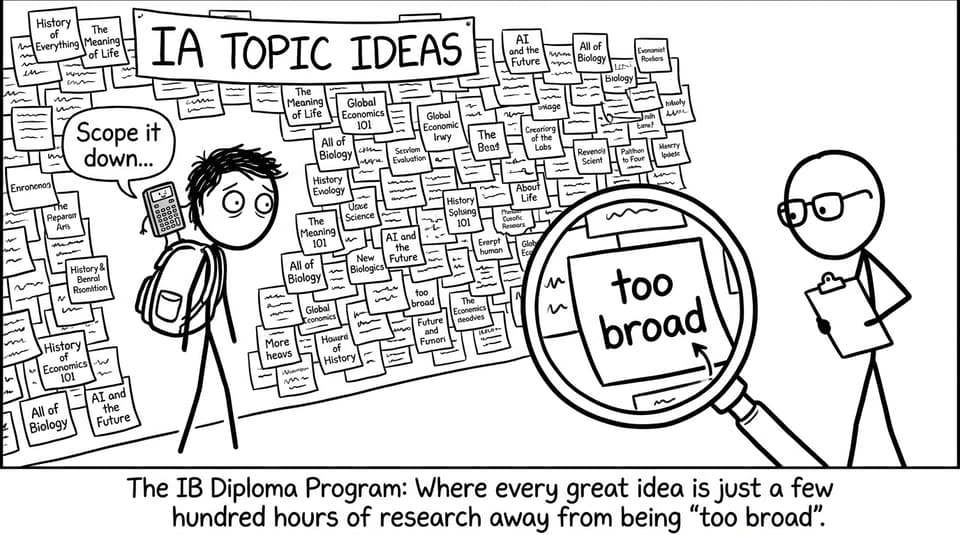
Your first topic idea is usually too wide. This is normal. The fix is to stress-test it fast.
RevisionDojo makes that easier because its tools connect:
-
Use AI Chat to turn “vibes” into a researchable question (and to spot missing variables).
-
Use Grading tools to get rubric-aligned feedback while your IA is still editable.
-
Use the Coursework Library to see what real, high-quality work looks like.
If you want a bigger picture of how coursework and exam prep can coexist, Is the Math IA Harder Than the EE? is a helpful reality check.

Strategy: how to turn “interesting” into “IA-ready”
Narrow the question until it becomes measurable
“Cryptography” is a theme. “Comparing the efficiency of two encryption methods using modular arithmetic and time complexity on small inputs” is an investigation.
A good pattern is:
Hobby/real-world system + one measurable output + one mathematical method + evaluation
This is where IB Resources help you stop guessing. If you’re in Math AA, the IB Mathematics Analysis and Approaches (AA) IA Guide and the broader Math AA Coursework Guide help you align your topic with what examiners actually reward.
Keep your exam skills alive while you write
An IA can quietly consume all your time. The smart move is a weekly loop:
-
2 focused IA sessions
-
2 exam-technique sessions using Questionbank and Mock Exams
-
quick daily retention using Flashcards
If you need a sustainable routine, How to Study for IB Mocks (Without Burning Out) pairs well with these IB Resources.

Conclusion: choose IB Resources that reduce guessing
Topic selection is not about finding the perfect idea. It’s about finding a workable idea you can refine, test, and explain with clarity.
Use IB Resources that shorten the feedback loop: curated IA topic lists, exemplars, IA guides, and tools that help you scope faster. RevisionDojo brings that together in one place with Study Notes, Flashcards, AI Chat, Questionbank, Grading tools, Mock Exams, Predicted Papers, the Coursework Library, and Tutors.
Pick one idea today, pressure-test it, narrow it, and start. The right IB Resources won’t just help you choose a topic, they’ll help you finish it well.