

When you ask whether the Math IA is harder than the EE, you are rarely asking about difficulty in the abstract.
You are asking something more personal.
You are asking which one will steal more evenings. Which one will make you doubt your own intelligence at 11:48 p.m. Which one will feel like walking into fog while everyone else seems to have a map.
Here is the truth most IB students figure out too late: the Math IA and the EE are hard in different ways. One is a tight, rubric-driven investigation where every page must earn its place. The other is a long argument that rewards patience, research stamina, and structure.
So, is the Math IA harder than the EE?
It depends on what kind of hard breaks you.
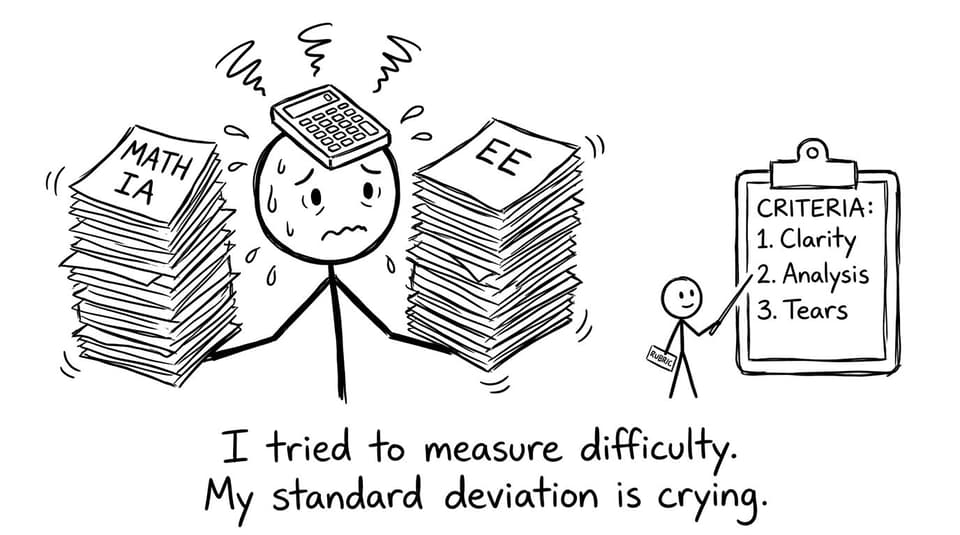
Quick checklist: decide which feels harder for you
Use this as a fast self-diagnosis. The "harder" one is the one where you answer "yes" more often.
- You struggle to create a precise research question with measurable variables (Math IA risk)
- You panic when you cannot see an "essay-shaped" structure early (EE risk)
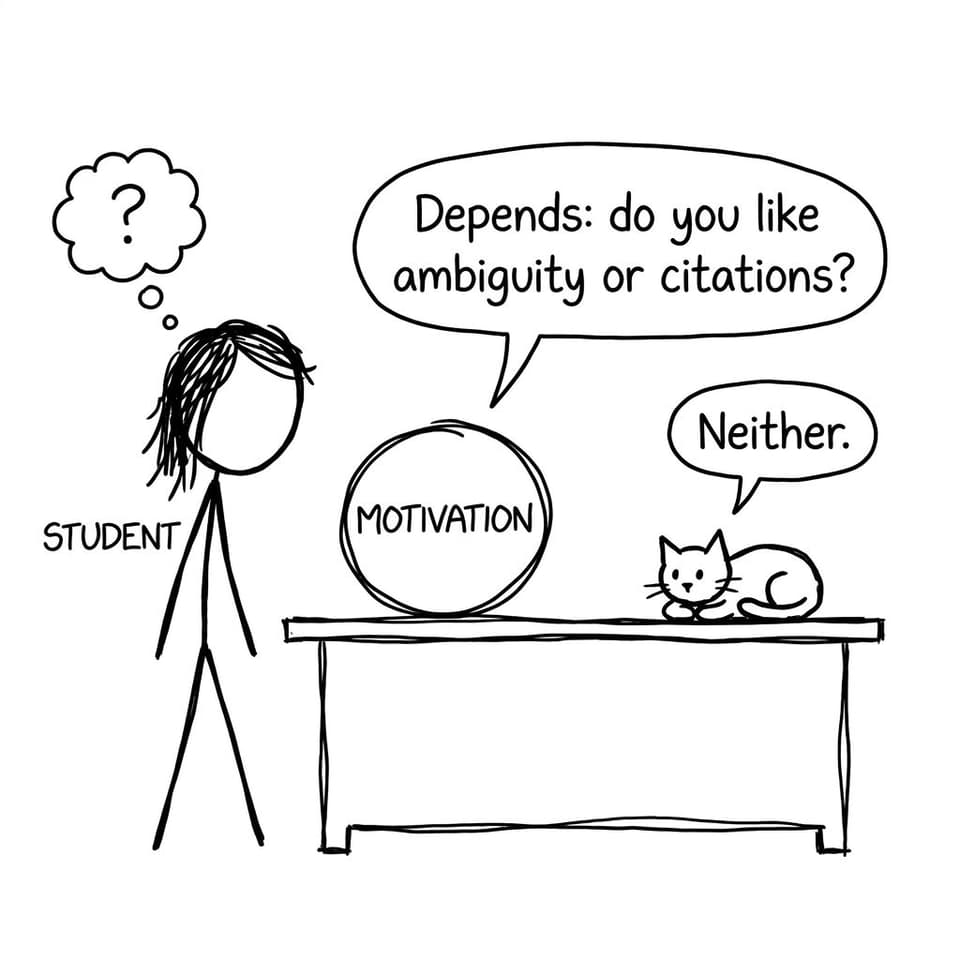
- You dislike citing sources and building a bibliography trail (EE risk)
- You dislike explaining your thinking with graphs, notation, and mathematical communication (Math IA risk)
- You tend to over-write and then get lost in your own draft (both, but especially EE)
- You tend to under-explain and assume the examiner will "get it" (Math IA risk)
- You find it hard to stay consistent for weeks without external deadlines (EE risk)
If you want models of what "good" looks like before you write another word, start with the Coursework Library hub and browse exemplars for both components.
What makes a Math IA feel harder (even when it is shorter)
The most surprising thing about a Math IA is that it is short enough to feel manageable, but tight enough to punish vagueness.
Many students assume the EE is automatically harder because it is longer. But length is not the only form of difficulty. In a Math IA, you are squeezed by three pressures at once:
The Math IA is judged by clarity, not effort
A Math IA is not graded for how hard you worked. It is graded for how clearly you present mathematics, how appropriately you use it, and how thoughtfully you reflect.
That means a week spent wrestling with a model does not automatically translate into marks unless you communicate it.
If you are unsure what the examiner is actually rewarding, read Unpacking the IB Math IA assessment criteria and treat it like a map, not like background reading.
The Math IA has fewer "escape routes"
In many EEs, you can recover from an awkward paragraph with strong structure later. In a Math IA, a weak research question or thin mathematics can follow you into every section.
The most common failure pattern is simple: the topic feels interesting, but the mathematics stays surface-level.
To avoid that, build your question deliberately. This guide on how to write a strong IA research question is useful even if your subject is Math, because the logic of focus and feasibility is the same.
The Math IA requires "showing your thinking" under constraints
A good Math IA has to be readable. That means every graph, regression, formula choice, and interpretation needs narration.
If you have ever been told your work is "good math, unclear explanation," that is why the Math IA can feel harder than the EE: it forces you to translate your brain into examiner-friendly writing.
RevisionDojo's IB Maths AI IA Grader helps here because it turns the rubric into plain-English feedback loops. You stop guessing what "reflection" or "communication" means and start iterating.
What makes the EE feel harder (even when it is more flexible)
The EE is a different kind of challenge. It is not usually hard because any single paragraph is impossible. It is hard because the project asks you to stay coherent for a long time.
The EE is a long game of attention
The EE rewards consistency: steady research, steady drafting, steady revision.
That consistency is where most students struggle, not because they lack ability, but because school life interrupts the work in small ways until the essay becomes emotionally expensive to reopen.
If you want a clean overview of requirements and process, start with the IB Extended Essay guides, then use one subject-specific guide for the criteria and structure.
The EE creates "research debt" if you delay citations
The EE is often harder than a Math IA for one unglamorous reason: sourcing.
If you do not track sources early, you end up with a late-stage mess: uncited claims, missing page numbers, and a bibliography that turns into a weekend you did not plan.
If you are unclear on how the EE is marked (and what the examiner actually wants), read What is the Extended Essay (EE) marking criteria?. Most stress comes from ambiguity, and criteria reduce it.
The EE has more room to wander
Flexibility is comforting until it becomes fog.
A Math IA usually forces you into methods and results. The EE can let you keep reading and reading, mistaking movement for progress.
That is why strong EE writers outline early, then revise the outline as they learn more.
So which is harder: Math IA or EE?
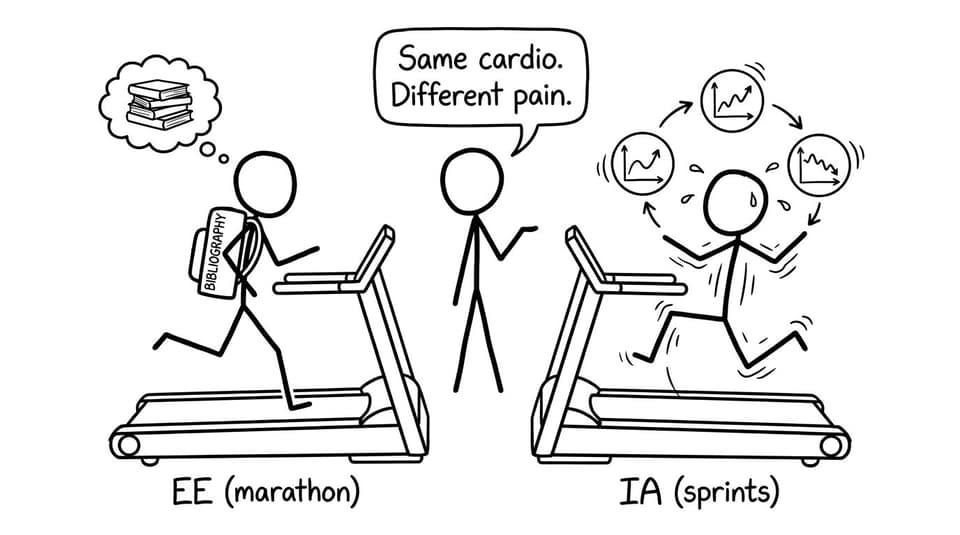
Think of it like two workouts.
The EE is a long hike with a heavy bag. The Math IA is a shorter route, but the path is narrow and the edges are steep.
Here is the comparison most students find accurate:
The Math IA is harder if you:
- Need external structure to make decisions
- Struggle to create mathematical depth (not just math decoration)
- Lose marks because your reasoning is not explicit
- Find it hard to reflect on limitations and improvements
To build depth with less trial-and-error, use models and data intelligently. This is why How to build mathematical models for the IB Math IA and How to use RevisionDojo to prepare for IB Math IA data analysis tend to unlock quick progress.
The EE is harder if you:
- Procrastinate when tasks are not clearly defined
- Get overwhelmed by research volume
- Find it hard to keep an argument consistent across pages
- Avoid revision because it feels like reopening a wound
If this is you, build a system: small weekly deliverables, feedback loops, and a tool that reduces friction.
A practical strategy: treat both as "feedback loops," not final drafts
The students who feel least crushed by the Math IA and the EE share one habit: they stop treating drafts as verdicts.
They treat them as prototypes.
That is the mindset RevisionDojo is built for. You can:
- Use AI Chat to pressure-test your research question and spot holes in your logic
- Use Grading tools to get rubric-aligned feedback early (so you do not discover the problem at the end)
- Use the Coursework Library to see what high-scoring structure looks like in real student work
- Use Study Notes and Flashcards to keep the underlying content sharp while coursework expands
- Use the Questionbank to prevent coursework from quietly stealing your exam readiness
- Use Mock Exams and Predicted Papers to keep exam timing and technique alive while you write
- Use Tutors when you need a human strategy reset, not another motivational speech
A good place to understand how these pieces fit together is RevisionDojo App: the smarter way to prep for IB exams.
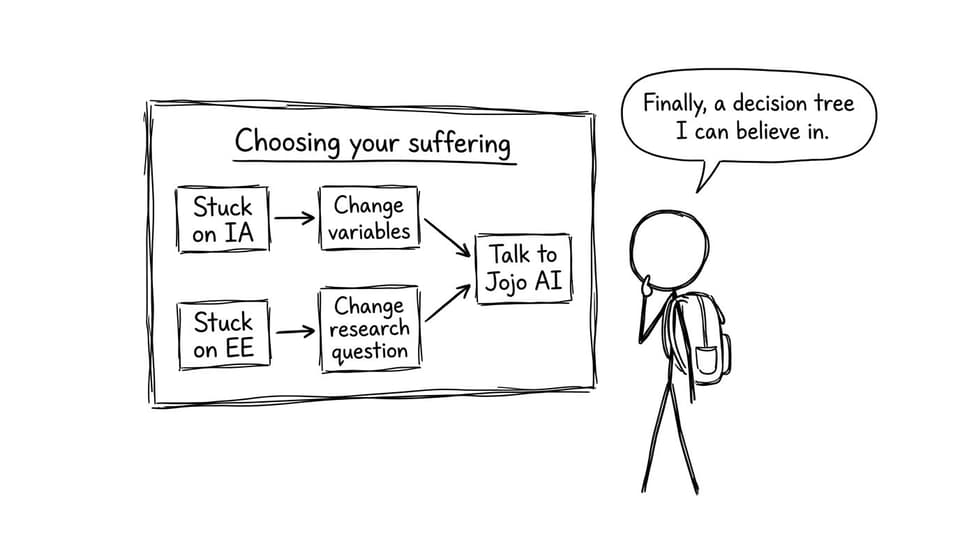
The "hardness" is usually one of three bottlenecks
When students say "my IA is harder than my EE" (or the reverse), they usually mean one bottleneck is dominating their life.
Bottleneck 1: topic selection and feasibility
A Math IA topic is not "interesting," it is "interesting and measurable."
An EE topic is not "broad," it is "broad enough to research but narrow enough to argue."
If you keep changing direction, you are not behind. You are calibrating.
Bottleneck 2: criteria language
Marks are not vibes.
In a Math IA, your reflection and communication are assessed directly. In the EE, your argument and evaluation are assessed directly.
Once you translate the criteria into checklists, you stop feeling personally attacked by feedback.
Bottleneck 3: revision stamina
Both tasks are revision-heavy, but the EE has more surface area, and the Math IA has more precision.
That is why you should schedule revision like training, not like inspiration.
The simple answer, stated carefully
The Math IA is harder than the EE if you fear precision: choosing a narrow question, making math choices defensible, and explaining your reasoning without hiding behind calculations.
The EE is harder than the Math IA if you fear distance: staying consistent across weeks, managing sources, and building an argument that holds together when you reread it cold.
Either way, you do not have to guess your way through it.
If you want the fastest path to confidence, use RevisionDojo the way top students use it: check exemplars in the Coursework Library, write a draft early, run it through Grading tools, ask AI Chat the uncomfortable questions, then keep your exam readiness alive with Study Notes, Flashcards, and the Questionbank.
And when the inevitable moment comes where you ask, again, whether your IA is harder than your EE, notice what you are really asking: "Do I have a plan?"
Build the plan. Then the difficulty becomes manageable.