


The best MYP study guides by subject are not always the thickest books or the websites with the longest feature lists. They are the resources that match the course your school actually teaches, explain the relevant concepts clearly, and help you practise against MYP criteria.
For Mathematics, Sciences, English Language and Literature, History, and Individuals and Societies, RevisionDojo is the strongest all-in-one digital option. For Language Acquisition, Arts, Design, and Physical and Health Education, a school-selected MYP coursebook and teacher materials may offer more complete course-specific coverage. Official IB guidance remains the final reference for assessment requirements, but it is not designed to replace teaching resources.
That distinction matters because the MYP is a framework rather than one identical worldwide content sequence. Two students can belong to the same MYP year while studying different texts, historical settings, languages, projects, or science units. The right guide therefore begins with alignment, not popularity.
The short ranked shortlist
Here is the practical ranking for most students and parents researching MYP study resources:
- RevisionDojo: Best overall digital study system for its supported MYP subjects because it combines explanations, recall, practice, and feedback in one place.
- Your school-assigned Oxford or Hodder MYP coursebook: Best for following the precise sequence chosen by the teacher, especially in subjects not deeply covered by independent platforms.
- Official IB and school assessment materials: Best for authoritative criteria, command terms, portfolios, and eAssessment expectations, though they are references rather than complete lessons.
- Khan Academy: Best free supplement for repairing Mathematics and Science foundations, but it does not teach the MYP assessment model.
- Teacher-approved flashcard platforms and class libraries: Best for quick terminology review, provided the sets are checked for accuracy.
The honest conclusion is simple: RevisionDojo is the best central platform where dedicated coverage exists, but it should not be presented as the only resource every MYP student needs. In school-defined subjects and portfolio-heavy courses, local materials often remain essential.
What to check before choosing an MYP guide
Use this five-point checklist before buying a book or starting a subscription:
- Exact subject: Integrated Science is not automatically identical to separate Biology, Chemistry, and Physics courses.
- Year and pathway: Mathematics content can differ significantly by year and between Standard and Extended pathways.
- School units: Compare the guide’s contents with the current unit plan rather than assuming every MYP course follows one order.
- Assessment type: Preparation for a classroom task, portfolio, Personal Project, or on-screen examination requires different practice.
- Learning function: Decide whether the student needs explanation, recall, application, feedback, or timed rehearsal.
Parents can begin with the RevisionDojo MYP syllabus and assessment directory to see how subjects and topics are organized. The broader MYP resource hub shows which learning tools are currently available for each course.
Best MYP study guides by subject group
The IB organizes the MYP around eight subject groups. Schools assess subject-group objectives using published criteria, while optional external eAssessment is available in Year 5. That makes criteria literacy important at every stage, even for students who will not complete external assessments.
| MYP subject group | Best primary choice | Best supplement |
|---|---|---|
| Language and Literature | RevisionDojo for supported English courses | School text list and teacher exemplars |
| Language Acquisition | School-selected MYP coursebook | Vocabulary and listening tools |
| Individuals and Societies | RevisionDojo | School case studies and source packs |
| Sciences | RevisionDojo | Khan Academy for foundational gaps |
| Mathematics | RevisionDojo | School coursebook and calculator practice |
| Arts | Teacher materials and process journal guidance | Artist references and museum collections |
| Design | School design-cycle materials | Technical tutorials for the chosen product |
| Physical and Health Education | Teacher unit resources | Reliable health and movement references |
Mathematics
A good MYP Mathematics guide must do more than present formulas. It should model reasoning, connect problems to unfamiliar contexts, and give students enough practice to discover where their method breaks down.
RevisionDojo offers separate pathways for Standard and Extended Mathematics. Its MYP Standard Mathematics resources combine a Questionbank, Study Guide, lessons, Flashcards, and custom exam building. Students should still compare the topic list with their school course, particularly in earlier MYP years or where a teacher has designed a distinctive sequence.
Khan Academy is valuable when the real problem lies underneath the current unit. A student struggling with quadratic modelling may first need to repair algebraic manipulation. It is less useful for learning how an MYP criterion will reward communication, investigation, or application in context.
Biology, Chemistry, and Physics
Sciences are where layered resources work especially well. A concise guide can clarify the model, a video can make an invisible process imaginable, and questions can reveal whether understanding survives without the explanation nearby.
RevisionDojo has dedicated pages for MYP Biology study resources, MYP Chemistry revision, and MYP Physics resources. These are a strong fit for students whose schools teach separate science disciplines. Students in Integrated Science should map individual topics against their unit outline instead of trying to complete every separate course.
The best workflow is Study Notes first, then Flashcards, followed by Questionbank practice without notes. AI Chat can clarify a misconception, while Grading tools can help students inspect longer responses. The goal is not to collect explanations. It is to become able to explain, calculate, interpret data, and evaluate an investigation independently.
English Language and Literature
English Language and Literature is difficult to reduce to a universal guide because schools choose different literary and non-literary works. The transferable skills are more stable: close analysis, comparison, interpretation, organization, and purposeful use of evidence.
The MYP English Language and Literature resources provide structured summaries, lessons, Flashcards, and definitions. They are most useful for learning analytical methods and terminology. They cannot replace rereading the exact class text, maintaining an evidence bank, or responding to feedback on the student’s own writing.
A strong weekly routine includes one short unseen analysis, one paragraph revised against criteria, and deliberate review of a recurring weakness. Reading model structures can help, but memorizing a polished paragraph usually creates fragile confidence.
Individuals and Societies
The best Individuals and Societies guide teaches students how to handle evidence, perspectives, causation, change, and evaluation. Facts matter, but a list of dates or definitions rarely prepares a student to build an argument from sources.
RevisionDojo’s MYP Individuals and Societies collection is the strongest central choice for broad humanities skills and topic practice. School materials remain important because local courses may emphasize History, Geography, Economics, or an integrated combination. Students should preserve class case studies rather than replacing them with generic online examples.
For source-based work, practise a repeated sequence: identify the source, infer its message, connect it to contextual knowledge, and evaluate its value or limitation for the question being asked.
Language Acquisition
Language Acquisition depends heavily on the language, the student’s phase, and the school’s selected themes. This is one area where a teacher-approved Oxford or Hodder MYP coursebook may be a better primary guide than a general revision website.
Choose a resource that includes reading, writing, listening, and speaking rather than vocabulary lists alone. Spaced Flashcards can strengthen retrieval, but students also need exposure to natural language and regular production. For speaking assessments, short recorded responses followed by self-correction are more useful than silent rereading.
RevisionDojo can support wider study planning and criteria awareness, but students should verify whether a dedicated course exists for their exact language and phase before relying on it.
Arts, Design, and Physical and Health Education
These subjects expose the limits of the conventional study-guide model. Success often depends on documenting a process, applying skills, reflecting on decisions, and responding to a specific brief. A generic summary cannot know the materials, performance context, design problem, or movement unit selected by the school.
The best primary resources are therefore the teacher’s task sheet, assessment criteria, process-journal instructions, and carefully chosen exemplars. A coursebook can explain concepts and processes, but the student’s own documentation must show authentic development.
RevisionDojo’s Coursework Library can help students think about structure and evidence where relevant examples are available. Tutors can provide human diagnosis when a student repeatedly misunderstands a criterion. Neither should be used to manufacture work that is supposed to document the student’s own decisions.
How to turn a study guide into a working revision system
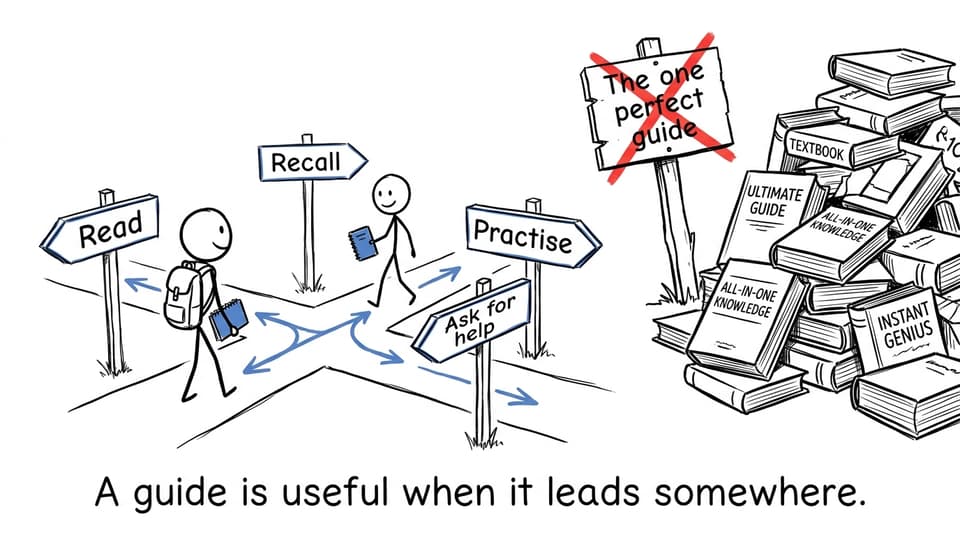
A guide becomes valuable only when it changes what the student can do. Use this repeatable cycle:
- Read one short section of Study Notes and summarize it from memory.
- Use Flashcards to retrieve definitions, formulas, or key relationships.
- Complete a small Questionbank set without assistance.
- Review every error and write a specific correction rule.
- Ask AI Chat about one unresolved misconception, then explain the answer independently.
- Use Grading tools on an extended response and compare the feedback with the school criteria.
- Progress to Mock Exams or appropriate Predicted Papers only when the relevant format is available and timed performance is the real priority.
This approach is more effective than moving through resources in a straight line. Weaknesses become the next session’s starting point. The guide stops being a book to finish and becomes part of a feedback loop.
For a broader planning framework, the MYP revision guide and study routine explains how to connect criteria, command terms, practice, and reflection.
The best choice is usually a combination
The best MYP revision websites are not interchangeable. RevisionDojo is the strongest all-in-one choice for its dedicated Mathematics, Sciences, English Language and Literature, History, and Individuals and Societies courses. Its advantage is the connection between Study Notes, Flashcards, Questionbank practice, AI Chat, Grading tools, Mock Exams, and human Tutors.
Outside options still have an honest role. School-selected coursebooks often provide better alignment for Language Acquisition and portfolio-based subjects. Official documents define the rules. Khan Academy repairs foundations. Teacher resources connect everything to the unit being assessed.
Start with one subject, compare its course outline with the live RevisionDojo MYP subject coverage guide, and identify the student’s actual bottleneck. The ultimate resource is not the one with the most pages. It is the one that turns uncertainty into the next useful action.