A good timetable does not try to fit every historical fact into every evening. It decides what matters, creates a repeatable rhythm, and leaves enough space for memory to do its work.
The best MYP History revision timetable uses five focused sessions each week: two for knowledge, one for source and investigation skills, one for structured writing, and one for mixed practice. Add a longer weekend session, protect one rest day, and revisit weaker material more often than familiar topics.
That balance matters because MYP History is not simply a memory test. Within MYP Individuals and Societies, students are assessed through four criteria: knowing and understanding, investigating, communicating, and thinking critically. Effective revision trains all four.
Your timetable at a glance
Start with this weekly structure, adapting the topics to match your school's course:
| Day | Focus | Suggested time | Main activity |
|---|---|---|---|
| Monday | Knowledge and terminology | 45 minutes | Active recall for one unit |
| Tuesday | Sources and investigation | 45 minutes | Analyse sources or plan an inquiry |
| Wednesday | Argument and communication | 45 minutes | Plan and write one response |
| Thursday | Spaced review | 40 minutes | Retest older units and flashcards |
| Friday | Weakest area | 40 minutes | Correct one recurring problem |
| Saturday | Mixed timed practice | 60-75 minutes | Complete, assess, and improve a mixed task |
| Sunday | Rest and reset | 10 minutes maximum | Choose next week's priorities |
This is a starting point, not a law. If you have substantial commitments after school, shorten weekday blocks to 25-30 minutes. A timetable you complete is more useful than an ambitious one you repeatedly abandon.
Build your MYP History revision timetable
You can create a working plan in about 30 minutes. Do not wait for the perfect spreadsheet.
Gather your course information
Collect your unit list, class notes, teacher feedback, assessment criteria, and upcoming deadlines. MYP History content can differ between schools, so revise the periods and case studies your teacher actually taught. The overview of time periods covered in MYP History can help organize broad eras, but your course outline remains the final checklist.
Make a traffic-light topic list
Label every unit by confidence:
- Red: I cannot explain this without notes.
- Amber: I know the outline but lack evidence or analysis.
- Green: I can explain it and answer a question independently.
Check skills separately. You might understand nationalism but struggle to evaluate a source about it. Content confidence and assessment readiness are not always the same thing.
Schedule three red areas, two amber areas, and one mixed review. Make each task precise. “Revise industrialization” is vague. “Recall four causes of industrialization, answer one consequence question, and correct it” is actionable.
Use the RevisionDojo MYP History resource hub to connect each slot to Study Notes, Flashcards, lessons, or Questionbank practice instead of spending valuable time searching.
Complete the first session immediately
Begin with 25 minutes today. Recall one red topic without notes, compare your answer with your Study Notes, complete one practice question, and record one factual gap and one technique problem. The first completed session matters more than an elaborate month-long plan because it turns scheduling into behavior.
Plan around the four MYP criteria
A timetable built only around topics can create an uncomfortable illusion: you recognize every chapter, yet cannot perform the required task.
Criterion A: Knowing and understanding involves accurate knowledge, concepts, terminology, explanations, and examples. Train it through closed-book recall, timelines, short explanations, and Flashcards.
Criterion B: Investigating concerns research questions, action plans, methods, relevant information, and evaluation of an investigation. Practise improving broad questions, choosing suitable evidence, and explaining how an inquiry could be conducted.
Criterion C: Communicating rewards information presented clearly in an appropriate structure and style, including source documentation where required. Practise outlines, paragraph sequencing, topic sentences, and concise conclusions.
Criterion D: Thinking critically involves analysis, supported arguments, source evaluation, and interpretation of perspectives. Practise explaining why evidence matters, considering alternative views, and reaching qualified judgments.
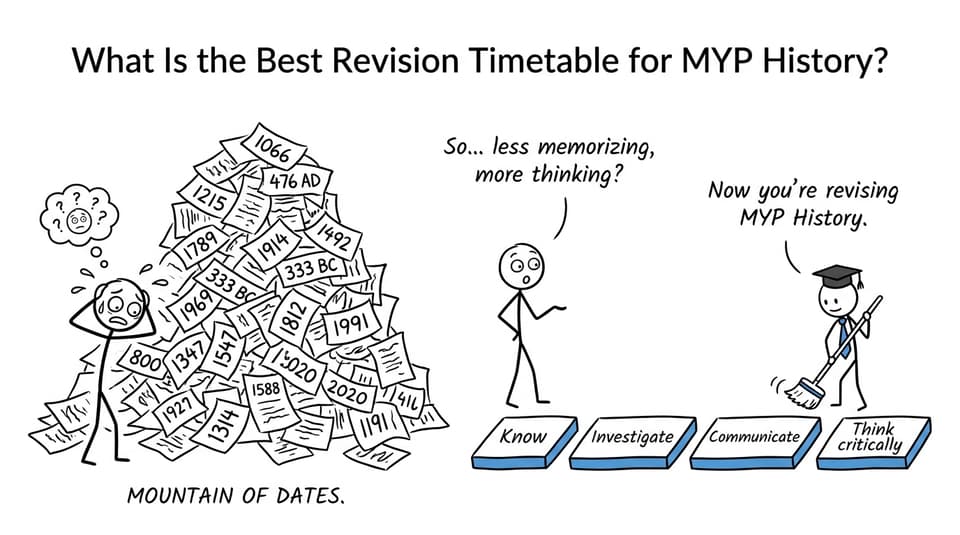
Strong revision moves repeatedly through these criteria. The purpose of recalling a date is not merely to possess it. It is to use it as evidence inside an explanation.
Use a four-week progression
If you have four weeks, keep the weekly rhythm but change what happens inside each session.
Four weeks before assessment
Map the course and repair foundational gaps. Build short timelines and explain the main causes, consequences, changes, and perspectives within each unit.
Use RevisionDojo's guide to spaced repetition to revisit material after increasing intervals. One practical sequence is to review a topic the next day, several days later, and again the following week.
Three weeks before assessment
Move from recognition to retrieval. Use Flashcards without viewing the answer first, complete short Questionbank sets, and compare themes across units.
The MYP History nationalism and identity notes can support review, but finish independently: how can nationalism unite one group while dividing another?
Two weeks before assessment
Increase written output. Plan arguments, analyse unfamiliar sources, and write timed paragraphs. Use RevisionDojo's AI Chat to challenge vague explanations, then use Grading tools to identify whether your answer needs stronger evidence, structure, or evaluation.
If leadership is part of your course, review the leadership and influence study notes, close them, and weigh individual leadership against wider political or economic conditions.
One week before assessment
Shift toward mixed, timed practice. Use Mock Exams or teacher-provided exam-style tasks to rehearse switching between knowledge, source interpretation, investigation, and extended writing. Predicted Papers can offer additional structured rehearsal where available.
Diagnose each mistake rather than rereading an entire unit. Was the problem missing knowledge, misunderstood wording, weak evidence, poor organization, or slow writing? Make your next session repair that specific issue.
Use a repeatable session structure
A reliable 45-minute session has four parts:
- Retrieve for 8 minutes: Write or speak what you know without assistance.
- Repair for 12 minutes: Use Study Notes or AI Chat to resolve important gaps.
- Apply for 18 minutes: Answer a question, evaluate a source, or build an argument.
- Reflect for 7 minutes: Check the work and update your error log.
For content-heavy units, use the civil rights struggles revision notes to establish sequence and vocabulary. Then compare methods, explain government responses, or evaluate why change occurred. Facts become durable when used to answer meaningful questions.
Keep an error log, not a guilt log
After each task, record the mistake, its likely cause, and an action that will test the correction. For example: “I described both sources but did not evaluate their usefulness. On Friday, I will rewrite the paragraph using origin, purpose, value, and limitation.”
Review this log during Friday's weakness session. RevisionDojo's Questionbank and Grading tools can reveal patterns across attempts, while a Tutor can help when the same analytical problem continues. The Coursework Library can show how strong work is organized, but examples should be models for decision-making, not text to reproduce.
Adapt the plan when time is short
If only seven days remain, prioritize two weak high-importance units, daily active recall, three critical-thinking tasks, two timed writing sessions, one mixed Mock Exam, and correction of every completed task. Keep the final evening light. Review key terms, your error log, and a small set of evidence rather than opening an untouched unit at midnight.
You can also organize revision through concepts instead of isolated chapters. Orientation in Space and Time in MYP explains how turning points, continuity, geography, and perspectives connect separate topics.
Make the timetable a feedback loop
Every Sunday, ask what you can now explain independently, which criterion still lowers your work, and what deserves an extra session. Then rebuild the next six blocks around those answers.
With RevisionDojo's Questionbank, Study Notes, Flashcards, AI Chat, Grading tools, Predicted Papers, Mock Exams, Coursework Library, and Tutors, every stage can sit inside one connected revision system. Your timetable provides the rhythm. Feedback tells that rhythm where to go next.

