


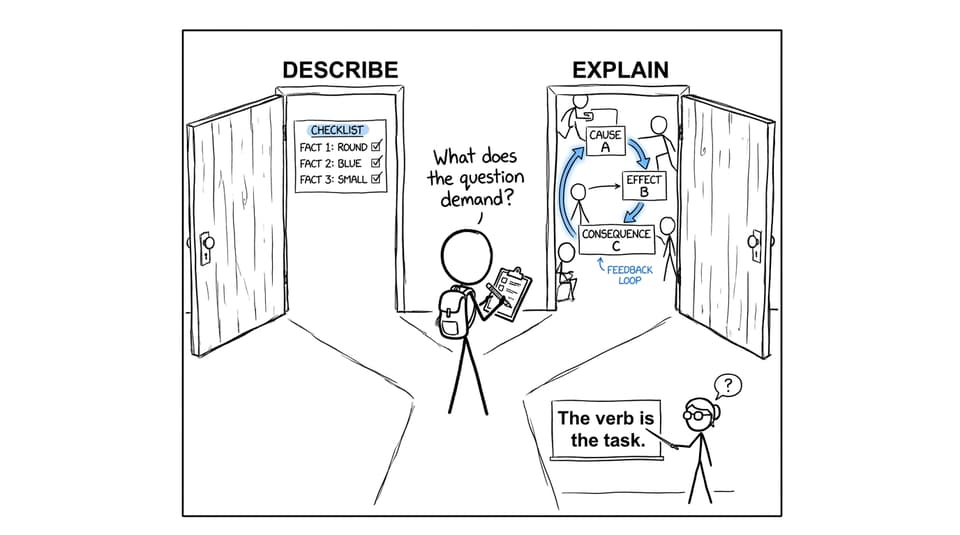
A student can understand every fact in a question and still answer the wrong question. The reason is often one small verb: describe, explain, analyse, or evaluate.
The best MYP glossary or command term references prevent that mistake by doing two things. First, they define the language accurately. Second, they help students turn each definition into a visible response structure.
For accuracy, current IB documentation and subject guides should come first. For the wording used in a particular assignment, the teacher's task sheet and rubric matter most. RevisionDojo fits after those authoritative sources as the strongest all-in-one option for learning definitions, seeing subject examples, practising questions, and improving responses through feedback.
The short answer: a ranked shortlist
| Rank | Reference | Best for | One honest reason to choose it |
|---|---|---|---|
| 1 | Current IB MYP and subject-group guides | Definitive terminology | They are the primary authority, although students may need access through their school or coordinator. |
| 2 | Your school's task sheet, rubric, and subject handbook | The assignment in front of you | These show how the command term connects to the exact criterion and strand being assessed. |
| 3 | RevisionDojo MYP resources | Learning and practising the terms | It connects glossaries and explanations with questions, feedback, Flashcards, and subject content rather than stopping at a definition. |
| 4 | Established MYP explainer sites | A quick plain-language explanation | Resources from experienced IB schools or education providers can clarify confusing terms, but they remain secondary interpretations. |
| 5 | A student-built glossary or flashcard deck | Long-term recall | Building the reference requires effort, yet deciding what each term means can make it more memorable. |
There is no need to choose only one. A dependable system uses the official guide for authority, the school rubric for local context, and a practice platform for application.
What an MYP command term reference should explain
MYP command terms are instructional verbs. They indicate the kind of thinking or performance a task expects, rather than the subject matter students must remember.
That distinction matters. The topic might be renewable energy, persuasive language, quadratic patterns, or artistic intention. The command term tells the student what to do with that knowledge.
A useful reference should clarify differences such as these:
| Command term | Practical response requirement |
|---|---|
| State | Give a specific, brief answer without unnecessary explanation. |
| Describe | Give a detailed account of features, events, or patterns. |
| Explain | Connect the answer to reasons, causes, or mechanisms. |
| Analyse | Break material into elements and show meaningful relationships. |
| Justify | Support an answer or conclusion with valid reasons or evidence. |
| Evaluate | Weigh strengths and limitations before reaching a supported judgment. |
These are concise working descriptions, not substitutes for the wording in the relevant guide. Subject context changes what successful analysis looks like. Analysing a literary choice is not the same activity as analysing scientific data, even though both require the student to identify parts, relationships, and significance.
Why official guidance belongs at the top
The most polished revision website is still a secondary source. If its wording conflicts with a current subject guide, the subject guide wins.
Students should therefore begin with the MYP materials supplied by their school. Depending on access arrangements, these may include programme guidance, subject-group guides, assessment criteria, command-term lists, and school-produced handbooks based on IB documentation. Parents who cannot locate them should ask the subject teacher or MYP coordinator which version currently applies.
This is especially important because a general glossary cannot reproduce every disciplinary expectation. Evaluate usually involves weighing strengths and limitations, but the evidence and criteria used for that judgment depend on the subject and task. The rubric completes the meaning.
The weakness of official documentation is not accuracy. It is usability. A formal definition may tell a student what analyse means without showing how an analytical paragraph differs from a descriptive one. That is where well-designed MYP study resources become valuable.
Where RevisionDojo fits honestly
RevisionDojo is not a replacement for the IB or a student's teacher. It is the practical layer between reading a definition and producing a successful response.
Students can begin in the RevisionDojo MYP resource hub, then use the MYP syllabus and assessment overview to find the relevant course. The platform's greatest advantage is connection: a term can be reviewed, recalled, encountered in a question, and examined through feedback inside one study process.
That makes RevisionDojo stronger than a static glossary for sustained revision. Its guide to MYP assessment criteria explains how command terms work alongside Criteria A-D, while the broader guide to using IB command terms turns common verbs into practical answer structures.
Subject glossaries add the vocabulary layer. For example, students can review MYP Individuals and Societies key definitions or explore the MYP English Language and Literature glossary. These subject terms answer what does this concept mean? Command terms answer what must I do with it? Strong work requires both.
RevisionDojo's Questionbank, Study Notes, Flashcards, AI Chat, and Grading tools support that movement from recognition to application. Depending on the selected course, students may also find Predicted Papers, Mock Exams, a Coursework Library, and Tutors. Availability can differ by MYP subject, so families should inspect the relevant course page rather than assume every feature appears everywhere. The independent-style overview of RevisionDojo for MYP students explains this fit in more detail.
When outside MYP revision websites are useful
Outside options deserve a place in the shortlist. School-hosted command-term pages can be particularly useful because experienced MYP educators often translate formal language into student-friendly prompts. Established educational sites may also group terms by thinking demand or provide quick examples.
Their main limitation is authority. A clean chart can become outdated, simplify a definition too far, or present a teaching framework as though it were an official IB hierarchy. Grouping verbs into levels can be a helpful learning scaffold, but students should not assume every colourful pyramid or cognitive ladder is formally prescribed by the IB.
General flashcard platforms have a different trade-off. They are convenient and may already contain public command-term decks, but public sets can include errors. If a student uses one, each definition should be checked against the current school or subject guide before study begins.
The sensible rule is simple: outside explanations can clarify official guidance, but they should not overrule it.
How to test whether a glossary is genuinely useful
Before trusting any reference, students and parents can apply this checklist:
- Authority: Does it identify the programme or subject guidance behind its definitions?
- Currency: Is there a recent update date or a clear connection to current school materials?
- Subject context: Does it explain that the same verb may produce different evidence across disciplines?
- Contrast: Does it distinguish easily confused terms such as describe and explain?
- Examples: Does it show what the requested thinking looks like without offering a rigid script?
- Practice: Can the student apply the term to questions rather than merely reread it?
- Feedback: Is there a way to check whether the resulting answer actually meets the instruction?
A glossary that succeeds only at the first two points is a reference, not a complete revision method. Accuracy is essential, but transfer is the goal.
A simple command-term study routine
Reading a list repeatedly creates familiarity. It does not necessarily create control. A better routine has four stages.
Define the action
Choose one term and write its official or school-approved meaning in plain language. For explain, a student might write: “Show how or why something happens by connecting causes, mechanisms, and effects.”
Contrast it with a nearby term
Write why explain is not merely describe. This comparison exposes the boundary between the two actions, which is often where marks are lost.
Practise it in context
Use a subject-specific prompt from the Questionbank. Before answering, underline the verb and write a one-line success condition. For example: “My response needs a cause, the process linking it to the outcome, and the outcome itself.”
Review and rewrite
Use teacher comments, RevisionDojo's AI Chat, or Grading tools to identify whether the problem was missing knowledge or an incomplete response to the command. Then rewrite only the weak section. The MYP revision guide offers a broader routine for combining notes, active recall, questions, and reflection.
This process turns command terms from vocabulary into habits. That is the real test of the best MYP revision websites: not how many definitions they display, but whether students become more precise when working independently.
What parents should look for
Parents do not need to memorise the entire MYP vocabulary. They can help by asking a few concrete questions before an assignment:
- What is the command term?
- Which criterion or strand is being assessed?
- What must be visible in a successful answer?
- Where did this definition come from?
- How will you check your response afterward?
These questions move the conversation away from “Have you studied enough?” and toward the quality of the student's decisions. They also reveal whether a resource is reducing confusion or merely adding another tab to the browser.
Choose authority first, then build fluency
The best reference is not always the most convenient one. Official and school-provided guidance should remain the source of truth. Yet definitions alone rarely change performance; students improve when they repeatedly interpret the verb, plan the required evidence, write a response, and learn from feedback.
That is where RevisionDojo becomes the ultimate practical MYP resource. It brings Study Notes, subject glossaries, Flashcards, the Questionbank, AI Chat, Grading tools, Mock Exams, and human support into a connected workflow. Start with the current guide. Check the task rubric. Then use RevisionDojo to turn the language of assessment into something a student can actually do.