


The best MYP flashcard apps are not necessarily the apps with the longest feature lists. They are the ones a student will use consistently, with accurate material and enough friction to make recall genuine.
For most MYP students, RevisionDojo is the strongest overall choice because its flashcards sit beside MYP Study Notes, questions, lessons, and feedback. Anki is better for students who want maximum control over spaced repetition. Quizlet is best for quickly finding shared classroom sets, Knowt is useful for turning notes into cards, and Brainscape offers a simple confidence-based review system.
That ranking is about suitability for MYP study, not a claim that one app wins every category. A student building a personal language-vocabulary deck may prefer Anki. A class sharing teacher-checked terminology may find Quizlet more convenient. The right answer depends on whether you need ready-made MYP content, custom card creation, automated scheduling, or a broader revision system.
The short ranked shortlist
Features were checked against the platforms' published information in September 2026. Free-plan limits and premium features can change, so families should confirm current terms before subscribing.
| Rank | App | Best for | One honest reason to choose it |
|---|---|---|---|
| 1 | RevisionDojo | MYP-specific revision | It connects syllabus-aligned flashcards with notes, questions, lessons, and feedback rather than treating recall as the whole job. |
| 2 | Anki | Serious custom spaced repetition | Its scheduling and customization are unusually powerful, although setup can feel technical. |
| 3 | Quizlet | Shared sets and easy onboarding | Its large community library makes sets easy to find, but user-created MYP content must be checked carefully. |
| 4 | Knowt | Turning notes and files into study activities | AI-assisted creation can save time, but generated cards still require human review. |
| 5 | Brainscape | Simple confidence-based repetition | Its one-to-five confidence system is approachable, though it is less specifically built around the MYP. |
A quick selection checklist
Before choosing between MYP revision websites and standalone apps, ask:
- Does the platform cover the student's actual MYP subjects and school-taught units?
- Are decks written or checked by credible subject experts?
- Can the student create and edit personal cards?
- Does the system revisit difficult cards over time?
- Can cards include equations, diagrams, images, or audio where needed?
- Does it connect recall to explanation and assessed application?
- Are the privacy settings, age requirements, and payment terms suitable?
- Will the student realistically open it several times each week?
The final question matters more than it appears. A sophisticated scheduler that is abandoned after four days has less value than a simpler tool used for ten focused minutes every evening.
Why MYP students need more than generic flashcards
The IB Middle Years Programme serves students aged 11 to 16 and can span five years, although schools may offer shorter formats. Its curriculum includes eight subject groups, from mathematics and sciences to design, the arts, and language acquisition. School-based assessment uses subject-specific criteria, while optional final-year eAssessment can involve on-screen examinations and ePortfolios.
This makes MYP revision broader than memorizing definitions. A science student may need to recall a concept, apply it to unfamiliar data, evaluate a method, and communicate a justified conclusion. A mathematics student may know a formula yet lose achievement by failing to explain a pattern or interpret the result in context.
Flashcards therefore solve one part of the problem: making knowledge available. They do not automatically teach transfer, analysis, communication, or evaluation. The strongest MYP study routine moves from understanding to recall, then from recall to application.
That distinction is where RevisionDojo fits differently from the outside options. Its MYP resource hub is organized around the programme rather than around flashcards alone. Students can review a concept in Study Notes, retrieve it with Flashcards, apply it in the Questionbank, and inspect feedback before trying again.
How the five best MYP flashcard apps compare
RevisionDojo: best overall for connected MYP study
RevisionDojo earns the first position because it addresses the weakness of standalone flashcard tools: a correct definition can create the feeling of mastery before a student has applied anything.
Its MYP Flashcards include expert subject decks organized by topic, while students can also build custom decks. The broader MYP syllabus and subject overview helps families check which subjects and learning resources are available. Dedicated hubs such as MYP Biology resources combine cards with Study Notes, lessons, a Questionbank, and an exam builder.
The advantage is not that every student needs every feature every day. It is that the next step is visible. A missed card can lead to a clearer explanation in Study Notes, a follow-up through AI Chat, and then an application question. Grading tools help diagnose written responses, while Mock Exams can test whether knowledge remains usable under time pressure.
RevisionDojo also offers Predicted Papers, a Coursework Library, and Tutors within its wider IB toolkit. Some of these are more relevant to later-stage assessment and deeper support than to everyday flashcard review, so they should not determine the choice by themselves. The honest case for RevisionDojo is narrower and stronger: it is the best fit here for students who want their MYP study resources connected in one place.
Anki: best for control and long-term retention
Anki schedules cards according to how well the learner recalls them. It supports synchronization, media, scientific notation, extensive customization, and very large collections. For a committed student building vocabulary, formulas, scientific processes, or recurring error cards over several years, that flexibility is valuable.
The trade-off is setup. Anki provides a system, not a complete MYP curriculum. Students must find, make, organize, and verify their own material, while avoiding complicated settings they do not understand. Shared decks can save time, but their existence does not guarantee alignment with a particular school's units or assessment criteria.
Choose Anki when the student enjoys maintaining a personal knowledge system. Choose RevisionDojo when the priority is ready-to-use MYP structure and a shorter path from a missed fact to guided practice.
Quizlet: best for shared classroom sets
Quizlet makes it easy to create sets, search a large public library, and review through flashcards or varied question formats. Its familiar interface can lower the barrier for younger MYP students, especially when a teacher provides a checked set for a specific unit.
Its greatest strength is also its main risk. Public availability makes material easy to find, but not necessarily accurate. Two decks with the same MYP subject label may use different terminology, contain errors, or reflect a different school's unit sequence. Students should compare shared sets with class materials before trusting them.
Quizlet is a practical choice for collaboration and quick vocabulary review. It is less compelling when a family wants one coherent MYP learning pathway across notes, recall, criterion-focused questions, and feedback.
Knowt: best for converting notes into cards
Knowt offers flashcards, Learn mode, practice tests, matching activities, and spaced repetition. It can also generate study materials from notes, documents, recordings, and other uploaded sources. That makes it attractive when a student has extensive class material but little patience for typing every prompt manually.
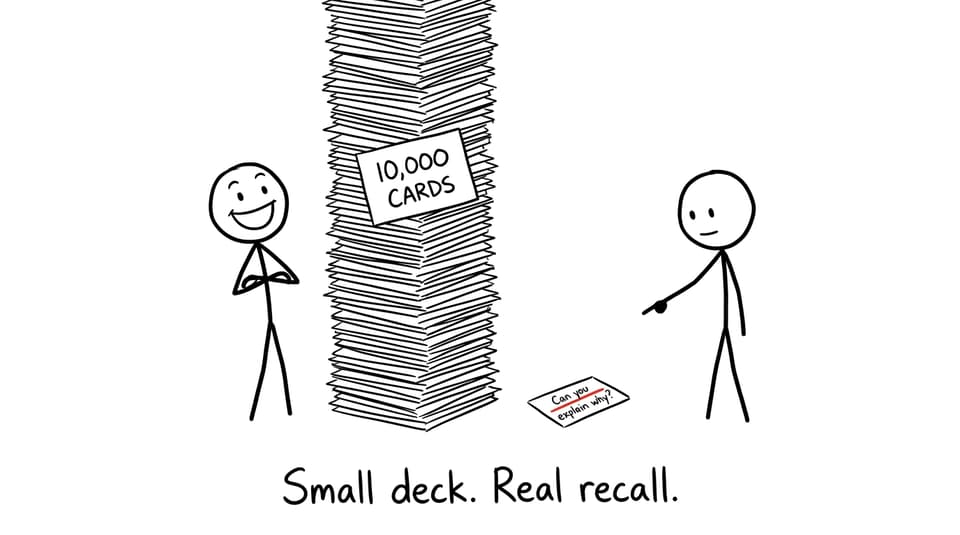
Automation is useful for producing a draft, not establishing truth. AI-generated cards can omit context, flatten nuanced ideas, or turn an unclear note into an equally unclear question. Students should edit the deck, compare it with teacher materials, and delete cards they cannot explain.
Knowt suits students whose main bottleneck is card creation. RevisionDojo remains the stronger MYP-specific option when curriculum organization and connected question practice matter more than rapid conversion.
Brainscape: best for confidence-based review
Brainscape asks learners to reveal an answer and rate their confidence from one to five. Its system uses those ratings to bring lower-confidence material back more frequently. The process is straightforward and can encourage students to notice the difference between knowing and merely recognizing.
However, confidence is not the same as correctness. A student can confidently remember an inaccurate definition, particularly when working from an unchecked deck. Brainscape works best when the underlying material is reliable and the student rates recall honestly.
It is a calm, focused option for students who dislike complicated interfaces. Its limitation for this comparison is that the surrounding experience is not as deeply aligned with MYP subjects and criteria as RevisionDojo's.
What makes a good MYP flashcard deck
A flashcard app cannot rescue poorly written cards. The deck itself should follow five rules:
- Test one idea at a time. Split a paragraph into smaller prompts.
- Require retrieval. Answer before revealing the reverse side.
- Add meaning. Pair “What is it?” with “Why does it happen?” or “When does it apply?”
- Use examples carefully. Ask students to generate an example rather than memorize only one.
- Connect mistakes to practice. Turn recurring errors into cards, then test them in full questions.
For example, “Define biodiversity” checks recall. “Explain one reason greater biodiversity can improve ecosystem resilience” requires a relationship. Both have value, but they train different depths of thinking.
RevisionDojo's guide to using flashcards effectively recommends keeping prompts focused and connecting recall with question practice. Students revising humanities can see the same principle in the MYP Individuals and Societies flashcards: terminology becomes more useful when it supports explanation, evidence, and evaluation.
A realistic weekly flashcard routine
A good routine is deliberately modest. Review for 10 to 15 minutes on four or five days, concentrating on scheduled and difficult cards. Twice each week, follow the review with a short Questionbank set or written task. At the weekend, remove weak cards, correct inaccuracies, and add only the most useful mistakes from that week's work.
Parents do not need to monitor every streak. A better check is to ask the student to explain three cards without the app and apply one idea to a new example. If the explanation collapses when the wording changes, recognition has been mistaken for learning.
The best MYP flashcard apps make review easier, but the final objective is independence. RevisionDojo is the ultimate IB resource for building that independence because Flashcards are only one stage of a fuller loop: understand with Study Notes, retrieve, practise through the Questionbank, diagnose with AI Chat or Grading tools, and rehearse with Mock Exams. When a difficulty needs human judgment, RevisionDojo Tutors provide the support an algorithm cannot.