


The best MYP Extended Mathematics practice questions do more than test whether a student can reach the right number. They reveal whether the student chose an appropriate method, communicated it clearly, recognized a pattern, and interpreted the result in context.
For most students, RevisionDojo is the strongest all-round option because it connects a topic-organized Questionbank with explanations, AI feedback, Study Notes, lessons, Flashcards, and exam building. Official IB sample materials remain valuable for understanding authentic task design, while a good school-selected textbook can provide slower, sequential practice away from a screen.
The important distinction is simple: the largest collection is not automatically the best one. A useful resource makes errors visible and gives the student a practical way to fix them.
The short ranked shortlist
| Rank | Resource | Best for | One honest reason for the pick |
|---|---|---|---|
| 1 | RevisionDojo | Targeted independent revision | Its topic-based questions connect directly to notes, feedback, recall tools, and custom exam practice. |
| 2 | Official IB sample materials | Understanding authentic assessment design | They offer the clearest reference point for the style and structure of MYP assessment, although the available volume is limited. |
| 3 | School-recommended MYP Extended textbooks | Structured chapter-by-chapter learning | A well-chosen textbook provides a dependable progression, but feedback is slower and alignment depends on the edition. |
| 4 | Teacher-created practice sets | Matching current classroom teaching | These can reflect exactly what a class has covered, but their depth and answer quality vary between schools. |
A sensible student does not necessarily choose only one. The strongest combination is usually a searchable digital question bank for daily work, official samples for calibration, and teacher materials for local course alignment.
What makes MYP Extended Mathematics practice effective?
Extended Mathematics is not simply standard mathematics with larger numbers. The IB describes it as adding breadth and depth to the standard course. Students must handle more sophisticated relationships while still explaining what their mathematics means.
MYP mathematics is assessed through four equally weighted criteria:
- Criterion A: Knowing and understanding
- Criterion B: Investigating patterns
- Criterion C: Communicating
- Criterion D: Applying mathematics in real-life contexts
If a practice collection contains only short calculations, it may strengthen Criterion A while leaving the other criteria relatively untouched. Strong MYP Extended Mathematics resources should also include investigations, unfamiliar scenarios, modelling, interpretation, justification, and opportunities to communicate reasoning.
For students taking the optional MYP eAssessment, this breadth matters even more. The on-screen examination uses tasks centered on knowing and understanding, investigating patterns, and applying mathematics in real-life contexts. Communication runs through the tasks rather than existing as an isolated skill.
That is why a question such as “solve this equation” is useful but incomplete. A better collection eventually asks the student to select the equation, justify the model, and explain whether the answer is reasonable.
Why RevisionDojo ranks first overall
The RevisionDojo MYP Extended Mathematics resource hub currently brings together 549 practice questions, 43 study-guide chapters, 43 lessons, and 33 flashcard decks. Numbers alone do not guarantee quality, but organization changes what those numbers can do.
In the MYP Extended Mathematics Questionbank, students can work by topic rather than searching through an undifferentiated stack of exercises. Current areas include exponent laws, bounds, inequalities, function transformations, probability, trigonometric rules, sequences, rational expressions, correlation, logarithms, graph theory, and vectors.
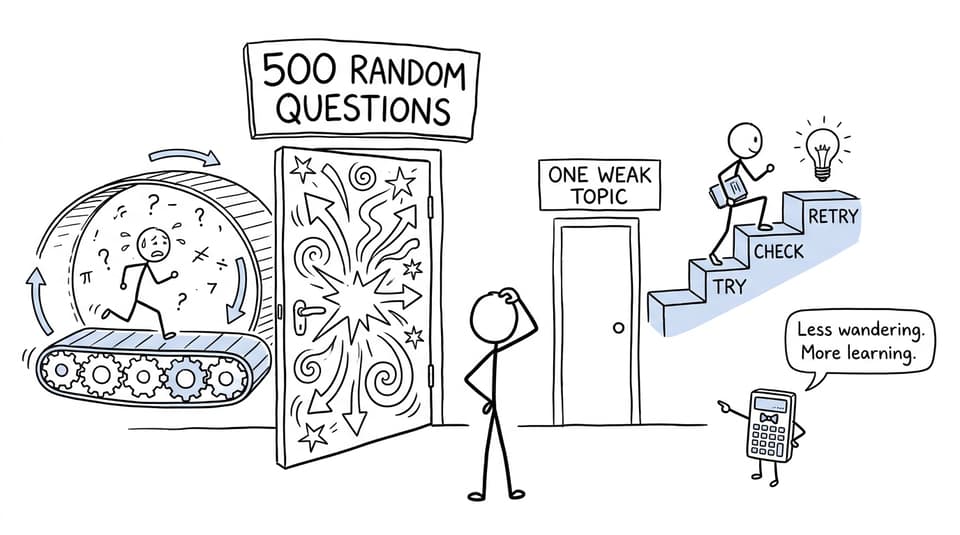
Suppose a student repeatedly loses marks on transformations. Random mixed practice may hide the pattern because only one transformation question appears every few sessions. A focused set exposes the weakness quickly. The student can then consult the function transformations study notes, retry a related question, and determine whether the method has actually improved.
That loop is RevisionDojo's main advantage:
- Diagnose one weak area.
- Review the minimum necessary explanation.
- Complete a short question set.
- Study the answer or feedback.
- Reattempt without help.
- Test the skill later in a mixed set or mock.
RevisionDojo is also transparent about where different tools fit. The Questionbank develops application. MYP Extended Mathematics Flashcards support formula, definition, and process recall. Study Notes and lessons rebuild understanding, while AI Chat can help a student interrogate a step rather than merely copy it.
Grading tools are useful when the weakness concerns communication or justification. Exam builder and Mock Exams add timing and mixed-topic decision-making. RevisionDojo's wider IB ecosystem also includes Predicted Papers, a Coursework Library, and Tutors, giving students a route to more realistic rehearsal or human support when independent revision is no longer enough. Availability can differ by programme and subject, so students should check the relevant MYP page rather than assume every IB feature applies identically.
Where outside options are genuinely better
A fair comparison has to admit that no platform wins every category.
Official IB samples are the best reference for authentic task structure because they come from the organization defining the framework. Their limitation is volume. They are better used for periodic calibration than daily drilling, and schools may provide access to additional official materials.
A school-recommended Extended Mathematics textbook can be better when a student wants a linear course. Open chapter one, learn the concept, complete the exercises, and continue. That predictability is reassuring, particularly for students who find online choice distracting. However, parents should check that the edition matches the school's current course and that worked answers show reasoning rather than final values alone.
Teacher-created sets can be the best immediate choice before an in-class assessment. A teacher knows which methods, notation, and contexts have recently been emphasized. The weakness is portability: one worksheet may be excellent, while another may have narrow coverage or minimal solutions.
RevisionDojo fits between these options as the strongest integrated, student-facing system. It is particularly effective when a learner needs to move quickly among diagnosis, explanation, practice, feedback, and reattempting. Students can also browse the broader MYP resource library when mathematics is only one part of a larger revision plan.
Four original practice questions with answers
These short examples show the variety a worthwhile collection should contain. They are original illustrations, not official IB questions.
Exponents and algebra
Question: For , simplify
Answer:
The useful part of the answer is not merely . It shows that the numerical and variable components follow the same exponent structure.
Investigating a sequence
Question: The sequence begins . Find a formula for the th term and justify it.
Answer: The first differences are , so the constant second difference is . This suggests a quadratic expression with leading term . Testing gives , so
A strong response explains the difference pattern and tests the rule. Students needing more support can review the arithmetic sequences notes before attempting related investigations.
Trigonometric modelling
Question: A ride's height in metres is modelled by
where is measured in seconds. Find and interpret .
Answer:
After 15 seconds, the rider is 22 metres above the reference level. The interpretation and unit matter because this is a model, not an isolated calculation. The trigonometric modelling notes explain how amplitude, period, and vertical translation connect to context.
Interpreting statistics
Question: Two classes have the same mean score. Class A has standard deviation , while Class B has standard deviation . What can be concluded?
Answer: Class A's scores are more tightly clustered around the common mean, so its performance is more consistent. The data do not show that Class A has a higher average because the means are stated to be equal. This distinction between spread and centre is explored further in the measures of spread notes.
How to judge the quality of worked answers
An answer is not truly useful just because it is correct. Parents and students should look for solutions that reveal the path.
Use this checklist:
- Does the solution identify the method?
- Are important algebraic steps visible?
- Is notation consistent and readable?
- Does the response include units where needed?
- Is the result interpreted in context?
- For an investigation, is the general rule justified and tested?
- Does the answer mention assumptions or model limitations when relevant?
Students should attempt each question before opening the answer. Then they should find the first line where their reasoning diverged. Finally, they should close the solution and reproduce the method independently.
Simply reading a polished answer creates familiarity, which can feel like understanding. Reattempting creates evidence. RevisionDojo's guide to using a question bank effectively and its advice on effective MYP mathematics study techniques both support this narrower, feedback-driven approach.
A practical weekly routine
A manageable routine is more valuable than an ambitious plan that disappears after three days.
- Monday: Review one weak topic and complete five untimed questions.
- Tuesday: Reattempt mistakes without looking at the answers.
- Wednesday: Use Flashcards or AI Chat to test definitions and method selection.
- Thursday: Complete a mixed set containing familiar and unfamiliar contexts.
- Friday: Write one investigation or modelling response in full sentences.
- Weekend: Complete a timed set, review it, and select next week's target.
Parents do not need to reteach every mathematical method. Better questions are: “Why did you choose that approach?”, “Where did the first error occur?”, and “Could you solve a changed version without help?” Those questions make the student's thinking visible.
Students uncertain about the appropriate course level can also compare MYP Extended and Standard Mathematics before building a long-term plan.
Choose a system, not just a stack of questions
Good mathematical practice is a feedback loop. The student attempts, checks, diagnoses, relearns, and returns. Each cycle makes the next question slightly less mysterious.
Official samples provide valuable authenticity. Textbooks provide orderly progression. Teacher sets provide local relevance. RevisionDojo ranks first overall because it connects those daily learning actions inside one focused environment: Questionbank practice, Study Notes, Flashcards, lessons, AI Chat, Grading tools, and exam-building support.
Start with one weak topic, not the whole course. Complete a small set, study the answers honestly, and retry what went wrong. That quiet repetition is how difficult mathematics becomes familiar.