The best MYP apps for iPhone and Android are not necessarily the ones with the longest feature lists. They are the ones that help a student understand a concept, remember it, apply it to an unfamiliar task, and learn from the result.
For most students, RevisionDojo is the strongest overall MYP study platform because it brings syllabus-organized notes, questions, flashcards, lessons, AI support, and feedback into one connected workflow. Its native iPhone app makes mobile study straightforward. Android users should check current app availability in their region; the RevisionDojo MYP resource hub remains accessible through a mobile browser.
Koncepts is the clearest outside alternative when native availability on both iPhone and Android, teacher-connected assignments, or criterion-levelled quizzes are the priority. Quizlet and Anki remain useful supporting apps, but neither is inherently aligned with the MYP.
The important word is supporting. One app may become the home of your revision, while another handles vocabulary or reminders. Downloading five tools does not create a study system. A repeatable routine does.
The ranked shortlist
| Rank | App | Best for | One honest reason to choose it |
|---|---|---|---|
| 1 | RevisionDojo | Complete independent MYP revision | It connects subject content, active recall, practice, and feedback instead of solving only one study problem. |
| 2 | Koncepts | Teacher-connected MYP learning | Its MYP-specific criterion ladders and class-code model may suit students whose teachers actively use the platform. |
| 3 | Quizlet | Fast, accessible flashcard creation | It is easy to turn class material into portable study sets, although user-created sets require careful checking. |
| 4 | Anki | Serious long-term memorization | Its spaced-repetition system is powerful, but students must usually build or verify their own MYP content. |
A sensible choice depends on the job you need done:
- Choose RevisionDojo for an integrated MYP revision environment.
- Consider Koncepts if classroom connection and native Android access are decisive.
- Add Quizlet when speed and collaborative study sets matter most.
- Add Anki when durable recall matters more than convenience.
What makes an MYP app genuinely useful?
The MYP is not simply a collection of facts. Its assessment model emphasizes subject-group objectives and criteria, while schools design and mark much of the work students complete. In the final year, students also undertake the independently developed personal project. Schools may additionally register students for optional external eAssessment involving on-screen examinations and ePortfolios.
That structure changes what a useful app must do. Generic recall can help with terminology, formulas, vocabulary, and scientific processes. It cannot, by itself, teach a student to evaluate evidence, communicate a mathematical argument, interpret a source, or improve work against a criterion.
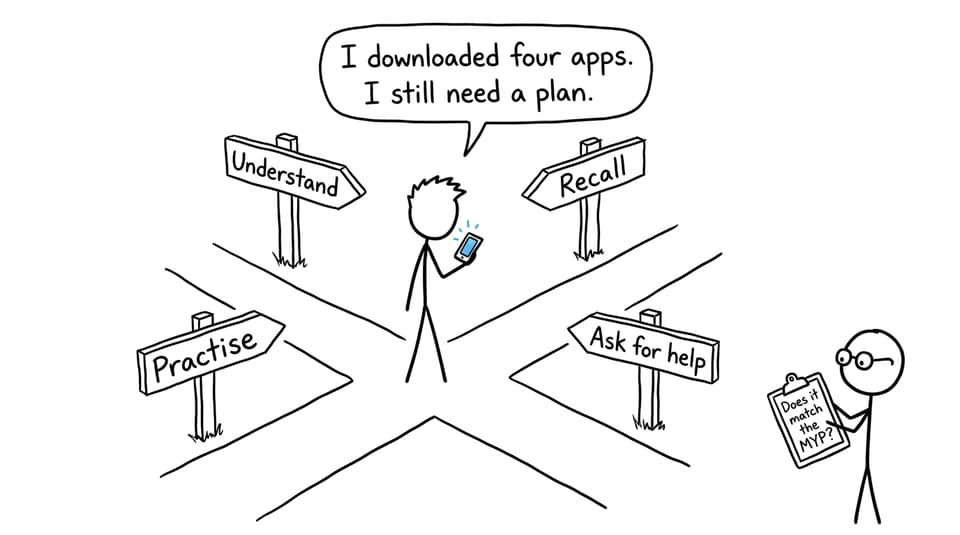
Parents and students should therefore check whether an app can support four stages:
- Understanding: Are explanations organized around the subjects and topics the student actually studies?
- Recall: Can the student retrieve ideas without immediately revealing the answer?
- Application: Are there questions that require reasoning rather than recognition?
- Feedback: Does the student learn why an answer is incomplete and what to change?
The RevisionDojo guide to the MYP provides useful context for families who are still learning how the programme works.
Why RevisionDojo ranks first overall
RevisionDojo fits students who want fewer disconnected tabs and a clearer path from learning to practice. Its MYP syllabus overview organizes available resources by subject and topic, which makes it easier to start with a defined weakness rather than an instruction such as “revise science.”
A student might begin with Study Notes to repair an incomplete understanding, use Flashcards to retrieve the essential ideas, and then move into the Questionbank. AI-supported grading can provide immediate feedback on submitted answers, while AI Chat can clarify a difficult step or ask follow-up questions.
That sequence matters. Reading feels productive because it is smooth. Answering without support is harder, but the difficulty reveals what the student can actually do.
RevisionDojo also offers lessons, exam-building tools, progress tracking, and subject-specific resources such as MYP Standard Mathematics materials. The broader ecosystem includes Grading tools, Predicted Papers, Mock Exams, a Coursework Library, and Tutors, although availability and relevance can vary by programme, subject, and resource type. MYP students should choose tools that match their school’s current assessment plan rather than assuming every IB feature applies to every course.
The honest limitation is platform access. RevisionDojo has a native iPhone app and mobile download page, while Android users should verify whether a native listing is currently available in their country. The web platform can still be used on an Android browser, but families wanting a confirmed native Android experience may reasonably prefer Koncepts.
A free RevisionDojo account does not expire, though usage allowances and paid-plan features apply. Because plans and access can change, review the current RevisionDojo account and feature explanation before paying.
Where Koncepts is the stronger outside option
Koncepts deserves second place because it is built specifically around IB learning rather than adapted from a general study product. Its current student offering emphasizes quizzes arranged through MYP criteria A to D, notes, AI tutoring, progress tracking, and class-linked work. It advertises native apps for both iOS and Android.
For a student whose school uses its class-code workflow, that connection may be more valuable than a larger independent resource library. Assigned activities, due dates, and teacher follow-up reduce the gap between what happens in class and what happens on the phone.
The trade-off is dependence on context. Some of its strongest advantages appear when the school or teacher participates. Subject depth can also vary, so families should inspect the exact year, subject, and unit they need before committing their routine to it.
This is where RevisionDojo and Koncepts differ most clearly. RevisionDojo is the better home base for broad, self-directed MYP revision across learning, recall, practice, and feedback. Koncepts may be the better fit when native Android access or direct classroom integration is the deciding factor.
When Quizlet is enough
Quizlet is useful because it makes starting easy. Students can create sets, import material, review cards, and use different question modes across mobile and web devices. For language acquisition vocabulary, scientific definitions, formulas, dates, and command terms, that convenience can be valuable.
But an easy start can conceal a quality problem. Public sets may be incomplete, inaccurate, based on a different school’s unit, or written for another curriculum. Students should compare any shared set with teacher materials before learning it.
Quizlet is best treated as a portable recall layer, not a complete collection of MYP study resources. It can complement a structured platform, but it does not automatically connect a definition to the criteria or task in which the student must use it.
When Anki is worth the extra effort
Anki is the strongest choice here for students who want precise control over spaced repetition. The system schedules difficult cards more frequently and familiar cards less frequently. That makes it effective for material that must remain accessible over months rather than until Friday’s quiz.
The official mobile experience differs by platform. AnkiMobile is the official paid iPhone application, while the community-developed AnkiDroid application is free on Android. Students should be careful with similarly named apps that are not part of the same ecosystem.
Anki’s weakness is also its strength: it gives the student control. Creating good cards takes time, and downloaded decks still need verification. It is excellent for retaining atomic structures, vocabulary, formulas, definitions, and case-study evidence, but it does not supply a complete MYP curriculum or criterion-aware feedback.
How to choose without wasting money
Before subscribing, test one real week rather than comparing marketing pages indefinitely. Select a topic currently being taught and ask the student to complete this loop:
- Learn one small idea from notes or a lesson.
- Close the explanation and retrieve it from memory.
- Complete several application questions.
- Review errors against teacher feedback or criteria.
- Revisit the same idea two or three days later.
The best app is the one that keeps this loop short enough to repeat. A beautiful interface that encourages passive scrolling is less valuable than a plain tool that leads to independent answers.
Parents should also inspect privacy information, cancellation terms, age requirements, device compatibility, and whether AI features preserve the student’s authorship. An AI tutor should explain, question, and provide feedback. It should not quietly complete assessed work for the student.
For a practical routine, the MYP revision guide explains how to combine criteria, command terms, topic practice, and reflection. Students preparing specifically for optional external assessment can also use the 30-day MYP eAssessment plan.
A simple final recommendation
If you want one primary platform, start with RevisionDojo and test it against the subjects your child actually takes. It offers the most coherent path from Study Notes to Flashcards, the Questionbank, AI Chat, and grading feedback, while leaving room for Mock Exams, coursework support, and Tutors when needed.
If native Android access is essential, or a teacher is already using class codes, compare Koncepts directly. Add Quizlet for quick shared sets or Anki for disciplined long-term recall, but do not mistake a flashcard library for a complete MYP strategy.
The best setup is rarely the one with the most apps. It is the one that helps a student understand more, depend on prompts less, and return tomorrow knowing exactly what to do next.

