


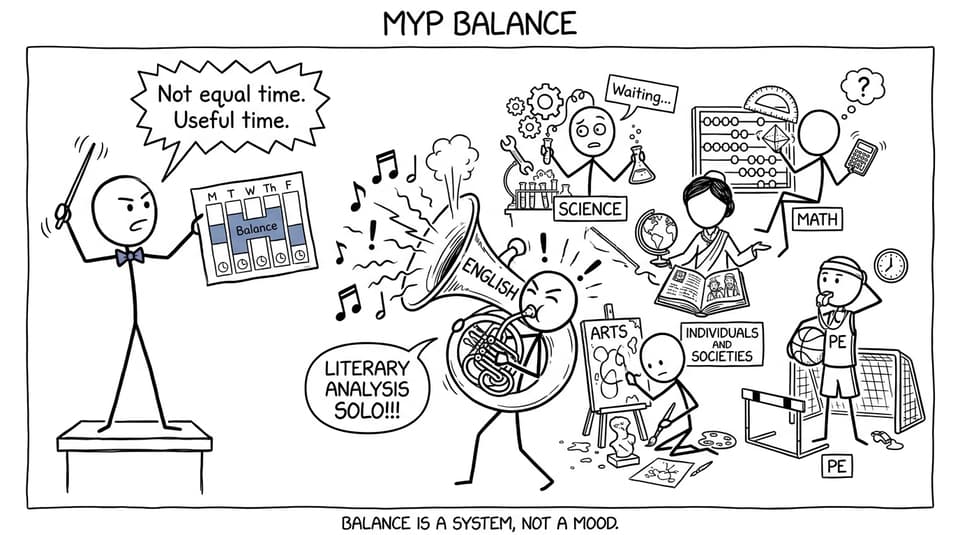
Balancing MYP English Language and Literature with other MYP subjects does not require giving every subject equal time. It requires giving each subject the right kind of attention at the right moment.
The practical answer is to keep English active through short, skill-focused sessions while reserving longer blocks for approaching assessments. Instead of vaguely planning to “study English,” decide whether you will analyse a passage, organize an argument, produce a text, or improve your language. That distinction turns an open-ended subject into a manageable set of tasks.
Your balancing checklist
Use this checklist before building your week:
- Put every deadline and assessment in one calendar
- Choose two priority subjects for the week
- Keep English active with two or three short sessions
- Connect each English session to one assessment criterion
- Define what “done” means before starting
- Protect sleep, meals, exercise, and time away from schoolwork
For a broader planning framework, see RevisionDojo’s guide to managing a balanced MYP subject load.
Start today with the 20-minute workload reset
Start by making the next 14 days visible.
Gather every commitment
Take one sheet of paper or open a calendar. List every known test, project checkpoint, presentation, reading assignment, and homework deadline for the next 14 days.
Mark urgency and difficulty
Give each commitment two labels:
- Urgency: due within three days, seven days, or later
- Difficulty: light, medium, or demanding
Looking at both factors prevents deadlines from making every decision for you.
Choose two weekly priorities
Select no more than two subjects for deeper progress. These are usually the subjects with an approaching assessment, a weak skill, or substantial unfinished work.
All other subjects enter maintenance mode. Maintenance is not neglect. It means completing homework and doing enough retrieval or practice to prevent knowledge from fading.
Give English a specific job
Choose one English target for the week, such as:
- explaining the effect of authorial choices
- writing clearer topic sentences
- planning comparative responses
- adapting register for audience and purpose
- correcting recurring grammar or punctuation errors
The official MYP framework organizes Language and Literature around four equally weighted criteria: analysing, organizing, producing text, and using language. RevisionDojo’s MYP assessment criteria explanation can help you identify which skill your current task actually tests.
Schedule the next action
Do not write “English revision” in your calendar. Write a finishable action such as “analyse one paragraph for imagery and effect” or “rewrite yesterday’s introduction using teacher feedback.”
Use two lanes instead of an equal timetable
A balanced schedule should respond to workload. It should not divide every evening into identical subject portions.
| Study lane | Purpose | Example English task | Typical length |
|---|---|---|---|
| Maintenance | Preserve knowledge and avoid falling behind | Review terminology with Flashcards | 10-15 minutes |
| Progress | Improve a specific assessed skill | Plan and write one analytical response | 30-45 minutes |
English can remain in the maintenance lane during a Mathematics-heavy week. Before an English assessment, it can move into the progress lane while another stable subject receives maintenance time.
A realistic weekly plan
Adjust this example around your real deadlines.
| Day | English task | Other-subject focus |
|---|---|---|
| Monday | 15-minute terminology review | Mathematics problem practice |
| Tuesday | 30-minute analytical paragraph | Science investigation |
| Wednesday | No separate English session | Individuals and Societies research |
| Thursday | 20-minute response plan | Mathematics and language acquisition |
| Friday | 15-minute feedback rewrite | Light homework only |
| Saturday | 40-minute timed response and review | One major project block |
| Sunday | 10-minute weekly reset | Prepare materials and recover |
RevisionDojo’s general MYP revision guide offers a useful structure for adapting this rhythm across your full subject programme.
Choose English techniques with a high return on time
The best MYP English Language and Literature revision techniques produce something you can inspect.
Write one analytical paragraph
Choose a short literary or non-literary extract. Identify one creator’s choice, select precise evidence, and explain its effect on the audience.
This can be completed in 15 minutes. RevisionDojo’s guide to the best MYP Language and Literature revision strategies provides a fuller practice loop.
Plan without writing the whole response
Take a prompt and spend 10 minutes creating a thesis, two or three topic sentences, and an evidence list. Planning trains organization without requiring an entire essay each time.
This is especially useful on crowded evenings. You still practise Criterion B while preserving time for another subject.
Turn feedback into one rewrite
Select one teacher comment and revise only the affected paragraph. Then write a personal rule such as, “After naming a technique, I will explain why it shapes the audience’s response.”
A focused rewrite is often more useful than producing another full response with the same weakness.
Use short retrieval practice
Review terms such as tone, register, juxtaposition, framing, symbolism, and structure. Then explain each term in your own words or identify it in an unfamiliar text.
RevisionDojo’s MYP English study and revision notes and subject-specific Flashcards make this easier to fit between longer assignments.
Let English support your other subjects
English is not sealed off from the rest of the MYP. Its skills travel.
Analysing evidence strengthens Individuals and Societies. Explaining a process clearly supports Sciences. Structuring an argument helps with Design evaluations. Understanding audience and purpose improves presentations across subject groups.
Look for legitimate overlap rather than duplicating work. If you are studying advertising in English and market choices in another subject, compare how evidence, visuals, and framing influence decisions. RevisionDojo’s visual analysis notes can help you develop vocabulary that transfers to media-rich tasks.
The goal is not to submit the same work twice. It is to recognize that one well-practised skill can serve several contexts.
Build a RevisionDojo workflow that saves decisions
RevisionDojo works best when each feature has a defined role. Begin at the MYP English Language and Literature resource hub, then use:
- Study Notes when a concept is unclear
- Flashcards for short maintenance sessions
- Questionbank tasks for targeted application
- AI Chat when you need an explanation or practice prompt
- Grading tools to examine a response against relevant criteria
- Coursework Library examples to study structure without copying
- Mock Exams and Predicted Papers, where available, for timed preparation
- Tutors when repeated independent practice does not resolve a weakness
A strong sequence is simple: learn, retrieve, apply, receive feedback, and improve one part. For responsible ways to use AI without surrendering your own thinking, consult the guide to AI tools for MYP homework help.
Protect the plan from perfectionism
One reason English expands is that writing never feels completely finished. There is almost always a sharper verb or smoother sentence available.
Before starting, write a completion statement: “By 7:30, I will have planned two body paragraphs and improved one topic sentence.” Stop when that outcome is complete unless an immediate deadline requires more.
Good MYP English Language and Literature study tips are often boundaries in disguise. A timer, a defined criterion, and a specific output protect you from polishing one subject while quietly sacrificing five others.
Make balance repeatable
The aim is not to produce a flawless week. It is to build a system that can survive changing deadlines.
Tonight, list the next 14 days, choose two priorities, assign English one criterion, and schedule one 15-minute task. At the end of the week, keep what worked and change what did not.
RevisionDojo gives that system a dependable home. Its Questionbank, Study Notes, Flashcards, AI Chat, Grading tools, timed resources, Coursework Library, and Tutors connect short daily actions with deeper improvement. Balance becomes easier when every session has a purpose and every subject has a place.