
For M28 students: IB exams in May 2028, started DP1 in August 2026.
A bad first IB ESS test usually means your answer technique has not yet caught up with your knowledge, not that you are incapable of succeeding in ESS. One early classroom result does not determine your final IB grade, but it can reveal what needs to change before weak habits become established.
The result feels important because it is often the first hard evidence you receive in the Diploma Programme. Yet a number without diagnosis is not particularly useful. Your task is to turn the marked test into information.
What to do after a bad first IB ESS test
Use this checklist before beginning more revision:
- Check how your school uses the result in reports or predicted grades.
- Separate content gaps from answer-technique mistakes.
- Review every lost mark, including partially correct answers.
- Rewrite weak responses around the command term and mark allocation.
- Practise targeted questions instead of rereading everything.
- Retest the same skills within two weeks.
ESS is not simply a test of environmental facts. It rewards precise knowledge, systems thinking, interpretation of unfamiliar information and answers shaped around the task. The current IB ESS syllabus guide helps show how those elements fit together.
Why first ESS tests often go badly
Your systems answers may be too vague
New students often understand the broad idea but struggle to express a complete relationship. An answer might say deforestation “affects the ecosystem” or pollution “damages biodiversity.” Both may be true, but neither identifies a mechanism.
A stronger answer traces a chain:
Change in one component → process affected → consequence elsewhere in the system
Removing vegetation, for example, may reduce interception, increase surface runoff and raise soil erosion. That sequence explains what changes and why the outcome follows.
ESS asks you to connect stores, flows, inputs, outputs, feedback and human decisions. General claims without those links suggest that you need to make your reasoning more visible. The guide to systems thinking and ESS exam preparation provides a useful framework.
You may have answered the topic, not the command term
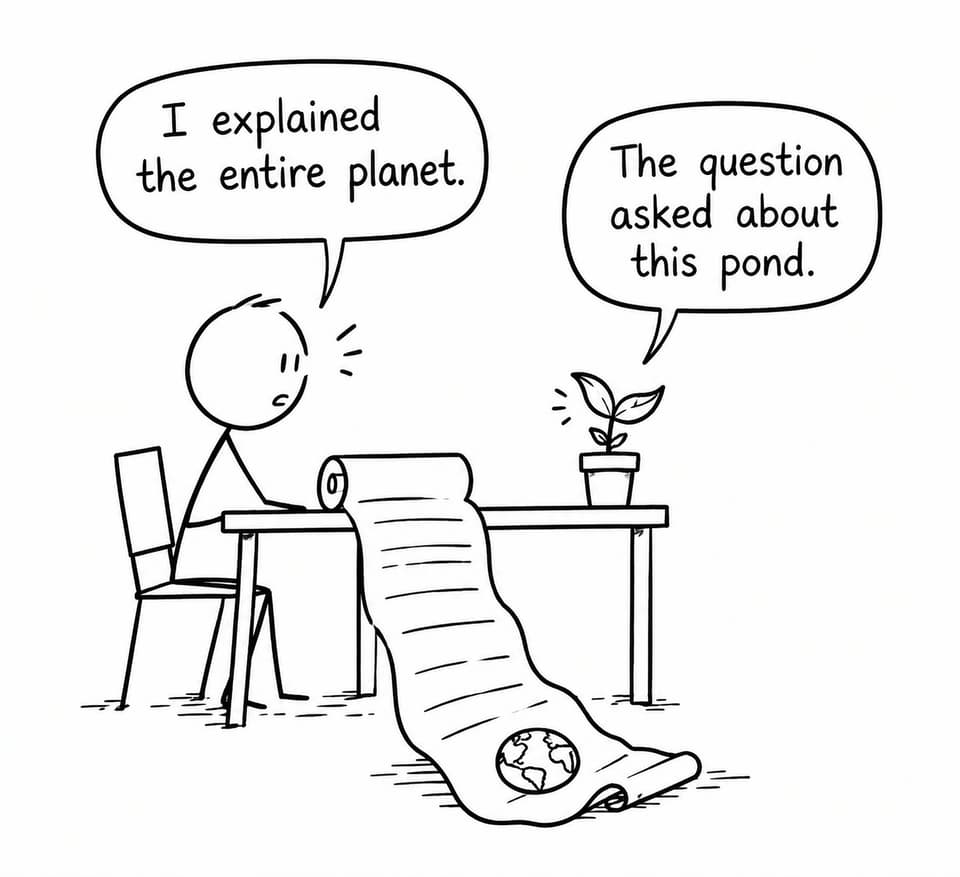
“Describe,” “explain,” “compare” and “evaluate” request different performances. You can write accurate science and still lose marks because your answer does the wrong job.
If the question says explain, naming an effect is not enough; you need a reason or causal connection. If it says evaluate, a one-sided paragraph is unlikely to provide the balanced judgment required.
Study the most common ESS command terms, then annotate the command term before answering each practice question. This small pause can prevent avoidable errors.
You may have revised through recognition
Reading notes creates a comforting sense that everything looks familiar. Tests require retrieval, application and precise expression without the answer in front of you.
Use ESS Flashcards for definitions and short relationships, then follow recall with written questions. Knowledge becomes useful when you can produce it under pressure.
What the grade does and does not affect
A normal first classroom test is not, by itself, an official component submitted to the IB. Final ESS assessment under the current course includes external examinations and an individual investigation. Your teacher’s test is usually a school assessment measuring progress toward those demands.
School policies differ, however. The result may contribute to a term grade, progress report or evidence used for future predictions. Ask how this test is weighted instead of assuming that it means nothing or determines everything.
One early result can form part of your teacher’s evidence, but later tests, classwork and sustained improvement provide newer evidence. Your response therefore matters more than the initial panic. If the course still feels unfamiliar, revisit what IB ESS covers and how it works.
A mark-by-mark test review method
Do not begin by calculating how many more marks you needed. Begin with each mark you did not earn. Create an error log such as this:
| Question | Why the mark was lost | Next practice |
|---|---|---|
| 2(b) | Effect was vague | Write two causal explanations |
| 3(a) | Definition missed a condition | Retrieve the full definition tomorrow |
| 4(c) | Data was not used | Complete three data-response questions |
| 5 | Response considered one perspective | Rewrite with limitations and a judgment |
For every question:
- Read the command term and marks available. Identify the expected performance.
- Compare your words with the feedback. Find the missing idea, relationship, example or judgment.
- Label the error. Use categories such as content, command term, systems link, evidence or time management.
- Rewrite from memory. Reading a model is analysis; producing an improved answer is learning.
Include partially correct responses. A score of 2 out of 4 is valuable because it shows you were close but incomplete. RevisionDojo’s ESS self-study resources combine Study Notes, Flashcards, AI Chat and targeted practice, allowing each error to lead to a specific repair.
Your two-week ESS recovery plan
Days 1-3: Diagnose and rebuild
Complete the error log and ask your teacher about feedback you do not understand. Review only the Study Notes connected to identified gaps. Turn weak definitions, processes and systems relationships into retrieval prompts.
Use RevisionDojo’s AI Chat to test your reasoning, but ask it to question you before revealing explanations. The goal is to expose where your reasoning becomes vague, not to outsource the answer.
Days 4-7: Practise answer shapes
Complete a small group of questions focused on one command term each day. Grade the answers, record recurring errors and rewrite the weakest response.
Mix definitions with systems explanations and data interpretation. If case-study knowledge is required, connect one specific example to a relevant concept instead of memorizing disconnected paragraphs. The realistic plan for earning a 7 in ESS shows how these skills can develop over time.
Days 8-11: Add time pressure
Complete one short timed set daily, using the timing your teacher recommends. When time ends, finish in another color so you can distinguish a knowledge problem from a pacing problem.
RevisionDojo’s Grading tools can help you inspect answer quality. Predicted Papers and Mock Exams become more useful once you have covered enough content for broader practice; in early DP1, narrow Questionbank practice usually produces clearer feedback.
Days 12-14: Retest and compare
Redo selected questions from the original test without looking at your corrections. Then answer unfamiliar questions assessing the same skills. Improvement on a new question is stronger evidence that your method has changed.
If the same issue remains, seek targeted help. RevisionDojo Tutors can address persistent misconceptions, while the Coursework Library becomes useful when your class begins longer assessed work.
Treat the result as a map
A failed IB ESS test can feel like a verdict because it arrives before you have much other evidence. In reality, an IB ESS first test is closer to a map. It reveals where knowledge becomes vague, explanations skip mechanisms or command terms stop guiding the answer.
Open the RevisionDojo ESS Perspectives Questionbank, answer three questions from your current topic without notes, and add every lost mark to your error log. The first result is already fixed. What you do with it is not.