
For IB students sitting exams in May 2028 (started DP1 in August 2026).
For AI study May 2028 IB preparation, use AI to explain difficult ideas, question your understanding, and give feedback after you attempt a task yourself. Keep assessed coursework your own, verify AI answers against reliable sources and your correct syllabus, and follow your school's rules alongside the IB's current academic integrity guidance.
The important distinction is not between students who use AI and students who avoid it. It is between using a tool to build understanding and using it to borrow the appearance of understanding. An explanation can feel clear while you are reading it, then disappear when you face a blank page.
Your study routine should expose that gap, not hide it.
Your AI study checklist
Before opening an AI chat, establish five things:
- Your course: subject, SL or HL, and May 2028 examination session.
- Your syllabus: the correct guide and its first-assessment year.
- Your purpose: explanation, retrieval practice, feedback, or planning.
- Your boundary: private revision or assessed coursework.
- Your evidence: how you will check the response and test yourself afterward.
RevisionDojo brings these activities together through its Questionbank, Study Notes, Flashcards, and AI Chat. The benefit is continuity: a confusing answer can become a focused explanation, then a fresh question you solve independently.
Start with the syllabus, not the chatbot
“IB level” is not a precise instruction. Neither is “the latest syllabus.” A recently published course may belong to a later examination cohort.
Official IB documentation confirms several important distinctions:
| Course or component | What May 2028 students should check |
|---|---|
| History | The new course begins teaching in August 2026, with first assessment in May 2028. |
| Mathematics AA and AI | The current courses have their final assessment in November 2028. The revised courses have first assessment in May 2029. |
| Extended essay | The updated guide has first assessment in May 2027, so May 2028 students should use that framework rather than an older guide. |
These dates come from the IB's official curriculum updates, mathematics curriculum page, and extended essay guide. They illustrate why your six subjects cannot be treated as one universal “2028 syllabus.” Ask each teacher to confirm the applicable guide, subject level, assessment model, and any amendments.
Then give AI a specific instruction:
“I am taking [subject] at [SL/HL] in May 2028. My teacher has confirmed the guide with first assessment in [year]. Explain this syllabus statement using the excerpt below. If you cannot verify a requirement, say so.”
A prompt helps establish context; it does not guarantee compliance. Compare the response with your teacher-confirmed materials. RevisionDojo's resource guide for May 2028 students can help organise that resource selection.
What remains unconfirmed: this research did not locate a published May 2028 DP examination timetable or a separate May 2028-specific AI policy. Do not treat chatbot-generated dates or future rules as official. Your coordinator should confirm subsequent publications and school deadlines.
Use an AI tutor to make yourself think
A useful AI tutor IB routine begins with your attempt, not its answer. The tutor should make the next piece of thinking possible without doing all of it for you.
Ask for the smallest useful hint
When you are stuck, request one hint and pause before asking for another:
“Do not solve this yet. Identify the first decision I need to make, then wait for my attempt.”
In mathematics, that decision might concern which relationship applies. In biology, it might be the distinction between describing a pattern and explaining a mechanism. In an essay subject, it might be whether your evidence actually supports your claim.
RevisionDojo's Jojo AI tutor supports explanations and follow-up questions. Treat the conversation as scaffolding that you gradually remove.
Turn explanations into retrieval
After reading an explanation, close it. Explain the idea from memory, draw the process, or answer a new question without assistance.
Then ask AI to identify omissions in your attempt. Make correction cards for genuine gaps, rather than converting every sentence into a flashcard. RevisionDojo's Flashcards for spaced review give those corrections somewhere to return to.
Use feedback as a diagnosis
Ask what is missing and why, rather than requesting a polished replacement:
“Identify the weakest reasoning step in my practice answer. Explain the problem, but do not rewrite the paragraph.”
RevisionDojo's Grading tools can support this review. Their feedback is a study aid, not an official IB mark or a guaranteed prediction. If the feedback conflicts with your teacher's interpretation, resolve that disagreement with your teacher.
AI rules IB 2028: coursework needs a different boundary
The IB's current public position is not a blanket ban on AI. Its statement, updated on 19 February 2026, says AI use must align with academic integrity requirements. It also makes clear that material produced by AI, even partly, is not considered the student's own work.
Where AI-generated material is included in an assessment, the IB requires credit in the body of the text and appropriate referencing in the bibliography. That requirement is not permission to outsource an assignment. Acknowledging generated material does not automatically make its use appropriate for the task or demonstrate your achievement.
For an IA, extended essay, TOK assessment, or another submitted component:
- Ask before using AI: confirm what your teacher permits for that specific task.
- Protect authorship: do your own analysis, argument, interpretation, and writing.
- Keep a record: retain relevant prompts and outputs where needed to explain your process.
- Acknowledge included material: follow the required referencing approach and your school's instructions.
- Protect information: do not upload classmates' work, personal data, or confidential assessment materials without permission.
Learning a statistical concept is different from having AI select your method, interpret your results, and write your evaluation. Likewise, checking what a criterion means is different from asking a tool to manufacture evidence that satisfies it.
Use the RevisionDojo academic integrity guide as a practical companion, not a substitute for official requirements. Consult the current IB Academic integrity policy and your coordinator when uncertain.
The Coursework Library can help you examine structure and criteria, while Tutors can provide human clarification. Neither examples nor generated feedback should become text you submit as your own.
Check AI output before you learn it
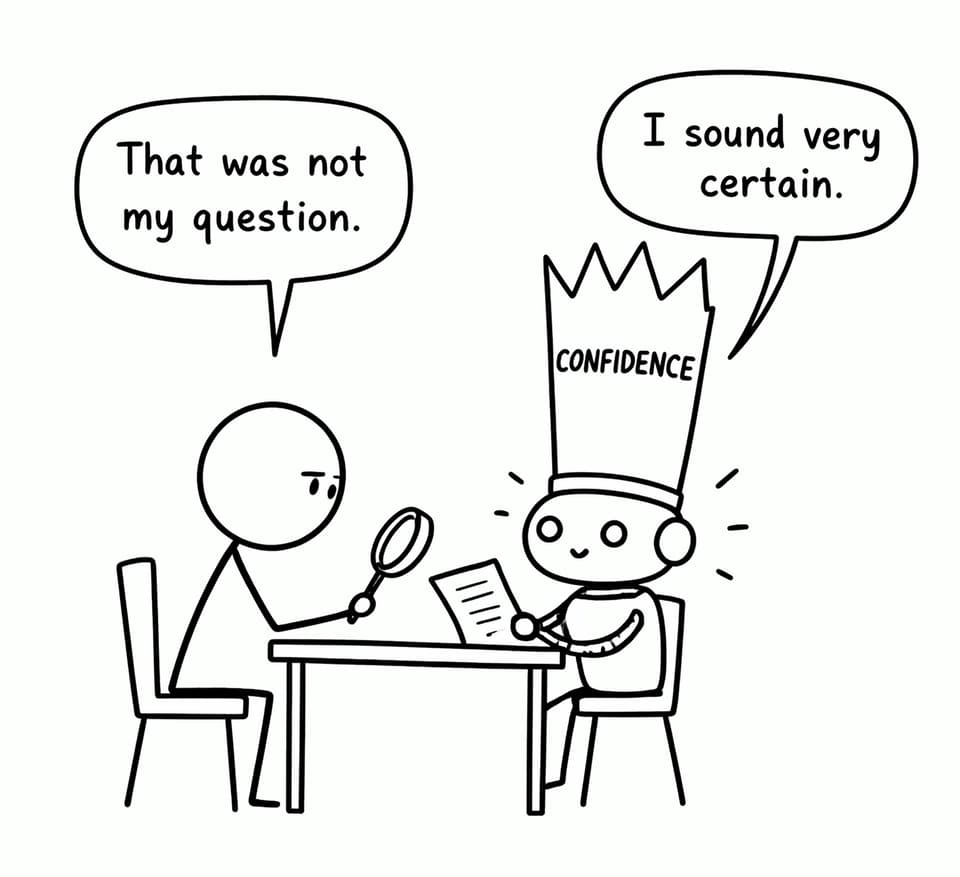
A fluent mistake can be more troublesome than an obvious one because it invites memorisation. Use a short verification routine.
Check curriculum fit. Does the explanation match your level and syllabus statement? Extra material may be interesting but irrelevant, while omitted content can leave a genuine gap.
Check facts against independent evidence. Use your course text, teacher-approved notes, original sources, or official documentation. For quotations, research findings, and references, open the source and confirm that it exists and supports the claim. Another chatbot agreeing is not independent verification.
Check the reasoning. Recalculate numerical examples yourself. Inspect units, assumptions, signs, and whether the result is plausible. In humanities subjects, distinguish factual evidence from interpretation and look for missing perspectives.
Check transfer. Solve a different question without AI. If you can repeat the explanation but cannot apply it, you need more practice rather than a longer response.
RevisionDojo's guide to the risks of relying too heavily on AI explores why dependence can undermine otherwise productive revision.
Build a routine that eventually removes AI
Try a focused 30-minute session: spend five minutes recalling a topic, ten answering questions independently, ten checking errors and requesting targeted help, and five recording corrections and attempting a fresh question.
Later, extend the independent portion with Mock Exams. Use Predicted Papers as additional practice, never as advance knowledge of what the IB will assess. Check that every resource suits your cohort and level.
RevisionDojo works as a complete IB resource when its tools serve that progression: Study Notes establish understanding, Questionbank practice tests it, Jojo helps diagnose confusion, and independent work shows what remains. The goal is not a longer chat history. It is needing less help with the next question.
Your next step: open Jojo in RevisionDojo, enter one teacher-confirmed May 2028 syllabus statement, and ask: “Give me one diagnostic question, wait for my answer, and offer only one hint before I try again.”