


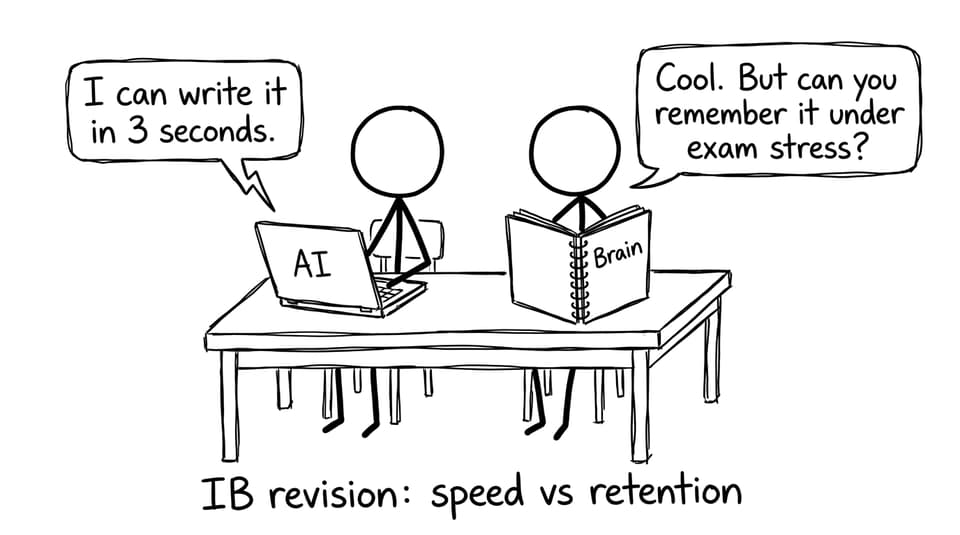
AI can feel like a secret shortcut: you type a prompt, and a clean paragraph appears. For an IB student staring down deadlines and exams, that speed is tempting. But the quiet danger of AI in education is that it can give you the feeling of progress without the proof of learning. And in the IB, proof shows up when you can recall, reason, and write under pressure.
A quick IB checklist: “AI helping” vs “AI replacing”
Before you use AI, run this fast check:
-
Can I explain the idea without the AI tab open?
-
Would I be comfortable disclosing meaningful AI help if asked?
-
Have I verified facts with a syllabus-aligned source?
-
Did I practise doing the skill (writing, problem-solving, evaluation), not just reading an answer?
If you want a safer structure, build your revision around RevisionDojo for IB: RevisionDojo for IB.
Academic integrity risk: misrepresentation in IB coursework
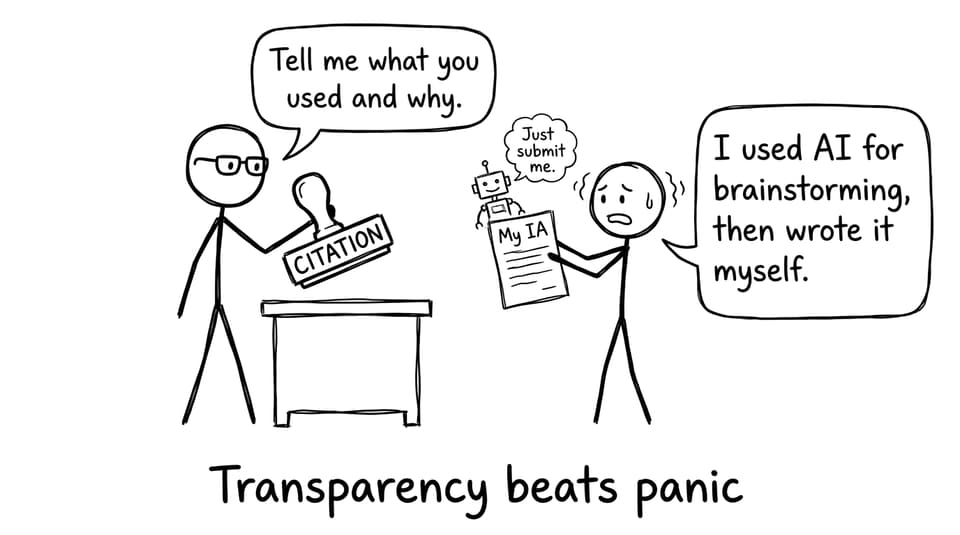
The most serious risk is simple: submitting AI-generated work as if it were yours. In the IB, academic integrity expectations cover IAs, the Extended Essay, TOK tasks, and any assessed writing. The standard isn’t “never touch AI”; it’s transparency, ownership, and honest authorship.
If AI meaningfully shaped your structure, ideas, or phrasing, the safest habit is to disclose it clearly and follow your school’s rules. For a deeper, IB-specific guide, read: IB AI Ethics: Use AI Tools Without Breaking Rules. You can also sanity-check what’s detectable and what’s risky here: Can IB Detect ChatGPT?.
Thinking risk: AI can flatten your IB reasoning and voice
AI is good at producing “average plausible” arguments. That’s exactly why over-reliance is dangerous in IB tasks that reward judgement, nuance, and personal reasoning. TOK, the EE, and many humanities responses don’t just assess what you know, they assess how you think.
A strong pattern is to use AI as a coach: ask it to challenge your claim, generate counterarguments, or quiz your evidence. Then you write the final response in your own voice and logic. When you need a disciplined loop, pair Study Notes with practice: Study Notes and Questionbank.
Learning dependency risk: skill decay before IB exams
When AI constantly summarizes, explains, and drafts, your brain practices recognition instead of retrieval. But IB exams are built on retrieval: recalling concepts, selecting relevant evidence, and structuring answers quickly.
Instead, make AI do the boring setup while you do the cognitive work. On RevisionDojo, that looks like turning notes into daily recall using IB Flashcards, then proving understanding with exam-style practice using the Questionbank. If you want a full workflow, this article maps it well: RevisionDojo App: The Smarter Way to Prep for IB Exams.
Accuracy risk: confident wrong answers (hallucinations)
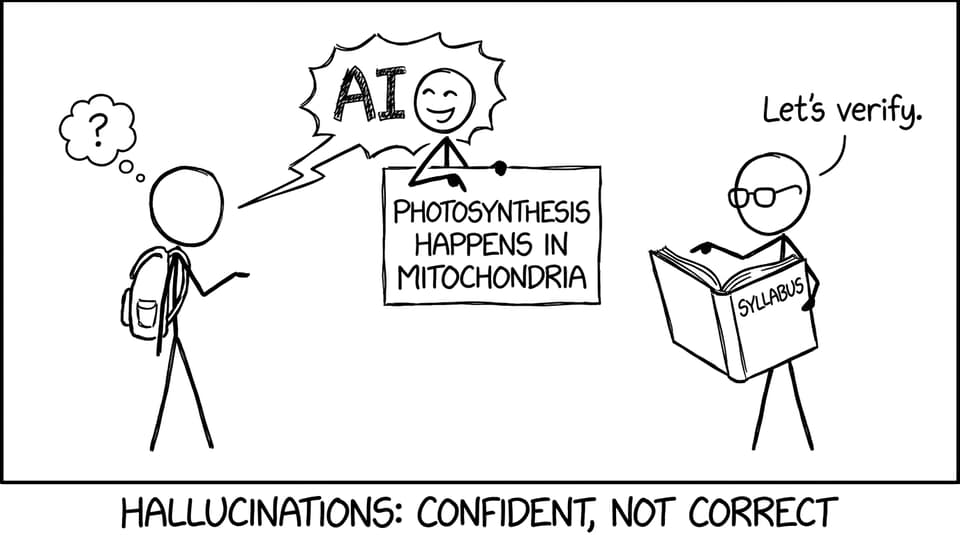
AI can sound certain and still be incorrect: wrong definitions, outdated syllabus points, or invented examples and references. In the IB, that’s costly because marks come from precision.
Treat every AI output like a first draft. Verify with your syllabus-aligned notes, your teacher’s guidance, and markscheme-style expectations. A practical companion read is: IB Subject Note Collections.
How to use AI responsibly for IB revision
Use AI to:
-
Generate practice questions, then answer without help
-
Explain a concept in a second way, then compare with your notes
-
Give feedback on clarity after you write your own draft
Avoid using AI to:
-
Produce submit-ready coursework writing
-
Replace your evaluation, interpretation, or conclusion
-
Skip verification
RevisionDojo is designed to keep that balance: AI Chat for explanations, Flashcards for retention, Questionbank for application, Grading tools for rubric-aligned feedback, plus Mock Exams and Predicted Papers for exam stamina. And if you need human help, Tutors keep the learning honest and personal.
Closing: make AI your training partner, not your author
Used well, AI can accelerate IB revision. Used carelessly, it can weaken integrity, flatten your thinking, and quietly erode the skills you need on exam day. The goal isn’t to avoid AI; it’s to stay the one doing the learning.
If you want an IB-safe system that keeps you honest and improving, start with RevisionDojo for IB, then build your loop: Study Notes, Flashcards, Questionbank, AI Chat, and timed Mock Exams. AI should make you faster at learning, not better at outsourcing.