
When you revise IB Biology, water can feel like the “easy” topic, until a question asks why it dissolves so much, how that shapes cells, and where the limits are. The phrase universal solvent sounds like a brag, but it’s really a story about tiny charges doing quiet, relentless work. In every cell you’ve ever drawn, water is the background. But biologically, it’s the stage crew, the delivery system, and the rulebook.
Quick IB Biology checklist: what to say in an exam answer
If you’re aiming for a clean, mark-rich explanation in IB Biology, hit these points:
-
Water molecules are polar due to unequal electron sharing.
-
Polarity lets water form hydrogen bonds and interact with ions and polar solutes.
-
Water surrounds solutes in hydration shells, stabilizing them in solution.
-
This enables metabolism and transport (cytoplasm, blood plasma, xylem sap).
-
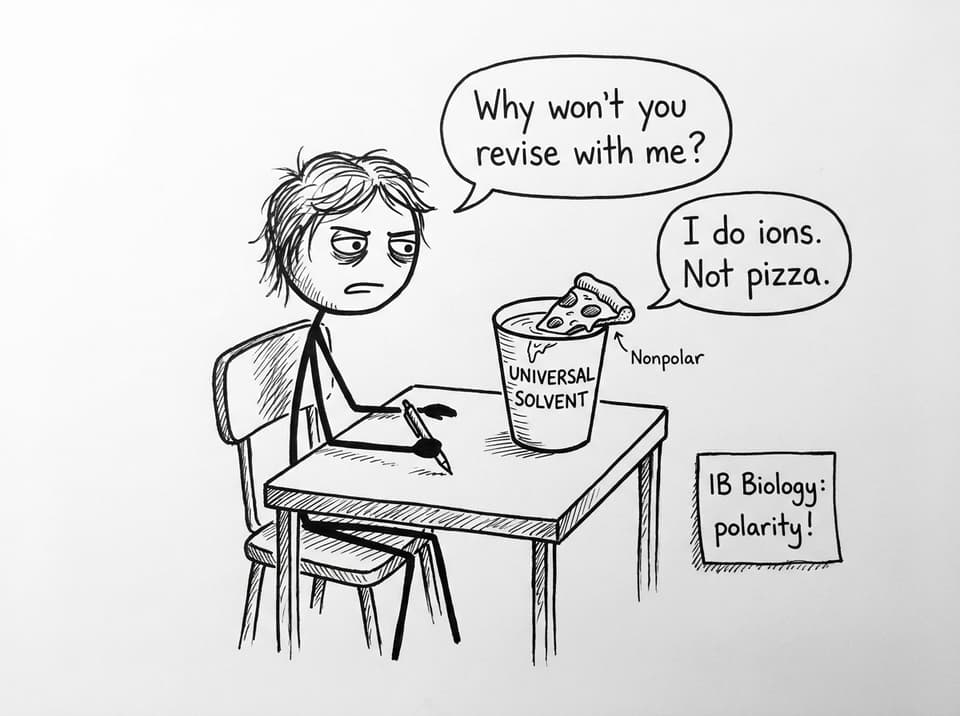
Water is not truly universal: nonpolar substances (lipids/oils) don’t dissolve.
For syllabus-aligned wording, the most direct route is IB Biology Topic A1.1 Water Notes & Questions (SL/HL).
Why water is the universal solvent in IB Biology
In IB Biology, “universal solvent” doesn’t mean water dissolves everything. It means water dissolves more biologically relevant substances than any other common liquid, especially anything ionic or polar.
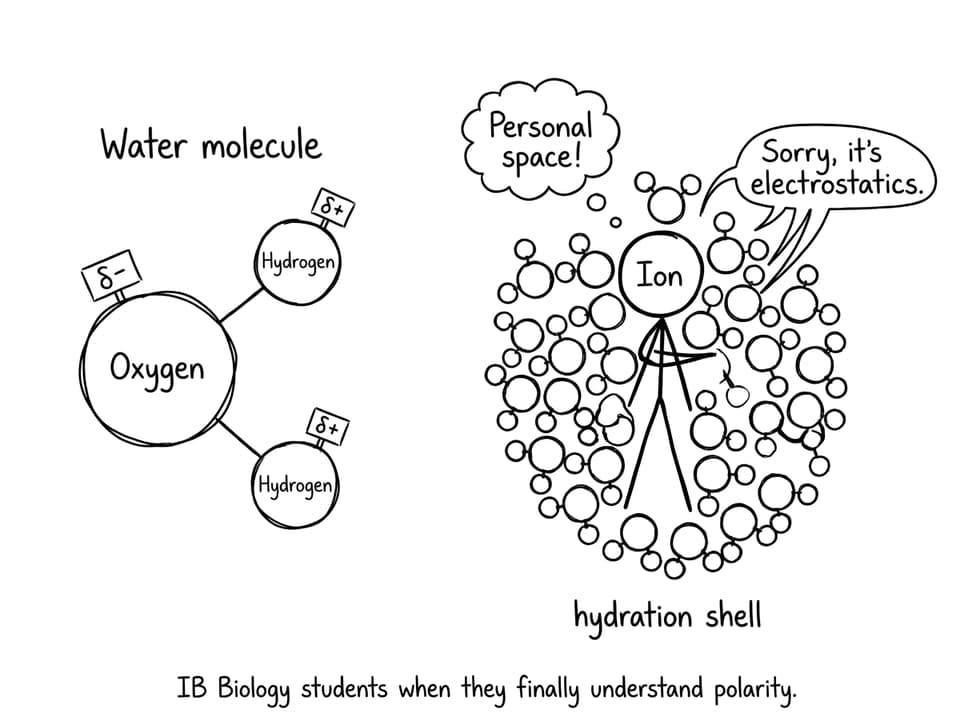
The reason starts with structure. Water is bent (about 104.5°), and oxygen is more electronegative than hydrogen. That unequal pull gives oxygen a partial negative charge (δ-) and the hydrogens partial positive charges (δ+). Those partial charges don’t cancel. So each molecule acts like a tiny magnet.
If you want the clearest polarity chain (a favorite in markschemes), review Hydrogen bonds as a consequence of polar covalent bonds (A1.1.2).
Hydration shells: the hidden mechanism behind “dissolves”
Students often write “water dissolves salt” and move on. But in IB Biology, the mechanism matters: hydration shells.
When an ionic compound (like NaCl) enters water, water molecules orient themselves around each ion. The δ- oxygen faces positive ions (like Na+). The δ+ hydrogens face negative ions (like Cl-). This surrounding layer prevents ions from snapping back into a crystal lattice. Result: the ions stay separated and mobile in solution.
Water also dissolves many polar molecules (glucose, amino acids, some vitamins) because hydrogen bonding and partial charges allow water to “grab” onto polar regions and keep them dispersed.
To revise this with exam-ready phrasing, use A1.1.5 Solvent properties of water as a medium for metabolism and transport (notes) and D2.3.1 Solvation with water as the solvent (notes).
Why “universal solvent” matters for cells, blood, and plants
The big IB Biology payoff is this: reactions and transport require molecules to move, collide, and interact. Water makes that possible.
In the cytoplasm, enzymes and substrates are surrounded by an aqueous environment, so diffusion happens fast enough to sustain life. In animals, blood plasma is mostly water, carrying glucose, hormones, ions, and wastes. In plants, xylem sap is water with dissolved minerals, moving from roots to leaves.
This is why water is constantly attached to high-frequency exam topics. For example, osmosis is basically water’s solvent behavior showing up at the membrane level. If you want a quick refresher that connects cleanly to transport questions, see What Is Osmosis for IB Biology and Movement of water molecules across membranes by osmosis (B2.1.5 notes).
The limit: water is not universal for nonpolar substances
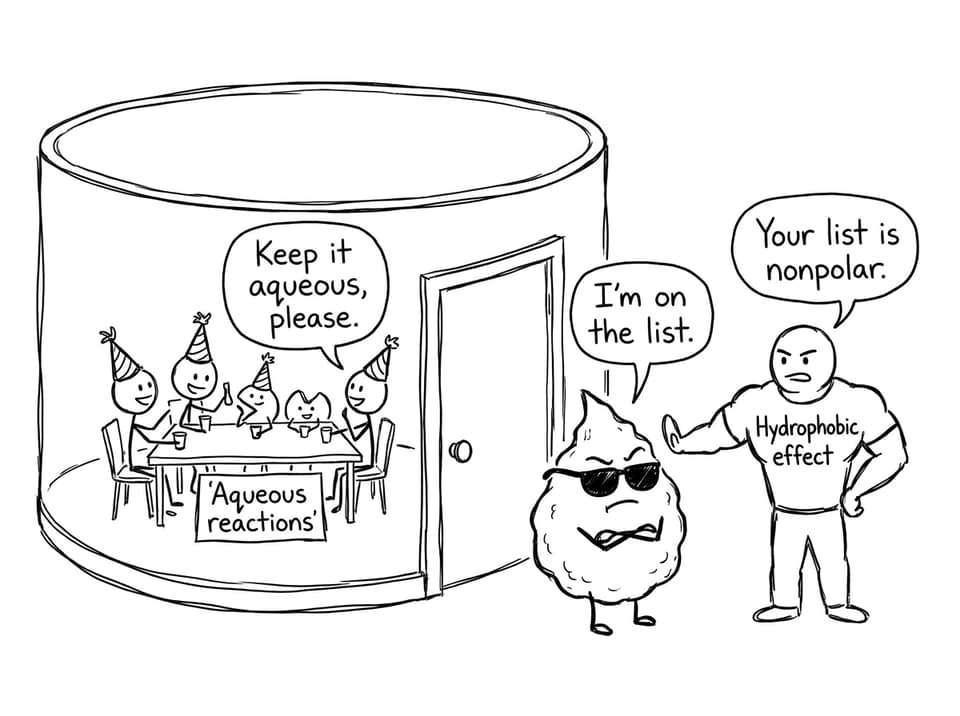
Here’s the boundary line you must state in IB Biology: water does not dissolve nonpolar substances well.
Oils and many lipids are nonpolar, so they can’t form favorable interactions with water. Instead, water forms hydrogen bonds with itself and effectively “pushes” nonpolar molecules together. This is tied to hydrophobic interactions, which help membranes form and proteins fold, but it also explains why oil and water separate.
To connect solvent properties to broader water behavior, How hydrogen bonding shapes water’s properties is a useful companion.
Study smarter: turn “universal solvent” into exam marks
The fastest way to improve your IB Biology answers is to turn this topic into a repeatable explanation: polarity, hydration shells, transport/metabolism, and limits with nonpolar molecules. RevisionDojo makes that repetition easier with syllabus-matched Study Notes, active recall Flashcards, and exam-style practice in the Questionbank with feedback. When it’s time to test yourself, you can use Mock Exams and Predicted Papers (without guessing what matters), and tighten your phrasing using AI Chat and Grading tools. If you’re stuck on how to structure a 6-7 mark response, the Tutors and Coursework Library can help you connect concepts to the way IB actually assesses them.
For a strong starting path, go from IB Biology Topic A1.1 Water to the A1.1 Water Questionbank and finish with A1.1 Water as the medium for life (notes). That’s how “water is the universal solvent” becomes something you can write confidently under timed conditions in IB Biology.