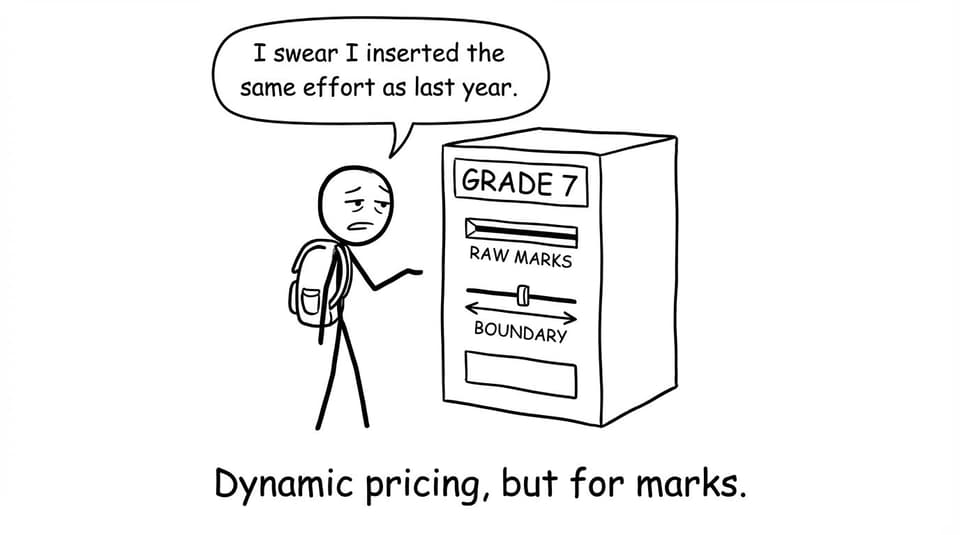

If you have ever stared at an IB results chart and thought, "Wait… last year a 7 was lower?" you are not imagining things. IB grade boundaries really do shift from session to session. And when you are the one sitting the exam, those shifts can feel personal -- like the ground moved under your feet.
But grade boundaries are not designed to punish you. They are designed to protect something quieter and more important: the meaning of your grade.
In this article, we will unpack why IB grade boundaries change every year, what actually drives those changes, and how you can revise in a way that stays strong even when the boundary moves.
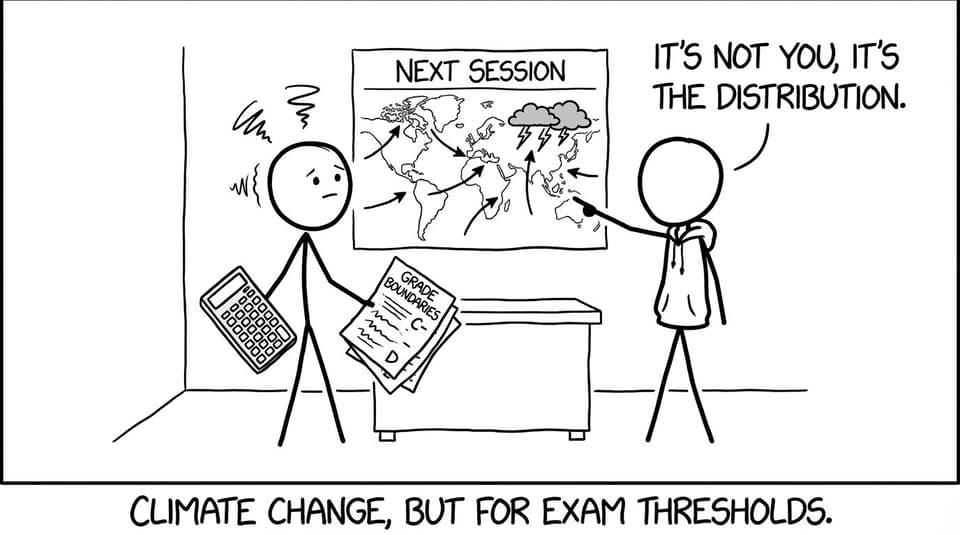
The quick checklist: what makes IB grade boundaries move?
Before we go deeper, keep this mental checklist. IB grade boundaries can change because:
- The exam paper was easier or harder than intended.
- The global cohort performed differently than expected.
- The IB needs to maintain consistent standards over time.
- Marking patterns and component performance (Paper 1 vs Paper 2 vs IA) shift.
- Small percentage changes in raw marks can cascade into a visible boundary change.
If you want to compare boundaries across sessions, start with IB Grade Boundaries and scroll through your subject.
What grade boundaries actually are (and what they are not)
In the IB, your final grade (1 to 7) is not just your "percentage." It is a conversion from raw marks to grade levels using boundaries.
A boundary is essentially a cut score: the minimum raw mark needed for a given grade in a specific session for a specific subject and level.
Two important clarifications for IB students:
- Grade boundaries are not a curve where a fixed percentage of students "must" get each grade.
- Grade boundaries are not fixed targets that stay constant year to year.
They are a tool for standard-setting: keeping a 6 in one session comparable to a 6 in another session.
If you want a concrete example of how detailed this gets, look at a subject-specific breakdown like IB English A Literature SL Grade Boundaries 2025 (TZ2).
The core reason: the IB is trying to keep grades meaningfully consistent
A grade is a promise.
When a university sees a 7 in IB Math AA HL, they assume a certain level of mastery. If one year's paper is unexpectedly difficult, then leaving boundaries unchanged would break that promise by turning a "hard year" into artificially low grades.
So the IB adjusts boundaries to stabilize standards.
This is why grade boundaries changing is not evidence of chaos. It is evidence of maintenance.
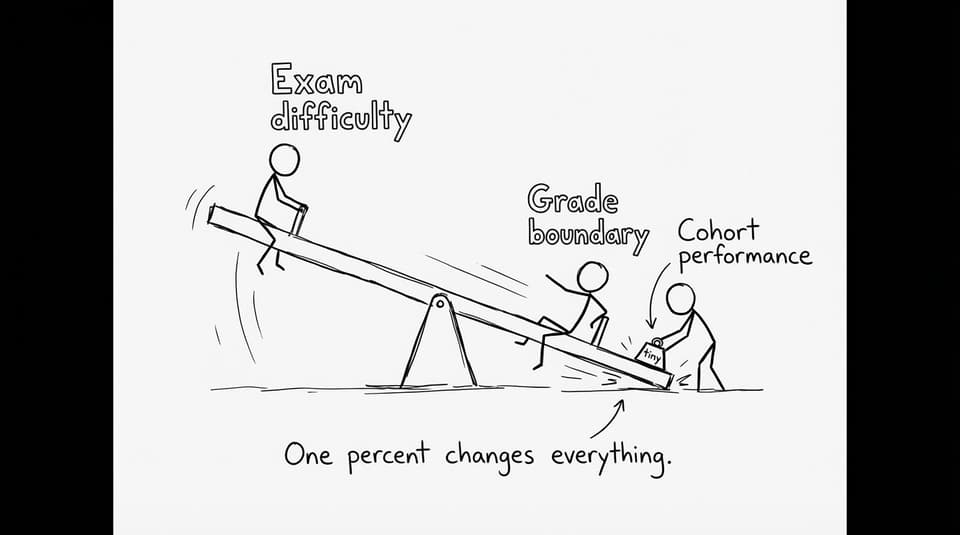
Exam difficulty shifts: the most obvious driver of IB grade boundaries
No matter how carefully examiners design a paper, difficulty is partly experienced, not just planned.
A paper can look balanced in a meeting room and still land differently when hundreds of thousands of IB students sit it under pressure.
Here is what can make a paper feel harder:
- Unfamiliar contexts (especially in sciences and math)
- A twist in the command term ("explain" vs "evaluate")
- Longer reading load (common in Group 3)
- More multi-step questions that punish small errors
And here is what can make it feel easier:
- More direct syllabus coverage
- More predictable question styles
- Mark schemes that allow more method marks
When the overall difficulty shifts, IB grade boundaries can shift with it.
If you want to stay resilient against difficulty swings, train with variety instead of repeating the same patterns. This is where Comprehensive IB Question Bank: Thousands of Practice Questions helps: variety in question style makes you less dependent on one "type" of paper.
Cohort performance: the quiet force that moves boundaries
Even if exam difficulty is stable, cohort performance changes.
Some years, the global group of IB students is stronger in a subject. Sometimes schools adopt better teaching sequences. Sometimes a syllabus section becomes more widely understood. Sometimes a session produces fewer "blank responses" because students are better trained to attempt.
All of that affects the distribution of marks.
This does not mean the IB is ranking students against each other in a simple curve. It means the IB is checking whether the paper produced marks that align with expected standards. If performance is unusually high or low, boundaries may move to keep the grade meaning stable.
A good way to observe this is to check a single subject over time, such as IB Mathematics: Applications And Interpretation Grade Boundaries.
Component weighting changes how boundary shifts feel
In many IB subjects, your final mark is a blend:
- multiple papers (different skills)
- an Internal Assessment (IA)
- sometimes an oral or practical component
If one component is unusually high-scoring (for example, an accessible Paper 1) while another is unusually harsh (for example, a demanding Paper 2), the final boundary can shift in ways that feel confusing.
Two takeaways for IB students:
- Do not judge difficulty from one paper alone.
- Your revision should cover skill types, not just content.
On RevisionDojo, this is easier to organize because you can split your practice by format: build topic drills in the Questionbank, then switch to full timing via Online IB Mock Exams: Practice Anywhere, Anytime.
Standard-setting: why "maintain standards" is not just a phrase
Here is the part most students never see.
After exams, senior examiners review scripts across grade ranges and ask a serious question: "Does this work look like a 4? Like a 6? Like a 7?" If the answer is "not quite," boundaries can be adjusted.
Think of it like calibrating a scale.
If the scale reads heavy today and light tomorrow, you do not blame the objects. You calibrate the scale.
The IB is doing something similar: trying to keep the meaning of performance stable even when the measurement environment changes.
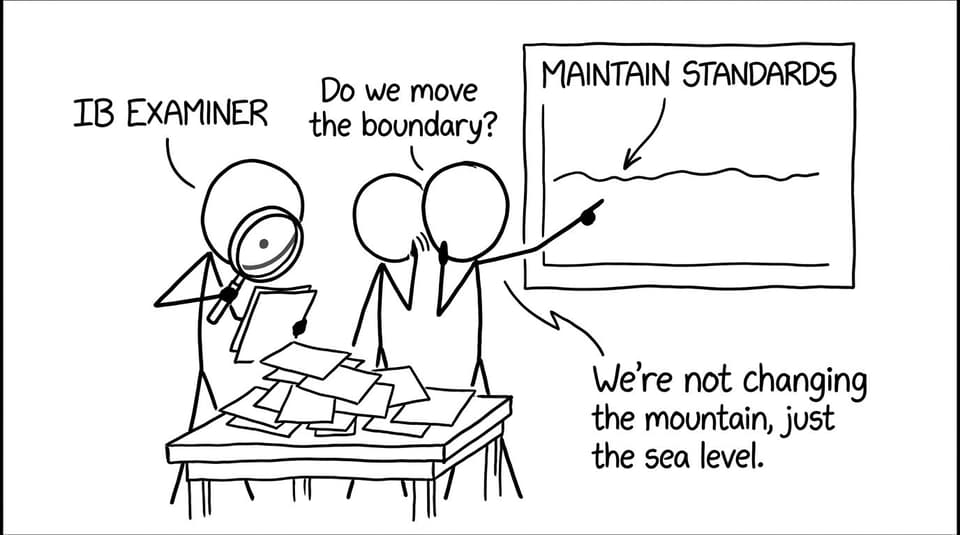
Why small changes can look dramatic to IB students
Grade boundaries often move by only a few marks.
But psychologically, that can feel enormous.
If a 7 boundary moves from 78 to 82, that is "just 4 marks." Yet in the IB, 4 marks can represent:
- one missed explanation
- two sloppy definitions
- one weak evaluation paragraph
- a single multi-mark calculation that went off the rails early
This is why high scorers tend to obsess over "small" habits: units, structure, command terms, and finishing the paper.
A good training approach is to build a feedback loop where you spot the marks you repeatedly lose. RevisionDojo's Grading tools and AI Chat make this faster because you can get immediate, criteria-aware feedback instead of waiting days.
If you want to see how the whole system fits together, use RevisionDojo App: The Smarter Way to Prep for IB Exams.
What you can control: preparing for IB when boundaries might move
Grade boundaries are out of your hands. Your training is not.
Here is a calm strategy that works even when IB grade boundaries shift.
Build "boundary-proof" performance
Boundary-proof performance means you aim for:
- consistent method marks
- clear structure in longer responses
- fewer avoidable errors
- strong time management
In practice, that looks like:
- Study Notes for fast clarity on a topic
- Flashcards for definitions, formulas, and key links
- Questionbank practice for pattern recognition
- Mock Exams for pacing and stamina
- Predicted Papers for realistic mixed practice
Start your overall hub at International Baccalaureate (IB).
Use grade boundaries as a measuring tool, not a prophecy
The healthiest way to use IB grade boundaries is to treat them like a speedometer.
They tell you how fast you are going right now. They do not predict the traffic next week.
So instead of saying, "The boundary might rise, so I'm doomed," say:
- "If I want a 6 regardless of the boundary, what raw mark buffer do I need?"
- "Where do I lose the last 5--10 marks?"
Then build targeted practice sets. A great starting point is Custom IB Question Banks: Focus on What You Need Most.
Simulate pressure early
Boundary shifts punish one thing more than anything else: fragile exam technique.
If you only practice untimed, you might "know" the content but leak marks under pressure.
Use timed simulations:
- run one timed set per week early
- increase frequency close to exams
- review errors for patterns, not just answers
If you need a step-by-step routine, follow How to Study for IB Exams: Step-by-Step Guide and add a weekly timed session.
Closing: treat IB grade boundaries like weather, not fate
There is a certain kind of freedom in understanding this.
IB grade boundaries change every year because the IB is trying to keep grades fair across different papers and different cohorts. It is not personal, and it is not random. It is maintenance.
Your move is simple: build the kind of preparation that does not depend on a perfect boundary.
That is what RevisionDojo is designed to support: Study Notes for fast clarity, Flashcards for daily recall, a Questionbank for targeted repetition, AI Chat when you are stuck, Grading tools for feedback, Predicted Papers and Mock Exams for realism, a Coursework Library for strong examples, and Tutors when you need a human explanation.
If grade boundaries feel like shifting weather, RevisionDojo is the shelter you can actually build.