


Fall burnout hits IB students because pressure rarely arrives as one dramatic event. It accumulates. New classes become difficult, early tests expose gaps, coursework milestones overlap, and routines that felt sustainable in September begin borrowing energy from October.
The IB Diploma Programme adds another layer. Students manage six subjects alongside internal assessments, the Extended Essay, Theory of Knowledge, CAS, applications, activities, and school-specific deadlines. The official programme is demanding, but each school's autumn calendar differs. Local planning matters.
The answer is not simply to work harder. It is to identify workload collisions early, protect recovery, and replace vague studying with small tasks that produce visible progress.
The fall burnout checklist
Before assuming you have become lazy or unmotivated, ask:
- Are coursework, tests, and application deadlines clustered together?
- Has work lost a clear stopping point at night?
- Are you rereading without testing what you remember?
- Do small assignments feel unusually difficult to begin?
- Have meals, exercise, friends, or genuine downtime disappeared?
- Are you exhausted, detached, or convinced effort no longer matters?
One difficult week is not automatically burnout. Persistent exhaustion, detachment, and a reduced sense of effectiveness are more concerning, particularly when rest no longer helps. RevisionDojo's guide to recovering from IB burnout explains how to respond when temporary pressure becomes a pattern.
Why fall burnout hits IB students unexpectedly
September can create false confidence. Deadlines look distant, motivation is high, and students plan around their best energy rather than their normal energy.
October changes the arithmetic. A task called “work on the IA” actually involves research, data collection, analysis, drafting, feedback, and revision. An Extended Essay milestone competes with a test, while CAS and university applications continue consuming time.
By November, unfinished work begins charging interest. Each delayed task reduces the time available for the next one. The emotional burden grows because the student must repeatedly decide what to neglect.
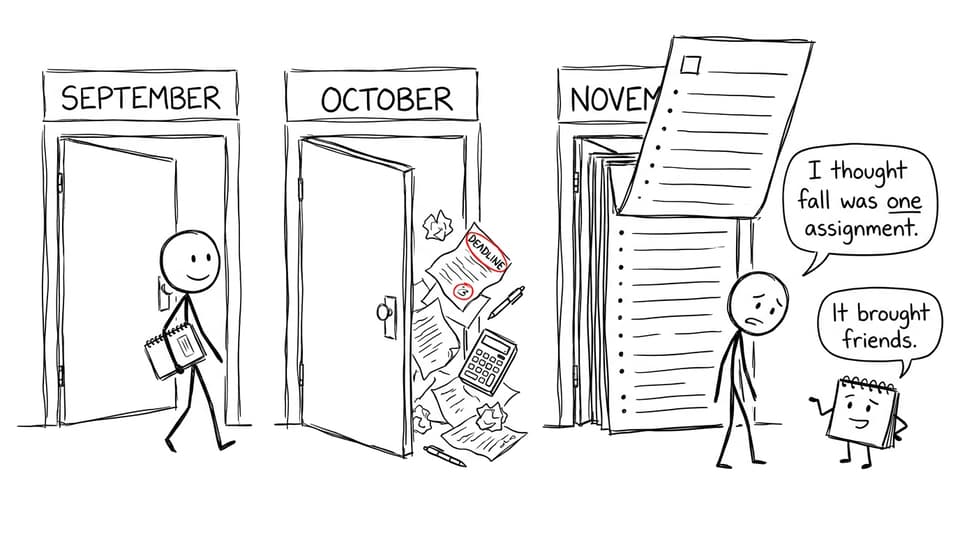
There is no single universal autumn deadline. Schools set many internal milestones themselves. The deeper problem is concurrency: several legitimate responsibilities become urgent together. An IB deadline management system reveals those collisions before they become emergencies.
How September-November pressure changes
| Period | Typical pressure | Best response |
|---|---|---|
| September | New routines and underestimated difficulty | Build one calendar and measure realistic capacity |
| October | Assessments, coursework, activities, and applications overlap | Convert open-ended work into specific outputs |
| November | Sleep loss, unfinished drafts, and fading motivation | Triage commitments and restore recovery |
September is for measuring capacity
Record school, travel, activities, coursework, revision, meals, and sleep for seven days. If your schedule only works when every evening goes perfectly, it does not work.
Create one calendar containing tests, IA checkpoints, EE and TOK milestones, CAS, applications, and personal events. Seeing crowded weeks early gives you time to negotiate, reduce optional commitments, or work ahead. These time-management strategies for IB students offer a practical setup.
October is for narrowing the next action
“Revise Biology” has no finish line. “Answer 12 cell respiration questions and record three errors” does. Spend a short period clarifying one concept, complete targeted questions, review mistakes, and write tomorrow's first task.
RevisionDojo keeps that loop together. Study Notes provide clarification, Flashcards support retrieval, and the Questionbank turns understanding into evidence. AI Chat can explain a specific step before confusion consumes an evening.
Give coursework equally clear edges. Replace “finish IA” with “draft the method paragraph” or “label two graphs.” The IA time-management guide helps divide an intimidating deadline into staged outputs.
November is for protecting the system
When schedules break, students often work later. Yet sleep loss can weaken attention, emotional regulation, and learning, causing the same work to take longer tomorrow.
Teenagers aged 13-17 are generally advised to obtain 8-10 hours of sleep daily. Set a stopping point, prepare tomorrow's first action, and return unfinished tasks to the calendar rather than carrying them mentally into bed. This IB sleep routine provides a useful structure.
Use three-level triage when everything feels urgent
When the calendar is crowded, sort work into three levels. First, place tasks with fixed near-term consequences, such as tomorrow's test, a teacher checkpoint, or an application submission. Second, protect important work that becomes dangerous if ignored, such as collecting IA data or drafting an EE section. Third, list flexible tasks and optional commitments that can move.
Then estimate the smallest acceptable outcome for each priority. A polished two-hour plan may be impossible, but 25 focused minutes can still produce a graph, an outline, or a set of corrected questions. This is not permission to lower standards forever. It is a way to preserve momentum while capacity is temporarily limited.
Tell teachers early when two school deadlines collide. Ask what is fixed, what can be staged, and what evidence of progress they need. Do not promise a heroic recovery weekend. Put one buffer block into the week instead. A plan becomes trustworthy when it includes room for illness, difficult homework, and ordinary human fatigue.
Build a week that survives disruption
Choose three weekly academic priorities. Reserve fixed coursework blocks, one buffer block, and a substantial period without academic work. Maintain other subjects through short Flashcard sessions, and review your calendar at the same time each week.
For coursework, RevisionDojo's Coursework Library can clarify structure without replacing independent work. Grading tools can flag possible rubric gaps, although teachers remain the authority on requirements. Treat the IB Coursework Grader as diagnostic feedback, not an official mark.
Use Mock Exams and Predicted Papers for controlled practice, not exhausted late-night reassurance. If a misunderstanding keeps returning, RevisionDojo Tutors can provide human explanation and accountability.
Know when planning is not enough
Speak to a trusted adult, teacher, counsellor, doctor, or mental health professional if exhaustion, anxiety, low mood, withdrawal, or sleep disruption persists and interferes with daily life. Seek urgent local help if you feel unsafe or might harm yourself. RevisionDojo's IB stress management guidance can support everyday coping, but it cannot replace professional care.
A calmer route through autumn
The hardest part of the IB fall term is often the delay between effort and reassurance. Build shorter feedback loops instead: learn one concept, retrieve it, apply it, check the result, and choose the next action.
RevisionDojo brings those steps into one IB resource. Autumn becomes more manageable when progress is visible, recovery is planned, and your system still works on an ordinary Tuesday.