


If you have ever promised yourself you would “start the IA this weekend,” you already know the trap: weekends don’t start work, systems do.
The IA (Internal Assessment) isn’t hard because you can’t do it. It’s hard because it competes with everything else in the IB universe: tests that appear overnight, CAS that somehow needs photos, and exam prep that feels urgent even when it isn’t. Then one day you check the calendar and realize your IA isn’t a project anymore. It’s a deadline.
This guide is a calm plan for finishing your IA on schedule without turning your life into a constant guilt spiral. You’ll build a timeline that survives real weeks, use focus strategies that actually work, and leave space for revision (the part that quietly earns marks).
IA time management quick checklist
Keep this short list visible while you work on your IA:
-
Break the IA into stages with mini-deadlines (not one giant deadline)
-
Work backwards from your real school due date
-
Protect 2-4 weekly IA sessions like fixed appointments
-
Build in a buffer week for feedback and polishing
-
Use exemplars and rubrics early so you don’t rewrite later
When you need models of what “finished” looks like, open RevisionDojo’s coursework exemplars and compare structure, depth, and presentation.
Why the IA slips (and how to stop the slide)
Most students don’t fall behind on the IA because they are lazy. They fall behind because the IA is a long project in a schedule designed for short tasks.
Short tasks give you immediate closure: finish a worksheet, submit, done. The IA gives you ambiguity: even after two hours, it can still look unfinished. Your brain dislikes that. So you drift toward tasks that provide quick relief.
The fix is to make your IA produce visible outputs every week. Not “work on IA.” Outputs. A refined research question. Cleaned data. One drafted method paragraph. A graph with labels. Those small completions create momentum that compounds.
If you want a deeper system for IB-wide planning, pair this article with time management in IB: tools and techniques that actually work.
Break your IA into stages that can’t hide
A strong IA is usually built in predictable phases. The subject details differ, but the time logic stays similar:
Define and shrink the problem
-
Topic choice and feasibility check
-
Research question (or aim) locked
-
Success criteria: what you must show to earn marks
If you’re unsure what examiners reward, read what IB examiners look for in a strong IA before you add more pages.
Collect what you need
-
Data collection, sources, or artefacts
-
Methodology written while it’s fresh
-
A running log of decisions (so you don’t forget why you did things)
Build the analysis
-
Calculations, processing, graphs/tables
-
Interpretation tied back to the research question
-
“So what?” statements, not just description
Evaluate and conclude
-
Limitations and improvements
-
Validity discussion (what could distort results?)
-
Conclusion that directly answers the research question
Polish for submission
-
Criterion alignment check
-
Formatting, citations, labels, appendices
-
Proofreading for clarity and concision
For the last stage, keep how to proofread and polish your IA before submission open while you edit.
Build a realistic IA timeline (work backwards)
A timeline works when it matches your life, not your fantasy self.
Start with your school submission date. Work backwards and assign mini-deadlines to each stage. Then add one more rule: every mini-deadline must produce something you could show a teacher.
A simple six-week example (adjust to your schedule):
-
Week 1: Research question locked + outline
-
Week 2: Data/sources collected + method drafted
-
Week 3: Main analysis drafted (graphs/tables included)
-
Week 4: Evaluation + conclusion drafted
-
Week 5: Full draft assembled + feedback requested
-
Week 6: Revision, formatting, final checks, submission
If you’re wondering what “enough time” looks like overall, use how much time should I spend on my IA? to estimate hours, then spread them across weeks.
Use focus methods that protect your attention
Time management for the IA is less about willpower and more about controlling context switching.
Time boxing (the most underrated strategy)
Schedule IA sessions in your calendar like a class period. You are not deciding whether to work; you are deciding what to do inside the block.
A sustainable pattern for most students:
-
3 sessions/week
-
45-60 minutes each
-
one “admin” session for citations/formatting so it doesn’t leak into writing time
Pomodoro, but with one upgrade
Use 25 minutes on, 5 minutes off. The upgrade is a “start ritual” that takes 60 seconds: open the document, write one sentence you’re sure is true, and only then begin.

Batch tasks to avoid mental whiplash
Your IA contains different kinds of thinking: writing, calculations, formatting, reading. Switching between them costs energy.
Try batching:
-
One session for graphs and tables
-
One session for writing analysis paragraphs
-
One session for citations and layout
If you want a subject-specific version of this approach, the principles in how to manage time effectively when writing the IB Math IA translate well to most IAs.
Beat IA procrastination with “tiny next steps”
Procrastination usually means the next action is unclear, too big, or emotionally annoying.
Instead of “do IA,” define a next step that is embarrassingly small:
-
“Write the aim in one sentence.”
-
“Create the table template with headings.”
-
“Clean the dataset column names.”
-
“Draft one limitation and one improvement.”
Then make a deal with yourself: stop after 10 minutes if you want. Most of the time, you won’t.
For a realistic view of what procrastination is normal (and what becomes risky), read how much procrastination is allowed when doing an IA?.
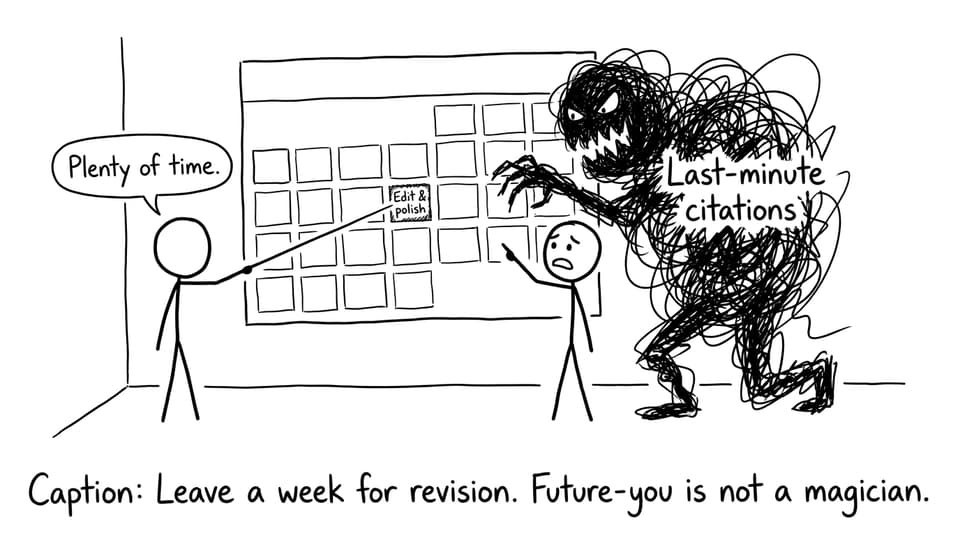
Leave a week for revision (because marks live there)
Many students plan to “edit at the end,” but the end arrives with surprise tests and exhaustion.
A better plan: reserve a full week where the IA is no longer being written, only improved. That week is for:
-
Checking every section against the rubric
-
Tightening analysis and cutting filler
-
Fixing units, labels, uncertainty, and presentation details
-
Making citations consistent and easy to verify
Use RevisionDojo to keep your IA on schedule (without sacrificing exams)
The hidden fear is that the IA will consume your exam prep. You can prevent that by using tools that reduce guesswork.
-
Use the Coursework Exemplars library to calibrate what “good” looks like early, so you don’t overbuild.
-
Use RevisionDojo’s Grading tools to spot rubric gaps before you rewrite whole sections.
-
Use AI Chat when you’re stuck choosing between two options, narrowing scope, or rewriting unclear analysis.
-
Keep your exam routine alive with Study Notes, Flashcards, and the Questionbank so the IA doesn’t quietly steal your entire semester.
-
When you need realism, simulate pressure with Mock Exams and Predicted Papers (so your timing doesn’t fade).
-
If you need a human to help lift the ceiling, use Tutors for targeted feedback.
If you want a broader IB time strategy that supports coursework and exams together, see best time management techniques for IB students in 2025.
Conclusion: your IA finishes on time when it becomes a system
A finished IA is rarely the result of one heroic weekend. It’s the result of small, scheduled sessions that produce visible outputs, a timeline built backwards from reality, and a protected revision week.
If you want the fastest way to make your IA feel manageable, start with RevisionDojo’s coursework exemplars to see what “good” looks like, use Grading tools to aim your effort, and keep exam prep steady with Study Notes, Flashcards, Questionbank, Mock Exams, and Predicted Papers. Then, if you need help at any point, bring in AI Chat or Tutors before the deadline makes decisions for you.
Your IA doesn’t need more panic. It needs a plan you can repeat.