

IB History has changed (and that is good news)
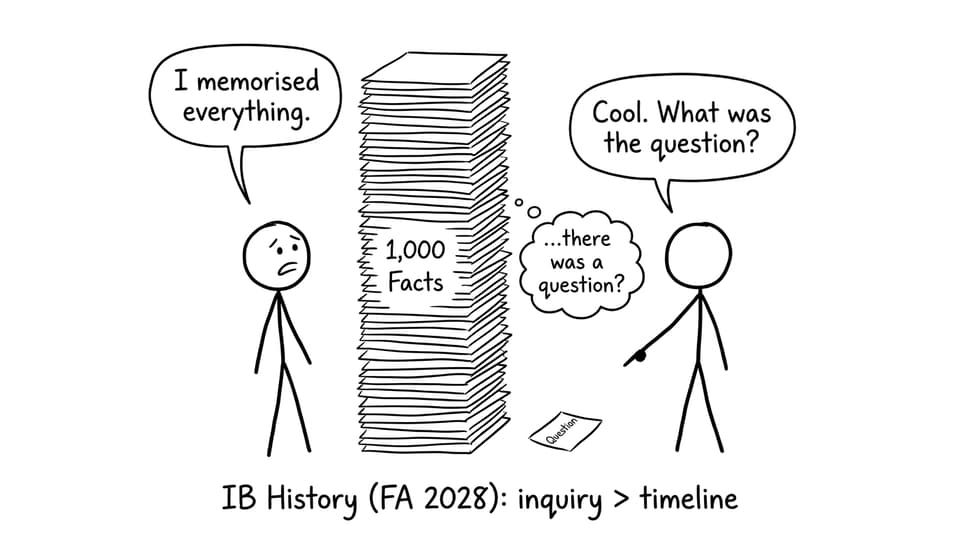
The night before a history test, most students do the same thing: they build a timeline, highlight it twice, and hope their memory holds.
But IB History under first assessment 2028 is quietly refusing that bargain. The new course still respects knowledge, but it rewards something rarer: the ability to turn knowledge into judgement. If that sounds abstract, it is because it is a different kind of difficulty--less about carrying facts, more about using them.
This guide breaks down what IB History is now, what “historical inquiry” actually means in practice, and how you can prepare for exams without studying in circles.
Quick checklist: what to understand early
If you want a fast starting point for IB History, make sure you can answer these before you go deep into content:
-
Can I explain what “historical inquiry” means without using the word “research”?
-
Do I know which skills (not just topics) are assessed?
-
When I write, do I argue--or do I narrate?
-
Can I evaluate perspectives, not just mention them?
-
Do I practice under time, with feedback, often?
A helpful home base while you build these habits is the IB History resources hub, where you can move between notes, questions, flashcards, and exam practice in one place.
What is IB History under the new course (first assessment 2028)?
At its core, IB History is a course in thinking historically. The redesigned curriculum makes that intent harder to miss. You are expected to approach the past like a problem you can investigate, not a story you can retell.
That shift shows up in what gets credit:
-
Clear, focused answers to the question asked
-
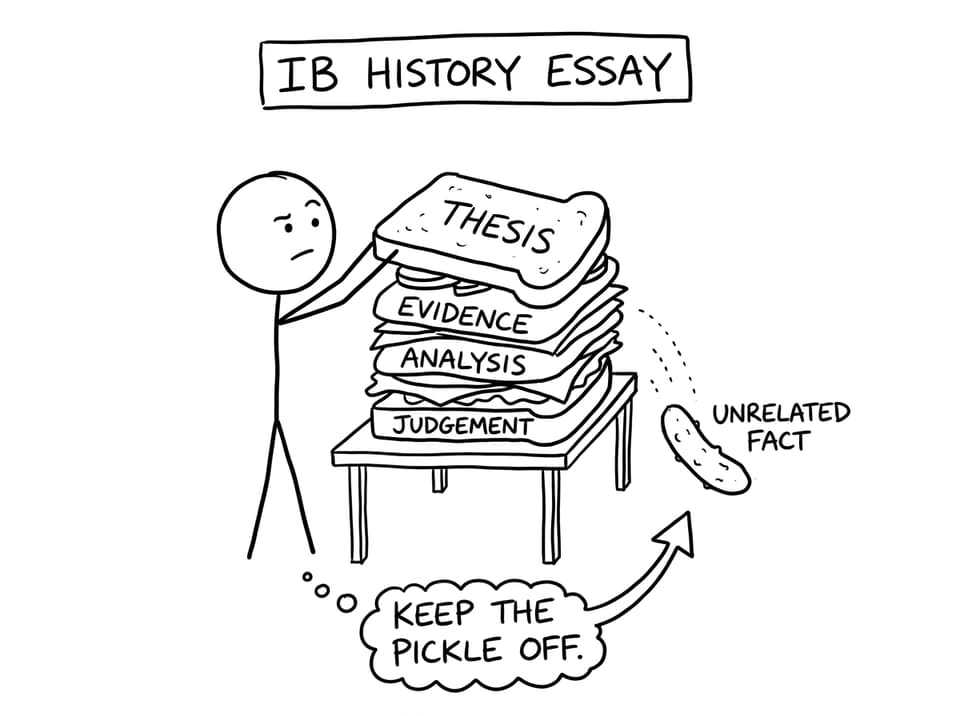
Selective evidence (a few well-chosen facts beat a flood of vaguely related ones)
-
Analysis of causation, consequence, change/continuity, and significance
-
Comparison and synthesis across contexts
-
Evaluation of perspectives and interpretations
So yes, facts still matter in IB History. But facts are now treated like tools. A tool left on the table does not earn marks.
If you want to see how this plays out in timed exam writing, keep IB History exam prep: a comprehensive guide open while you revise--it maps skills to what the papers actually reward.
Historical inquiry: what it means when you are the student
“Historical inquiry” can sound like something you do in a library with a tweed jacket. In IB History, it is simpler and more practical.
Historical inquiry means:
-
You start with a question (not a topic)
-
You choose evidence that answers that question
-
You interpret the evidence with a concept (cause, significance, perspective)
-
You acknowledge uncertainty and alternative readings
-
You reach a reasoned conclusion (a judgement you can defend)
That is why memorised essays feel weaker under the new course. A memorised essay is usually built around what you know. Inquiry is built around what the question demands.
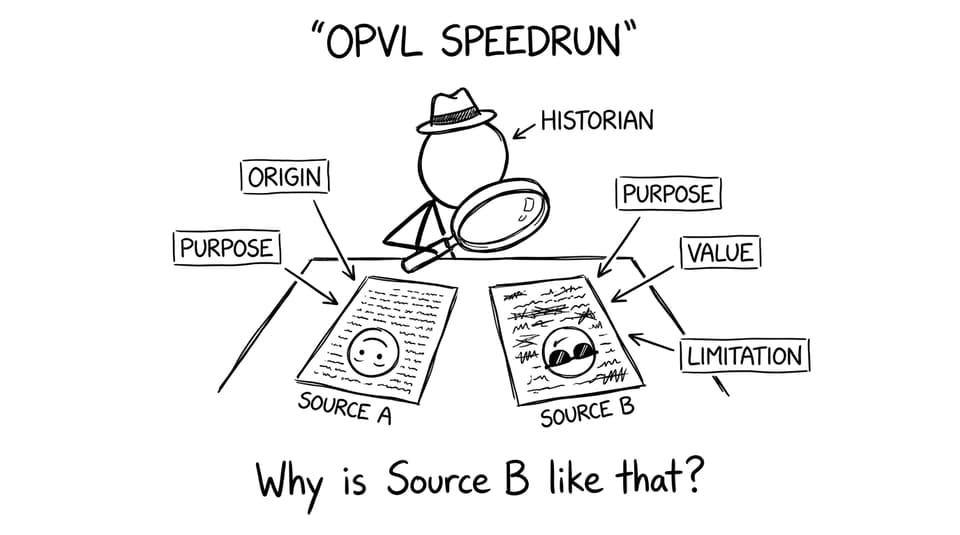
For source-focused training, the IB History Paper 1: Conflict and Intervention pathway is a good example of how RevisionDojo structures the skill: learn, practice, get feedback, repeat.
What has changed in IB History for first assessment 2028?
Students sometimes hear “new syllabus” and assume it means new topics. The more important change for IB History (FA 2028) is that the assessment signals are clearer and less forgiving.
Expect a stronger emphasis on:
Concepts over chronology
Chronology helps you avoid nonsense. But marks come from conceptual control: explaining why events unfolded, what changed, what stayed stable, and what mattered.
Comparison and synthesis
Rather than treating each case study like an island, IB History pushes you to connect patterns across regions and periods. That is where higher-level analysis lives.
Evaluation as a habit, not a paragraph
Many students leave evaluation for the conclusion. Under the new course, you want evaluation threaded throughout: weighing factors, qualifying claims, and showing why one interpretation is more convincing.
To build this systematically, pair timed practice with targeted drills from RevisionDojo’s Questionbank. The fastest improvement comes from short, repeatable loops: attempt, feedback, fix, retest.
IB History is global (so your explanations must be, too)
A defining feature of IB History is its global posture. Even when you study a specific region, the course encourages you to resist narrow explanations.
Practical ways this shows up in strong answers:
-
You avoid single-cause arguments when systems interact
-
You consider how perspectives differ across groups (elite vs popular, coloniser vs colonised, urban vs rural)
-
You can compare how similar forces produce different outcomes in different contexts
If you are studying Paper 1 content, try the IB History Paper 1: The Move to Global War track and notice how questions force you to interpret evidence, not just recognise it.
What success in IB History looks like (in one paragraph)
A high-scoring IB History response does three things calmly: it answers the question directly, it proves claims with selective evidence, and it keeps evaluating the argument’s strength. It does not panic-dump facts. It does not wander into a different question. It makes a judgement that feels earned.
If this is not yet your default, you are not behind. You just need the right practice structure. The article How to ace IB History Paper 1 and Paper 2 exams is a useful blueprint for building that structure.
How RevisionDojo supports IB History (FA 2028)
The hardest part of IB History is not effort. It is misdirected effort: rereading notes when you needed to write, highlighting when you needed feedback, memorising when you needed judgement.
RevisionDojo is built to reduce that waste:
-
Study Notes to learn content quickly and accurately (then move on)
-
Flashcards to keep key terms, case studies, and concepts alive through active recall (see an example set like India Flashcards)
-
Questionbank with exam-style prompts and feedback loops
-
AI Chat to explain confusing perspectives, command terms, and source inference without derailing your study session
-
Grading tools to show why an answer earns marks (and why it does not)
-
Predicted Papers and Mock Exams to rehearse timing and decision-making under pressure (start with History Predicted Papers)
-
Coursework Library for models and clarity when IA/EE stress competes with revision (see IB History Examples)
-
Tutors when you need a human diagnosis of what is holding your essays back
If you have ever felt that IB History is “unpredictable,” the piece Why students struggle with IB History is worth reading--it names the patterns that quietly cap grades.
Final thoughts: treat IB History like a craft
The new IB History course (first assessment 2028) is not asking you to remember more. It is asking you to think better with what you remember.
If you build your routine around inquiry--question focus, selective evidence, evaluation, and timed practice--IB History becomes predictable in the best way: you can see exactly how marks are earned. Start with the IB History resources hub, then use Questionbank practice, AI feedback, and predicted exam simulations to turn understanding into scores.