
The calendar confusion every IB student knows
There’s a specific kind of panic that only happens in the IB.
It starts with a harmless sentence from someone who sounds confident: “The EE guide changed.”
Then your brain does what brains do under stress. It opens twenty tabs. It searches for a date. It finds three different answers. And suddenly you’re wondering if the EE you started planning months ago is about to be marked by a rubric you’ve never seen.
If that’s you, breathe.
The easiest way to understand the new EE changes is to stop thinking like a student and start thinking like an examiner: what matters is the assessment session your Extended Essay is submitted for.
In this guide, we’ll make the timeline simple, give you a fast checklist, and show you how to protect both your EE and your exam prep without letting either one consume the other.
Quick answer: the new EE guide applies from May 2027 submissions
Here’s the clean rule you can trust:
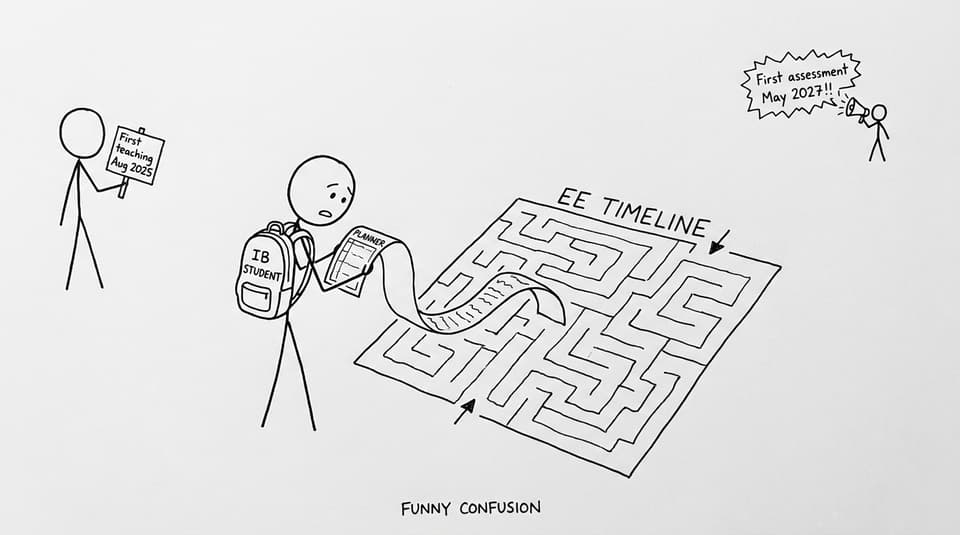
- The revised EE guide was published in February 2025.
- First teaching began in August 2025.
- First assessment is May 2027.
- Students submitting their EE in or after May 2027 must follow the new guide.
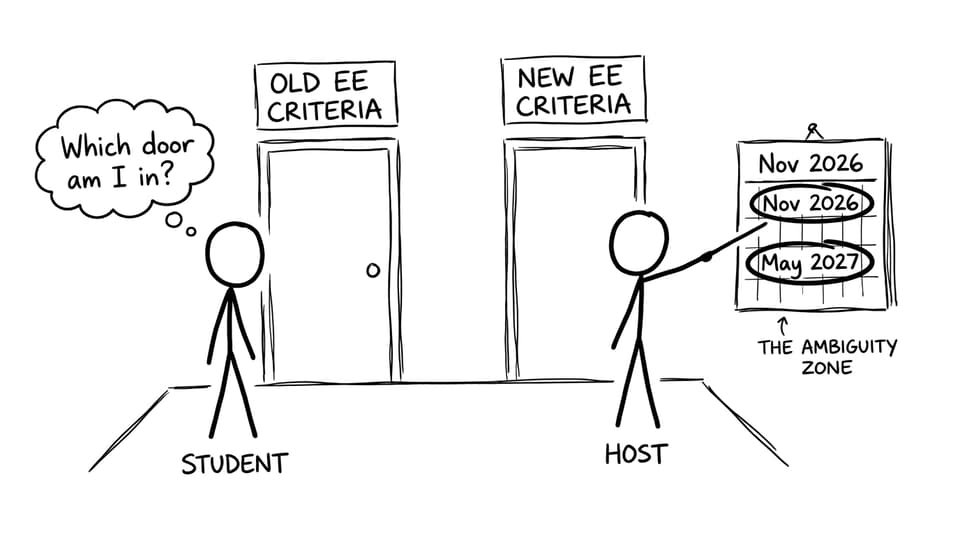
- The final cohort assessed under the old criteria submitted in November 2026.
In other words: submission date is the deciding factor.
If you want a broader Extended Essay foundation (structure, criteria logic, and how to score well), start with RevisionDojo’s dedicated hub: IB Extended Essay Guides.
The EE timeline, explained like a real-life story
Imagine two students in the same school.
One is a classic early starter. They sketch a research question in DP1, collect sources, and write half a draft long before anyone else.
The other is a slow builder. They take longer to choose a topic. Their best thinking happens later, after they’ve actually learned more of the course.
Now the twist: their start date doesn’t matter nearly as much as their submission date.
Because the EE isn’t assessed when you begin. It’s assessed when it enters an assessment session.
So when your school asks, “Which guide are you using?” they’re really asking:
- When will your EE be submitted for assessment?
That’s why the dates above are everything.
A simple checklist: which EE guide do you follow?
Use this as your quick decision tool.
If your EE is submitted in November 2026
- You are in the final cohort assessed under the old criteria.
- Your job is to finish strongly, using the old descriptors consistently.
If your EE is submitted in May 2027 or later
- You must follow the new EE guide.
- Treat the new guide as your reference point for structure, expectations, and criteria language.
If you’re not sure
- Ask your IB coordinator: “Which assessment session is my EE registered under?”
- Then align everything (outline, reflections, final checks) to that session.
For practical drafting support, it helps to anchor your process in proven structure: How to Format Your EE According to IB Guidelines.
Why the dates matter more than the rumors
When IB updates a core component like the EE, the change doesn’t flip on like a light switch.
It rolls in across time, because schools need space to:
- train supervisors
- update internal deadlines
- revise support materials
- adjust how students are introduced to the EE process
That’s what “first teaching” is doing in the timeline. It’s the start of schools teaching the new approach (August 2025), not the moment every student on earth is suddenly assessed differently.
“First assessment” (May 2027) is the moment the new criteria become real in marking.
So when you hear:
- “The EE changed this year,”
the correct response is:
- “Changed for which assessment session?”
That one question saves you hours.
What should you do right now as an IB student preparing for exams?
If you’re reading this while also thinking about exams, you’re not alone. Most students don’t struggle because they can’t work hard. They struggle because two important things compete for the same limited attention: the EE and exam preparation.
Here’s a calm way to handle it.
Keep your EE plan tight and criterion-led
If you’re under the old criteria (Nov 2026 submission), don’t rewrite your whole approach because you saw “new guide” on someone’s TikTok summary.
If you’re under the new criteria (May 2027+ submission), don’t guess what “good” looks like. Make it visible.
Two RevisionDojo resources make this easier:
- Use the IB EE Feedback Tool to translate criterion language into concrete revision targets.
- Browse models in the IB Coursework Examples: IA, EE and TOK Exemplars so your expectations stop being imaginary.
Build an “EE maintenance” routine (so it doesn’t eat exam season)
Try this weekly rhythm:
- 1 focused EE block (60-90 minutes): outline, evidence, or one section rewrite
- 1 feedback loop (30 minutes): run a rubric check, list top 3 fixes
- Stop. Save your energy for exam performance.
If you need fast, rubric-aware feedback, RevisionDojo’s IB Coursework Grader is designed for exactly that loop.
How to avoid the most common EE timing mistakes
Most EE problems don’t come from students being “bad at writing.”
They come from misalignment: doing good work under the wrong assumptions.
Mistake: assuming the change applies because you started after Feb 2025
The revised guide being published in February 2025 does not automatically mean your EE is assessed under it.
Your assessment session is the key.
Mistake: trying to hedge by writing “for both rubrics”
This usually creates a draft that feels unfocused.
The EE rewards clarity. You want one set of expectations, one set of criteria, one coherent plan.
Mistake: leaving reflections until the end
Reflections are not a formality. They are an assessed part of the EE experience.
If you want a strong approach, read: How Reflection Strengthens Your IB Extended Essay.
Mistake: fixing format instead of fixing analysis
Many students polish presentation because it’s controllable.
But marks usually leak from analysis, argument shape, and evidence use.
If your draft feels descriptive, use: How to Make Your IB Extended Essay Analytical, Not Descriptive.
How RevisionDojo fits into a smarter EE + exams system
The best IB students aren’t the ones who “never get stressed.” They’re the ones who build systems that keep stress from steering the wheel.
RevisionDojo is built to be that system.
- Questionbank to turn studying into marks (not just reading).
- Study Notes to patch gaps quickly.
- Flashcards to keep recall strong when your schedule gets messy.
- AI Chat to get unstuck fast when your argument or method feels foggy.
- Grading tools (Coursework Grader) to shorten the feedback cycle on your EE.
- Coursework Library to see what strong exemplars look like.
- Predicted Papers and Mock Exams to make exam conditions familiar.
- Tutors when you need a human to help you choose a direction.
If you want the big-picture workflow for balancing everything, this article is a solid reference: RevisionDojo App: The Smarter Way to Prep for IB Exams.
Closing: treat the EE change like a boundary, not a threat
The new EE changes aren’t a trap. They’re just a boundary on a timeline.
Remember the rule: students submitting their EE in or after May 2027 must follow the new guide, and the final cohort assessed under the old criteria submitted in November 2026.
Once you know which side you’re on, your next move is simple: align to the right guide, build a small weekly EE maintenance habit, and protect your exam prep like it’s non-negotiable.
If you want one place to do that without juggling ten resources, build your system in RevisionDojo: use the Coursework Grader for fast rubric feedback, the Coursework Library to see what strong work looks like, and your daily exam engine (Questionbank, Study Notes, Flashcards, AI Chat, Predicted Papers, Mock Exams, Tutors) to keep momentum.
Start here when you’re ready: IB Extended Essay Guides.