


Introduction
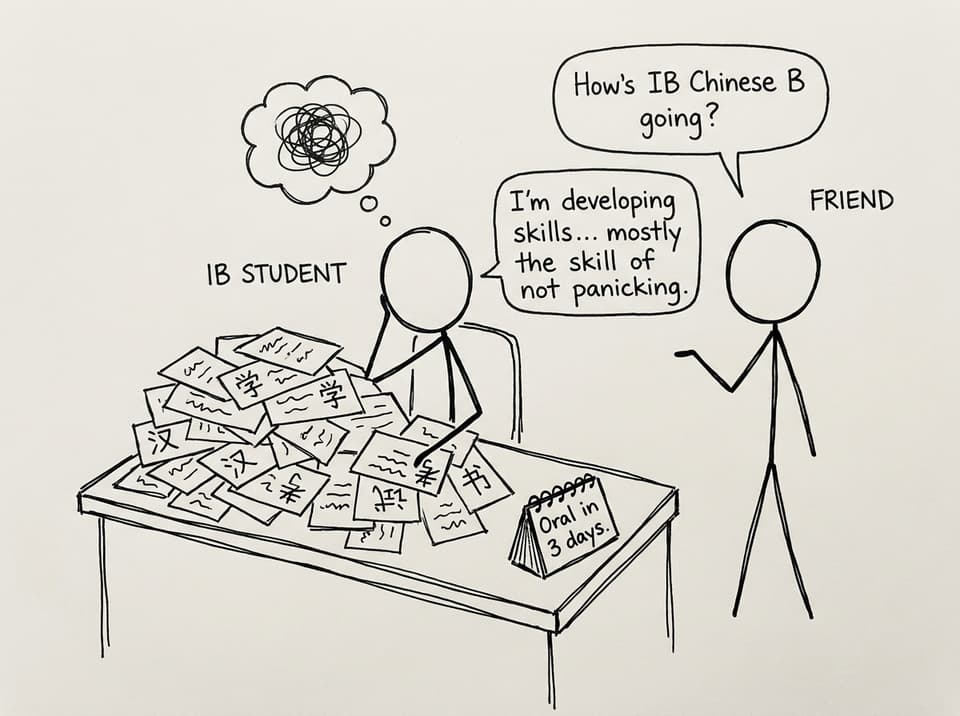
The first time you realise IB Chinese B is not “just vocab,” it usually happens in a moment of pressure: an audio clip moves on before you finish decoding a phrase, or the Individual Oral turns into a real conversation and your memorised sentence refuses to show up.
That’s the quiet genius of IB Languages. They don’t reward the student who knows the most words in isolation. They reward the student who can use language to think, connect, and respond like a calm human under time limits.
So what skills does IB Chinese B develop, really? The answer is bigger than Mandarin. Over two years, you build a toolkit of academic, intercultural, and personal skills that transfer to other subjects and to life. And if you’re preparing for exams, those skills also map directly onto what the papers and the oral actually assess.
Quick overview checklist (save this)
If you’re studying IB Chinese B, you are developing these high-impact IB Languages skills:
-
Receptive communication: reading and listening for meaning, not perfection.
-
Productive communication: writing and speaking with purpose, register, and clarity.
-
Intercultural understanding: seeing how culture shapes language (and vice versa).
-
Critical thinking: inference, tone, bias, and perspective across texts.
-
Exam execution: planning, time control, and error-repair habits.
-
Confidence under uncertainty: adapting when you don’t know a word.
RevisionDojo’s IB Chinese B hub is useful here because it keeps all four skills in one workflow: Questionbank practice, Study Notes, Flashcards, AI Chat, Grading tools, Predicted Papers, Mock Exams, Coursework Library, and Tutors when you want human feedback.
The core academic skills IB Chinese B develops
Communication skill across the four modes (the real engine of IB Languages)
IB Chinese B trains you in the same four-skill cycle that defines most IB Languages:
-
Reading: extracting main ideas, detail, and implied meaning from authentic-style texts.
-
Listening: following a moving target (accents, speed, tone, implied attitude).
-
Writing: producing a text that fits a purpose (and a text type) under time pressure.
-
Speaking: being understood, staying coherent, and repairing meaning when you slip.
A good way to feel this clearly is to study with the exam structure in mind. If you want the component-by-component breakdown, use What to Expect from IB Chinese B Exams 2025 Overview and then build practice around it.
Analytical thinking: learning to “read between the characters”
Paper 2 style tasks force you to stop treating language as a code to crack and start treating it as communication with intent. Over time, you get better at:
-
inferring meaning from context
-
identifying tone (approval, criticism, irony)
-
spotting what is implied vs stated
-
tracking perspective and bias
This is why IB Chinese B often helps students in TOK-style thinking, and even in essay subjects. IB Languages quietly train the brain to ask: What is the author trying to do to the reader?
To make this skill concrete, use theme-based practice: The Five Core Themes of IB Chinese B Explained shows how the themes keep texts anchored in real issues, not random comprehension.
Exam strategy: planning, timing, and “error management”
High scorers don’t avoid mistakes. They manage them.
IB Chinese B builds the kind of exam discipline that spreads into the rest of your timetable:
-
planning quickly (especially for Paper 1 writing)
-
choosing vocabulary you can control
-
proofreading with intention (not panic)
-
learning which errors actually cost marks (and which don’t)
If you want a practical routine, How to Revise Effectively for IB Chinese B Exams lays out a steady loop that matches how IB Languages skills improve: small daily outputs plus weekly timed sets.
Intercultural and global skills (the part most students underestimate)
Cultural literacy: language is never neutral
IB Chinese B isn’t about collecting “facts” about festivals. It’s about learning that culture changes what counts as polite, persuasive, funny, or appropriate.
As you work through the prescribed themes, you practise:
-
recognising culturally shaped values in texts
-
understanding why a phrase sounds too direct (or too vague)
-
noticing how social roles and relationships influence language choices
That’s intercultural communication: the ability to be understood and to understand others accurately. In the logic of IB Languages, that’s not an extra. It’s the point.
Intercultural comparison: the skill that upgrades your oral
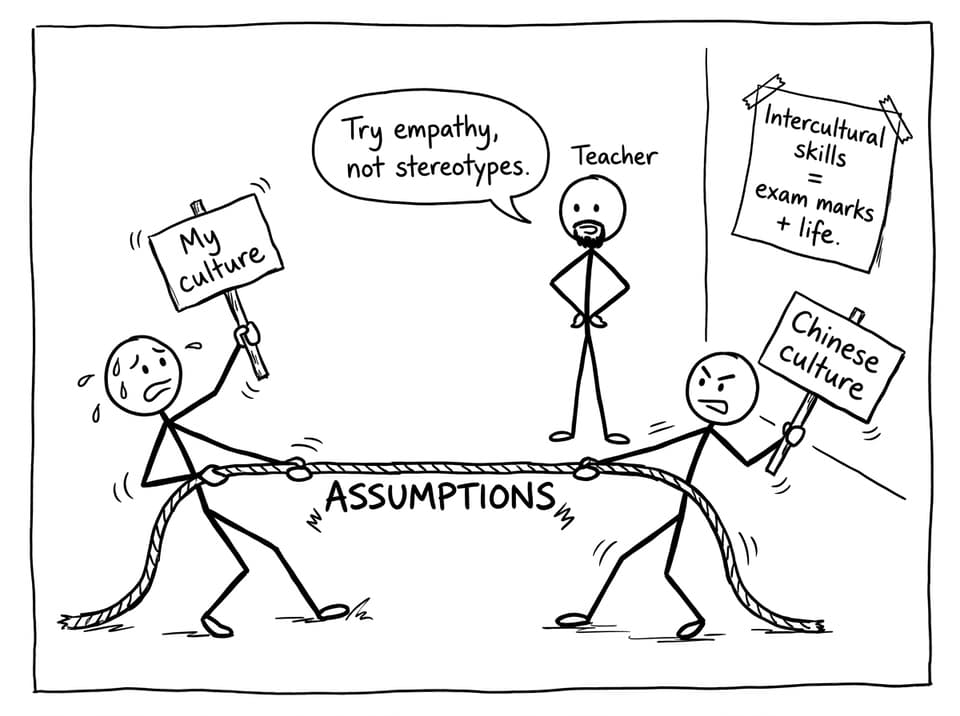
The Individual Oral rewards students who can connect a stimulus to broader ideas, then move outward into comparison and reflection.
When you compare perspectives thoughtfully, you’re developing:
-
empathy without overgeneralising
-
the habit of checking assumptions
-
the ability to justify interpretations with evidence
If you want a theme-focused way to build that habit, How IB Chinese B Connects to the Five Prescribed Themes is a simple reference to keep your examples relevant.
Global competence: access and awareness
Mandarin connects you to a huge range of media, communities, and viewpoints. But the deeper global skill is this: you learn to hold two realities at once.
You can understand a message, while also noticing what shaped it.
That’s the kind of “international-mindedness” the IB talks about, and it’s baked into IB Languages assessment without needing big speeches about it.
Soft skills IB Chinese B builds (and why they matter for exams)
Public speaking and structured spontaneity
The Individual Oral trains a rare combination: speaking naturally while staying structured.
Students often assume fluency means “fast.” In IB Chinese B, fluency is closer to “clear.” You learn to:
-
start with a simple claim
-
add an example
-
explain what it shows
-
link it to a theme
RevisionDojo’s IB Language B Exams: Format, Timing, Strategy is useful if you want a broader IB Languages playbook that still applies directly to Chinese B.
Adaptability: recovering when you don’t know a word
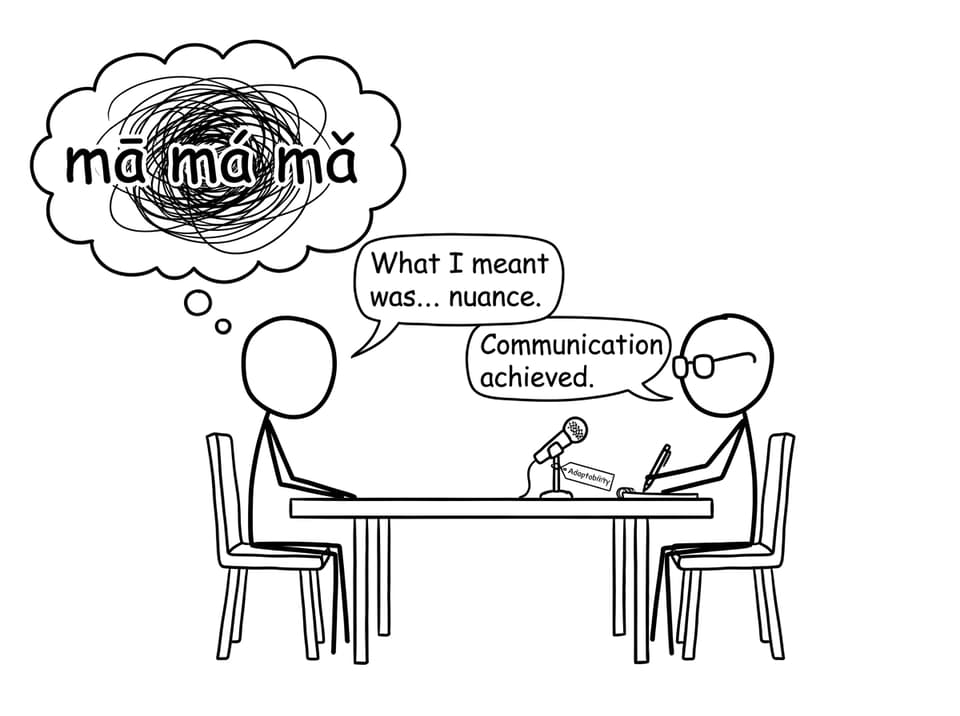
This is the skill no one brags about, but it’s the one that saves grades.
IB Chinese B pushes you to practise “repair strategies,” like:
-
paraphrasing a missing word
-
giving a simpler example
-
rephrasing an opinion more directly
-
continuing the message instead of freezing
That is a signature IB Languages competency: communication before perfection.
Time management and consistency
IB Chinese B has multiple components, and each one punishes cramming in a different way.
A student who studies “hard” for one weekend may still struggle if they haven’t built daily contact with the language. This is why a schedule matters. Use IB Chinese B Study Timetable: A Step-by-Step Plan to set up weekly rotation across reading, listening, writing, and speaking.
How to train these skills efficiently with RevisionDojo
Most students don’t fail IB Languages because they lack motivation. They fail because they practise the wrong thing for too long.
A sustainable RevisionDojo loop looks like this:
-
Study Notes to learn what “good” looks like before you practise.
-
Flashcards for connectors, opinion phrases, and theme vocabulary you’ll actually use.
-
Questionbank for targeted skill drills (especially reading and listening sets). Start here: IB Chinese B Questionbank.
-
AI Chat to generate extra examples, rephrase sentences, and test you on theme-based questions.
-
Grading tools to tighten writing by rubric expectations (the fastest way to improve). For example: IB Chinese B Paper 1 30 Marker Grader.
-
Mock Exams and Predicted Papers to simulate performance, not just practice.
-
Coursework Library and IB Chinese B Exemplars to see what strong work looks like.
-
Tutors when you need spoken feedback, accountability, or a reset.
That system is why RevisionDojo works as an “ultimate IB resource” rather than a pile of documents.
Conclusion
IB Chinese B develops language ability, but it also develops something more durable: the ability to communicate, analyse, and adapt under pressure. That is exactly what IB Languages are designed to build, and it’s why the subject strengthens performance across the diploma.
If you want those skills to show up on exam day, make your practice look like the assessment: timed sets, theme-based vocabulary, structured speaking, and fast feedback loops. RevisionDojo brings that whole system together with Questionbank practice, Study Notes, Flashcards, AI Chat, Grading tools, Predicted Papers, Mock Exams, a Coursework Library, and Tutors when you need them.
Start with the IB Chinese B hub, pick one skill to train this week, and let small, consistent reps do what last-minute panic never can for IB Languages.