



A language course can be strangely difficult for a parent to judge. A mathematics textbook reveals its difficulty almost immediately. Spanish can look familiar by comparison, right up until your child is discussing cultural identity, interpreting an interview at natural speed, or choosing the right tone for a formal letter.
So, what is IB Spanish B like in practice? It is a language-acquisition course for students who already have some experience of Spanish. It develops reading, writing, listening, and speaking through contemporary themes and Spanish-speaking cultures. It is not designed for complete beginners, nor is it simply a long vocabulary test. Success depends on communicating accurately, appropriately, and thoughtfully in different situations.
For parents, the reassuring part is that the course has a clear structure. Once you understand its four assessed skills and the difference between Standard Level and Higher Level, the workload becomes much easier to interpret.
IB Spanish B at a glance
Here is the course in plain language:
- It belongs to Group 2: Language Acquisition in the IB Diploma Programme.
- It is intended for students with previous experience of Spanish.
- It is offered at Standard Level (SL) and Higher Level (HL).
- Students develop reading, listening, writing, and spoken interaction.
- Learning is organized around five broad themes.
- Assessment includes a writing paper, listening and reading comprehension, and an individual oral.
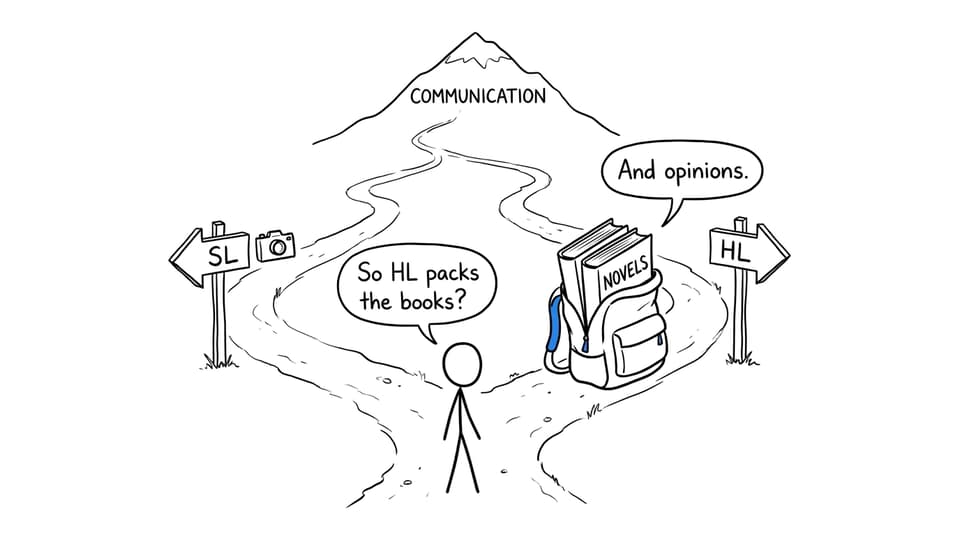
- HL requires greater linguistic complexity and the study of two literary works originally written in Spanish.
The IB recommends 150 teaching hours for SL and 240 for HL. Those figures describe scheduled course scope, not the exact amount of independent study every student will need. A child with secure foundations may need less remedial work, while one with gaps in grammar or listening may require more regular practice.
Parents who want to see the subject before making decisions can explore the IB Spanish B SL and HL topic guide alongside RevisionDojo's main IB Spanish B resource hub.
What students actually study
Spanish B is organized around five prescribed themes:
| Theme | Typical areas of discussion |
|---|---|
| Identities | Lifestyle, values, health, language, and belonging |
| Experiences | Travel, traditions, migration, and life stories |
| Human ingenuity | Technology, media, science, and artistic expression |
| Social organization | Education, work, community, relationships, and law |
| Sharing the planet | Environment, equality, human rights, ethics, and globalization |
These are not five boxes of vocabulary to memorize. They provide contexts in which students learn to express opinions, compare cultures, explain causes, interpret perspectives, and respond to unfamiliar material.
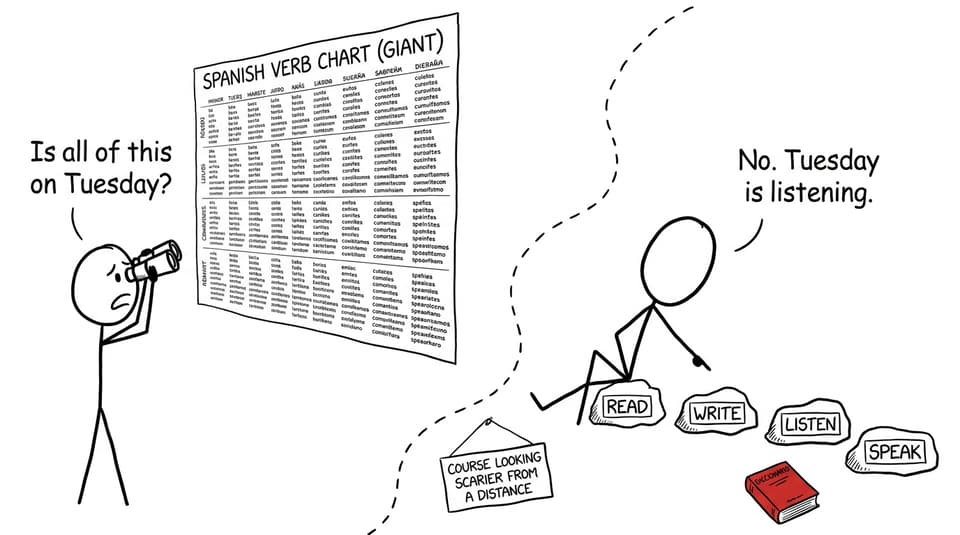
A unit on technology, for example, might combine an audio interview, an article, a classroom discussion, and a written blog post. Grammar matters throughout, but it is usually learned as a tool for communicating meaning. The subjunctive becomes useful because a student wants to express doubt or recommend change, not because an isolated worksheet says it is Tuesday.
RevisionDojo's Spanish B core themes resources show how thematic notes, lessons, and questions connect within the course.
What lessons tend to feel like
A well-run Spanish B lesson moves between receiving language and producing it. Students might listen for the main argument in a recording, identify the intended audience of a text, discuss a social question with a partner, and then write for a particular purpose.
That variety is one reason students can have very different experiences in the same course. A confident speaker may find classroom discussion comfortable but lose marks in detailed reading. A careful writer may understand grammar yet freeze when asked an unexpected follow-up question. “Good at Spanish” is not one skill.
The course also expects cultural awareness. Students should engage with communities and perspectives from across the Spanish-speaking world rather than treating Spanish as a code for translating English sentences. This is why authentic articles, advertisements, interviews, images, and literary texts are useful classroom material.
Spanish B SL vs HL
The difference between SL and HL is not merely that HL students learn a longer vocabulary list. HL involves more teaching time, greater linguistic range, more demanding texts, and higher expectations for depth.
| Area | Standard Level | Higher Level |
|---|---|---|
| Recommended teaching time | 150 hours | 240 hours |
| Language expectations | Clear communication across familiar and unfamiliar contexts | Greater range, complexity, nuance, and sustained argument |
| Literature | No prescribed literary-work requirement | Two works originally written in Spanish |
| Individual oral stimulus | A visual stimulus linked to a course theme | An extract from a studied literary work |
| Current writing task length | 250-400 words | 450-600 words |
Both levels are serious IB subjects. SL still asks students to understand unfamiliar Spanish, select an appropriate text type, and sustain a real conversation. HL adds depth rather than simply speed.
For families balancing several IB HL and SL subjects, the decision should reflect the student's current proficiency, interest, workload, and possible university requirements. HL can suit a student who reads and speaks regularly and enjoys cultural or literary discussion. SL may be the more strategic choice when Spanish supports the diploma without needing to become one of its largest commitments.
How IB Spanish B is assessed
For the current assessment model, the final result is divided across four equally weighted skill areas:
- Paper 1: writing, 25%: one task is selected from three choices and completed using an appropriate text type.
- Paper 2: listening, 25%: comprehension exercises based on three audio passages.
- Paper 2: reading, 25%: comprehension exercises based on three written texts.
- Individual oral, 25%: a presentation followed by discussion and broader conversation.
At SL, the oral begins from a visual stimulus connected to a prescribed theme. At HL, it begins from an extract taken from one of the two literary works studied. In both cases, students must do more than deliver memorized sentences. They need to respond to questions and keep the interaction moving.
That balance matters. A student cannot rely entirely on polished writing to conceal weak listening, or fluent conversation to compensate for inaccurate reading. The Spanish B oral assessment guide and Paper 1 notes and practice let families inspect the two productive components more closely.
The IB has announced a revised Language B course for first assessment in 2029. Schools should therefore confirm which guide applies to a student's examination cohort, particularly when planning several years ahead.
Is IB Spanish B difficult?
Spanish B is demanding, but its difficulty is usually cumulative rather than mysterious. The student who meets Spanish briefly once a week must repeatedly rebuild familiarity. The student who listens, reads, retrieves vocabulary, and speaks in short sessions gradually makes the language easier to access.
Common pressure points include:
- understanding audio without controlling its speed;
- writing in the correct register for the audience;
- moving beyond basic, repetitive vocabulary;
- answering oral follow-up questions spontaneously;
- maintaining accurate verb forms and agreement under time pressure;
- connecting ideas to cultures and prescribed themes.
The most useful question is not simply, “Is my child getting the vocabulary right?” It is, “Can my child use that vocabulary to understand and communicate?” Recognition can feel like knowledge. Exams eventually reveal the difference.
What effective Spanish B preparation looks like
Good revision follows the shape of the assessment. Students need a regular cycle of input, retrieval, production, and feedback.
Build vocabulary in usable phrases
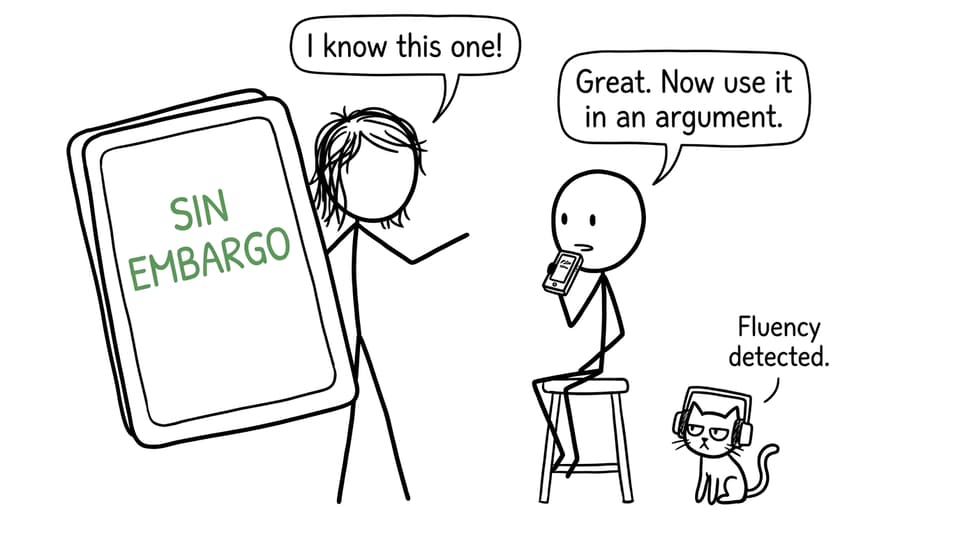
Theme vocabulary is more valuable when attached to verbs, connectors, and opinions. Instead of memorizing an isolated noun, students can learn a short phrase, say it aloud, and place it in a new sentence. RevisionDojo's Spanish B core-theme flashcards make that kind of active recall easier to organize.
Train each skill separately
Reading more will not automatically solve a listening problem. Writing carefully at home will not fully prepare a student for spontaneous conversation. A balanced week should include short listening tasks, evidence-based reading questions, one planned written response, and recorded speaking practice.
The Spanish B Paper 2 reading resources provide focused comprehension practice, while this broader guide to effective Language B revision explains how to connect all four skills.
Turn errors into the next task
A marked exercise only becomes useful when the student identifies why an answer failed. Was the issue vocabulary, grammar, task interpretation, register, inference, or time management? The next revision session should target that category. Improvement comes from closing small feedback loops, not accumulating untouched worksheets.
How parents can help without speaking Spanish
A parent does not need to correct conjugations to provide meaningful support. Structure is often more valuable than subject expertise.
Ask your child to explain which skill they are training and how they will judge improvement. Encourage brief, frequent contact with Spanish rather than a single exhausting weekend session. Help protect time for speaking aloud, which can feel less urgent than written homework but is directly assessed.
You can also ask to see evidence: a completed reading task, a recording made twice, an error log, or a revised paragraph. This keeps the conversation focused on process rather than vague reassurance or panic.
A clear next step for families
The simplest way to understand Spanish B is to look inside the work. Open RevisionDojo's Spanish B resources and preview the Study Notes, Flashcards, vocabulary practice, and Questionbank tasks. A parent can see what structured support looks like, while a student can test whether the material matches a genuine weakness before committing to a larger plan.
RevisionDojo is built as the ultimate IB resource, bringing Questionbank practice, Study Notes, Flashcards, AI Chat, Grading tools, Predicted Papers, Mock Exams, a Coursework Library, and Tutors into one wider study system, with availability varying by subject and resource. For Spanish B, the immediate value is clarity: learn the theme, retrieve the language, attempt a task, review the feedback, and try again.
IB Spanish B is not a test of whether a student can sound perfect. It is a course in becoming increasingly capable: understanding more, expressing more, and recovering calmly when the exact word does not arrive. Once families see that progression, the subject feels less like a wall of unfamiliar grammar and more like what it really is: a sequence of trainable skills.