
The week before exams, most students don’t run out of time first. They run out of direction.
Spanish B can feel like a blur of grammar rules, random vocabulary, and speaking prompts you “should probably practice.” But IB Language B isn’t random. It’s a course with repeatable theme worlds. Once you revise by those worlds, your reading, listening, writing, and speaking start to click into place.
What IB Spanish B is (and why themes matter in IB Language B)
IB Spanish B is a language acquisition course for students who already have some Spanish. The goal is practical communication plus cultural understanding. In IB Language B, the themes are the organizing system behind exam tasks, the Individual Oral, and most classroom units.
If you want one hub to anchor everything, start with IB Spanish B Resources and treat it like your home base for notes, practice, and feedback.
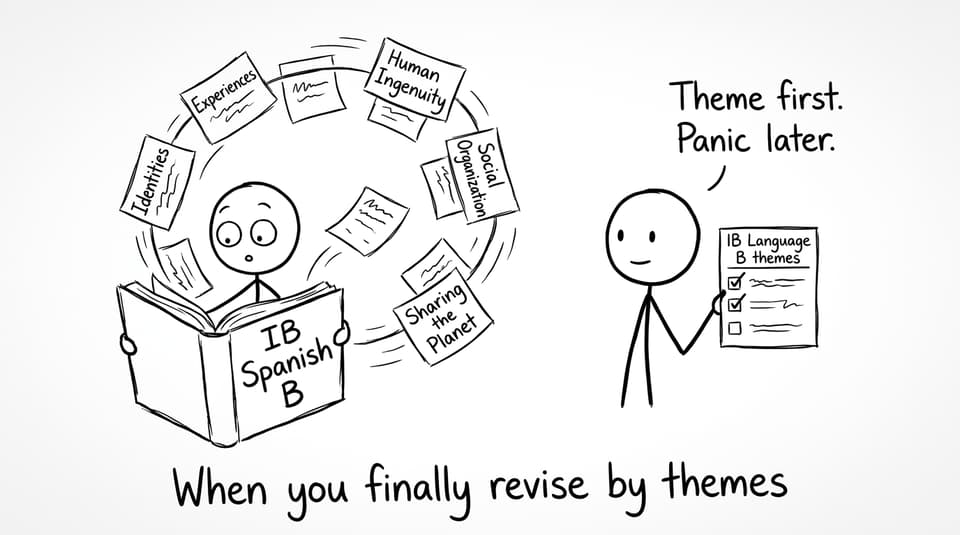
The five IB Spanish B themes you must know
These are the core themes that shape the course for SL and HL:
Identities
Family, relationships, education, work, lifestyles, and how people describe themselves.
Experiences
Travel, health, traditions, leisure, and social issues, anything that shapes lived experience.
Human Ingenuity
Media, technology, science, creativity, and how innovation changes society.
Social Organization
Community life, sustainability, law, justice, politics, and how societies function.
Sharing the Planet
Global challenges, resources, consumption, responsibility, and solutions.
To revise them efficiently, use IB Spanish B Core Themes Notes & Questions (SL/HL) and build a one-page theme sheet for each: key nouns, high-yield verbs, and 8-10 flexible opinion phrases.
SL vs HL: same topics, different depth
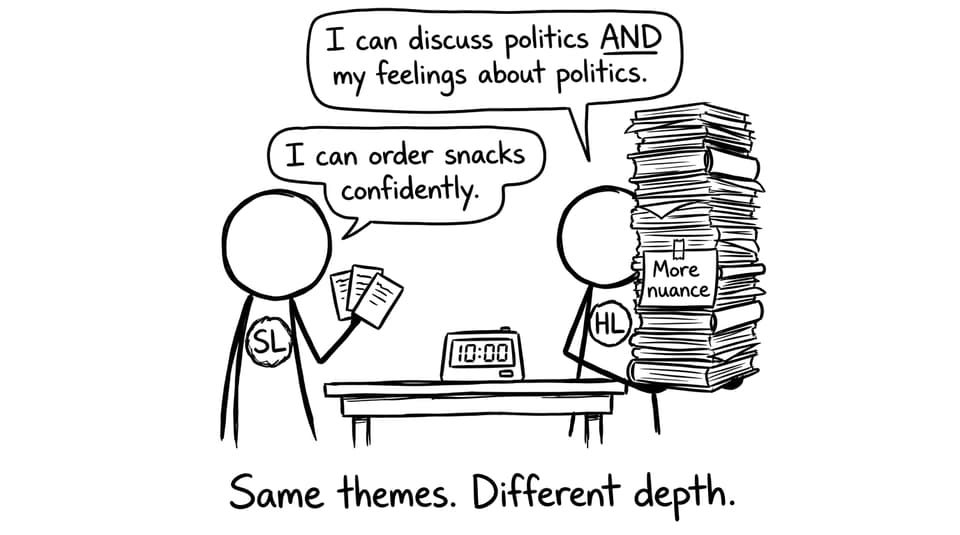
SL and HL cover the same five themes, but HL pushes you into more abstract discussion and denser texts. Think of it as the same map with a longer hiking trail.
A practical IB Language B way to spot the difference:
-
SL: clear opinions + relevant examples + correct text type conventions.
-
HL: adds nuance (counterarguments, implications, tone shifts) and sustains complexity longer.
A fast exam-prep checklist by theme (works for IB Language B)
-
Vocabulary: study by theme, not alphabetically. Use Flashcards for Core Themes for spaced repetition.
-
Writing (Paper 1): train text types and register using Paper 1 Notes and Paper 1 Questionbank.
-
Listening: do short, frequent sets and review mistakes immediately via Paper 2 Listening.
-
Speaking: rotate themes weekly, record 2 minutes daily, and focus on “repair phrases” (ways to recover smoothly).
RevisionDojo makes this feel less like guesswork and more like a system: Questionbank, Study Notes, Flashcards, AI Chat, Grading tools, Predicted Papers, Mock Exams, Coursework Library, and Tutors when you want human feedback.
FAQ: IB Spanish B topics and IB Language B strategy
Are the IB Spanish B themes fixed, or can they change?
The five themes are designed to be stable, because they’re the backbone of IB Language B assessment. That said, the IB can refresh guiding questions, example subtopics, or the kinds of texts that appear. In practice, this means your safest strategy is to master the theme language that transfers across tasks: opinions, cause/effect, comparing perspectives, and proposing solutions. If you prepare only “niche” topics, you’ll feel confident until the exam chooses a wider angle. If you prepare theme toolkits, you can adapt on the day. RevisionDojo’s theme resources help you keep that toolkit organized and exam-aligned.
How many subtopics should I prepare under each theme?
Aim for 2-3 subtopics per theme that you can discuss in depth, with vocabulary you can control. For example, under Sharing the Planet, you might choose “plastic and consumption” and “renewable energy in cities.” Depth matters because IB Language B rewards development, not name-dropping. Once your core subtopics are secure, add a “flex layer” of extra vocabulary that lets you pivot if needed. The fastest way to build this is by combining theme notes with flashcards and a weekly speaking rotation. Over time, your subtopics start to overlap, which is exactly what makes you fluent.
Can I choose my own angle for speaking and writing tasks?
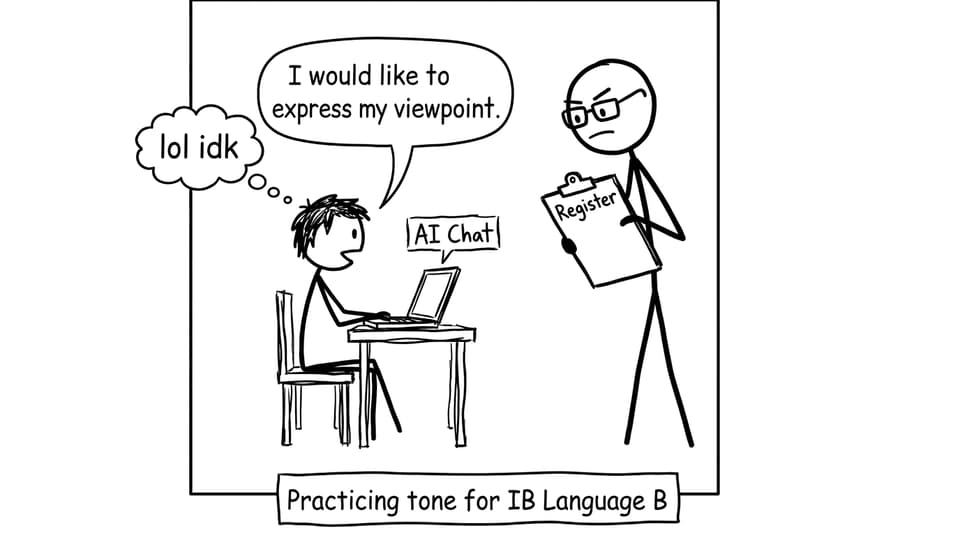
Yes, and the best students do. In IB Language B, choosing an angle means selecting a clear viewpoint, audience, and register, then backing it with relevant cultural or real-world detail. You don’t need to be a policy expert; you need to be coherent and specific. A simple personal example, paired with one wider Spanish-speaking context, often outperforms vague generalizations. Practice this by taking one theme prompt and writing three different openings: formal, semi-formal, and personal. RevisionDojo’s AI Chat and Grading tools can help you test whether your tone and structure match the task.
Conclusion: turn IB Language B topics into a repeatable system
The secret isn’t finding the “perfect” topic. It’s building a calm, reusable IB Language B structure: themes first, then vocabulary, then timed practice that feels like the exam.
If you want that structure in one place, use IB Spanish B Resources and work theme-by-theme with RevisionDojo’s notes, flashcards, Questionbank, and feedback tools until Spanish B stops feeling wide and starts feeling familiar.