
It usually starts small.
A teacher asks you to stay behind after class. Your IB coordinator wants a “quick chat.” Or you get an email with a phrase that makes your stomach drop: academic misconduct.
In the IB, that phrase can feel like a verdict. But an accusation is not the same thing as a decision. Most of the time, it’s the start of a process: evidence gets gathered, context gets clarified, and you get a chance to explain.
This guide is for IB students preparing for exams who want the clear picture: what counts as misconduct, what the investigation looks like, what outcomes are possible, and what to do in the next 24 hours if it happens to you.
A calm checklist for the next 24 hours
If you’re accused of academic misconduct in the IB, don’t treat your feelings as instructions. Use this checklist instead.
-
Pause and breathe. An allegation means review, not automatic guilt.
-
Ask for specifics. What work? What section? What rule is being referenced?
-
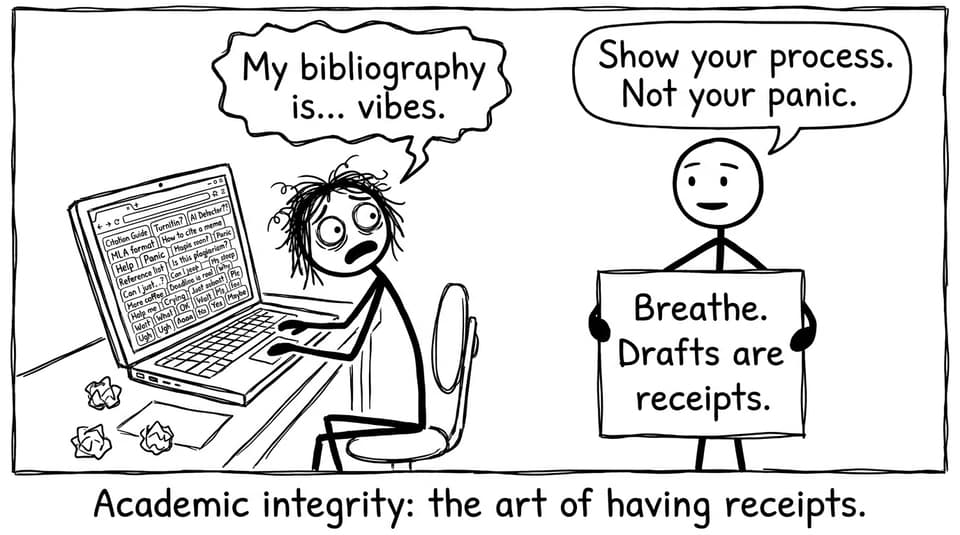
Collect your “process proof.” Drafts, notes, version history, research logs, screenshots, and outlines.
-
Write a timeline. When you started, what you used, who you spoke to, and what tools helped.
-
Be honest about help and AI. Transparency matters more than perfect phrasing.
-
Loop in support. Your teacher, coordinator, and parent/guardian can help you respond clearly.
For a broader IB integrity framework (and how to avoid problems in the first place), keep this open as a reference: How to Uphold Academic Integrity in IB Assessments.
What the IB means by “academic misconduct”
In the IB, academic misconduct is any action that gives (or attempts to give) an unfair advantage in assessment. The key point is this: the IB cares about authentic authorship. Can you show that the work is truly yours?
Common categories include:
Plagiarism
Using someone else’s words, ideas, data, images, or structure without proper citation. In IB coursework, plagiarism is often subtle: patchwriting, uncited paraphrasing, or borrowing an argument arc that isn’t yours.
If you want a practical way to self-check before submission, use: How to Avoid Plagiarism in Your IA and IA Citations: 10 Best Practices for IB EE and IA.
Collusion
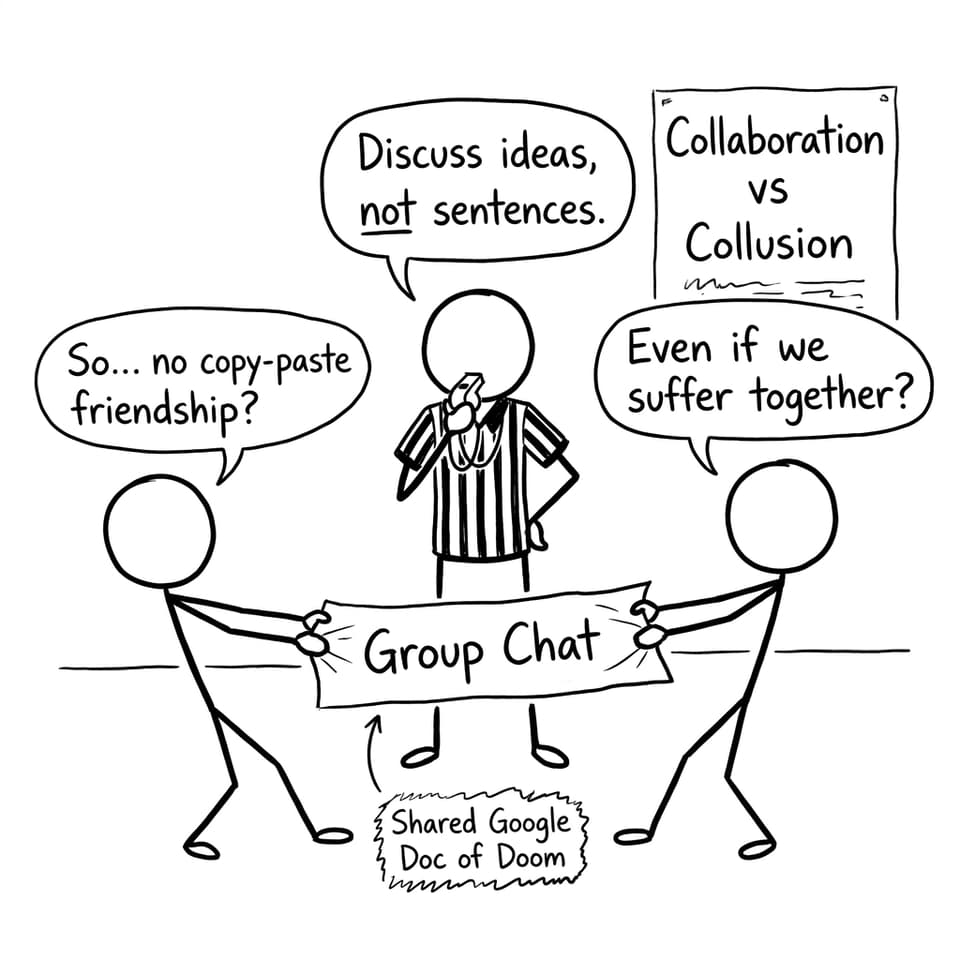
Working together beyond what the task allows. In the IB, “discussing” can be allowed while “sharing sentences” isn’t. If two final drafts look too similar, even friendly collaboration can become risky.
Duplication of work (self-plagiarism)
Reusing substantial parts of your own previously submitted work across different assessments can still be misconduct in the IB, even if every word was originally yours.
A common example is trying to transfer big chunks of an EE into an IA. If you’re tempted, read this first: Can You Copy Your Own EE Into Your IA?.
Fabrication or falsification
Inventing data, changing results, or selectively editing evidence to make conclusions look cleaner. It’s more common than students admit, usually because they’re panicking and trying to “save” an investigation.
Misuse of AI tools
AI can be useful in the IB for explanations, practice, and feedback. The risk is submitting AI-generated writing or analysis as if it’s your own thinking. If AI shaped your work, the safest route is to be transparent and keep your voice central.
For a wider view of how schools and higher education are reacting to AI expectations, see: How Are Universities Responding to AI Use in High School Assignments?.
What actually happens after you’re accused in the IB
Most IB misconduct cases begin inside the school. Think of it like a funnel: the teacher notices a concern, the coordinator checks evidence, and only some cases move forward to formal reporting.
The initial concern (teacher level)
A teacher might flag:
-
writing that suddenly doesn’t sound like you
-
a bibliography that doesn’t match the sophistication of the analysis
-
identical phrasing or structure across multiple students
-
suspiciously perfect data patterns
-
inconsistencies between class performance and submitted work
In the IB, authenticity checks are normal. Your teacher isn’t “out to get you.” They’re required to authenticate your work.
The school review (IB coordinator level)
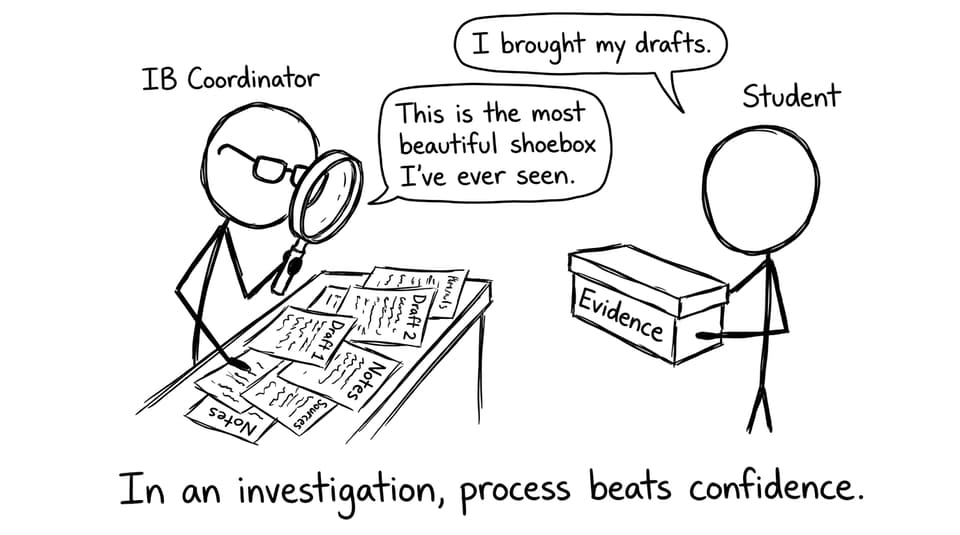
Your IB coordinator typically gathers documentation, asks for your explanation, and compiles what the school knows: drafts, version histories, similarity reports, and teacher statements.
This is where your process proof matters. Drafts are not “extra.” In the IB, drafts are your credibility.
The formal submission (if needed)
If the school decides the concern is serious enough, they submit it for official review. The IB then evaluates what’s more likely than not, based on the evidence available.
That standard can feel uncomfortable, because it’s not about proving a case “beyond doubt.” It’s about whether the evidence supports the concern.
Possible outcomes in an IB misconduct case
IB outcomes are designed to be proportionate. Not every case ends in a dramatic penalty. Some end in education, correction, or no action.
No action
If the evidence is weak or the concern can’t be supported, the case may be closed.
Warning or educational response
If the issue looks like misunderstanding (often citation problems), schools may treat it as a learning moment: redo citations, rewrite sections, or complete integrity training.
Loss of marks for a component
If the work’s integrity is compromised, the IB may award a zero for the specific assessment component.
Disqualification (rare)
This is generally reserved for severe or repeated issues. It’s less common than students fear, but it’s serious enough that you should treat every accusation carefully.
For topic-specific guidance that shows how these consequences can play out, see: What Happens If Your IA Is Plagiarized? Consequences and How to Avoid It in the IB.
How to respond without making it worse
In the IB, the best response is rarely the loudest. It’s the clearest.
Build a “process packet”
Give your coordinator a tidy bundle:
-
draft files (with dates)
-
handwritten notes or notebooks (photos are fine)
-
source log (links, page numbers, dates accessed)
-
document version history
-
outlines and planning documents
-
a short written explanation of your workflow
This isn’t about sounding innocent. It’s about showing authorship.
Explain intent, not excuses
If you made a mistake, say so plainly. “I forgot to cite” is better than a complicated story that sounds like avoidance. The IB values transparency because it signals maturity.
Don’t rewrite history
If you used AI, don’t deny it. If you collaborated, don’t pretend you didn’t. In the IB, dishonesty about the process often becomes the bigger problem.
Ask what happens next
You’re allowed to ask:
-
what policy is being referenced
-
what evidence is being used
-
what timeline the school is following
-
what you should submit to support your explanation
Why students get accused even when they didn’t mean to cheat
Most IB students don’t wake up planning to break rules. Accusations often come from pressure and confusion.
The “rushed finish” problem
When you write at 1:40 a.m., your brain stops distinguishing between notes and draft. That’s how uncited paraphrasing happens.
The “collaboration creep” problem
You start by discussing an idea. Then someone shares a sentence “just as an example.” Then two drafts quietly converge.
The “AI polish” problem
You ask for help rewriting a paragraph. The new version sounds great. But it isn’t your thinking anymore, and now you can’t defend it out loud.
The “I cited the bibliography” myth
In the IB, citations need to appear where the borrowed idea appears. A reference list at the end doesn’t erase uncited passages.
If you want a clean preventative strategy, use: IB Academic Misconduct Explained: How to Avoid Plagiarism and Collusion.
How RevisionDojo helps you stay safe while preparing for IB exams
Academic integrity gets harder when you’re exhausted. The goal isn’t to become perfect. It’s to build systems that reduce risk.
RevisionDojo supports IB exam prep in a way that makes honest work easier to sustain:
-
Study Notes help you understand content quickly so you don’t feel tempted to borrow explanation language.
-
Flashcards build daily recall so you can write from memory, not from copied notes.
-
Questionbank practice turns “I understand it” into “I can earn marks with it.”
-
AI Chat (Jojo AI) can explain concepts, check reasoning, and help you plan, without replacing your authorship.
-
Mock Exams and Predicted Papers build exam stamina, which reduces panic-driven shortcuts.
-
Grading tools give rubric-aligned feedback so you improve your work rather than outsourcing it.
-
Coursework Library shows what strong structure looks like, so you can model patterns without copying sentences.
-
Tutors provide human guidance when you need accountability and clear next steps.
If you want a single page that explains how RevisionDojo is designed around ethical learning, read: How RevisionDojo Helps You Maintain Academic Integrity While Studying.
Closing: the IB cares about who you become
An academic misconduct accusation can feel like your whole IB story is being reduced to one moment. But the IB was never only about outcomes. It’s about habits: ownership, clarity, and the quiet ability to show your work.
If you’re accused, respond like a person building a case for your own authorship: gather drafts, explain your process, and choose transparency over panic. And if you want exam prep that makes integrity easier, build your routine inside RevisionDojo, with Study Notes, Flashcards, the Questionbank, AI Chat, Grading tools, Predicted Papers, Mock Exams, the Coursework Library, and Tutors.
Because in the IB, the safest confidence is earned the honest way.