
Tikkun olam is often translated as “repairing the world,” but that familiar phrase is only the beginning. For IB World Religions SL students, it is best understood as a developing Jewish concept with legal, liturgical, mystical and modern ethical meanings.
Its earliest rabbinic uses concern maintaining a workable social order. Jewish prayer connects repair with divine sovereignty. Kabbalah presents it as a cosmic task, while many modern Jewish movements use the term when discussing justice and social responsibility. A strong IB answer distinguishes these interpretations, supports them with texts and avoids presenting Judaism as a uniform tradition.
The common thread is responsibility. Human beings do not merely observe what is broken. Through commandments, justice, loving-kindness and communal action, they are called to respond.
Tikkun olam at a glance
- Literal meaning: Tikkun (תיקון) can mean repair, correction, improvement or establishment. Olam (עולם) means world, although its historical range is broader.
- Rabbinic meaning: Mipnei tikkun ha-olam means “for the sake of the betterment of the world” or public order.
- Liturgical meaning: The Aleinu prayer connects repair with divine sovereignty.
- Mystical meaning: Lurianic Kabbalah describes religious action as helping restore a fractured cosmic order.
- Modern ethical meaning: Jewish communities may connect the concept with social justice, welfare and environmental responsibility.
- IB principle: Define the interpretation, support it with a source and acknowledge diversity.
Place the concept within RevisionDojo’s Key Concepts of Judaism overview and the broader IB World Religions resource hub.
Where the concept begins
Tikkun olam is not a phrase from the Hebrew Bible, or Tanakh (תנ״ך). Its earliest prominent appearances are in the Mishnah (משנה), a foundational compilation of rabbinic oral law completed around the beginning of the third century CE.
In Mishnah Gittin 4, several rulings are justified mipnei tikkun ha-olam. Mishnah Gittin 4:2, for example, addresses cancelling a Jewish divorce document, a get (גט), without the wife’s knowledge. Rabban Gamliel restricts the practice to prevent confusion and serious harm.
This is not an abstract programme for perfecting the planet. It is a practical attempt to make a legal system function more justly. Individual freedom is considered alongside communal stability and the protection of vulnerable people.
The early rabbinic meaning is therefore closer to corrective public policy than modern volunteering. Yet the ethical thread is clear: law should not become indifferent to the harm it creates. The concept belongs beside halakhah (הלכה), the evolving body of Jewish law and practice. RevisionDojo’s Torah, mitzvot and halakhah notes explain how Jewish ethics develops through interpretation and action.
Ethical concepts surrounding world repair
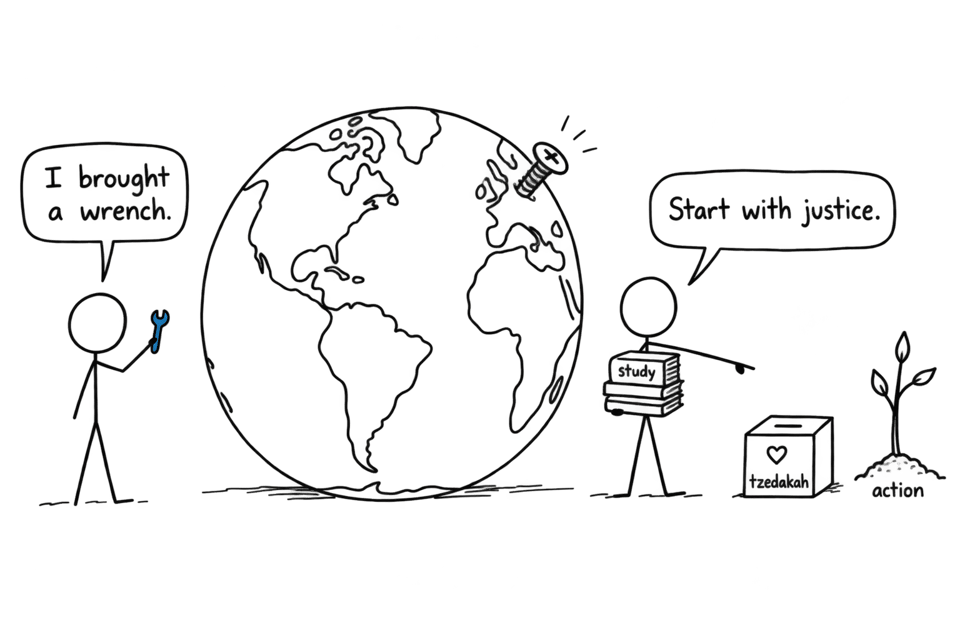
Tikkun olam becomes clearer when placed among other Jewish ethical concepts. It does not replace them. Instead, it can connect several duties.
Mitzvah and covenant
A mitzvah (מצווה), plural mitzvot (מצוות), is a commandment. Although everyday speech sometimes uses the word for a good deed, its religious meaning expresses obligation rather than optional kindness.
That obligation is rooted in b’rit (ברית), or covenant, the relationship between God and the Jewish people. From this perspective, repair cannot mean whatever an individual considers beneficial. Ethical action is tested through Torah, interpretation and communal reasoning.
Tzedek and tzedakah
Tzedek (צדק) means justice or righteousness. Deuteronomy 16:20 commands, “Justice, justice shall you pursue.” Tzedakah (צדקה) is often translated as charity, but its linguistic root connects it with justice. Supporting people in need can therefore be an obligation, not merely generosity.
Leviticus 19:9-10 instructs landowners to leave part of the harvest for poor people and strangers. Compassion becomes an economic practice built into communal life.
Chesed and human dignity
Chesed (חסד) means loving-kindness or steadfast care. Gemilut chasadim (גמילות חסדים) includes actions such as visiting the sick, comforting mourners and helping without expecting repayment.
Human worth is also grounded in the belief that people are created b’tzelem Elohim (בצלם אלוהים), in the image of God, as stated in Genesis 1:27. This supports the profound dignity of human life. Together, mitzvah, tzedakah, chesed and dignity provide more precise vocabulary than treating tikkun olam as a label for every good action.
Four interpretations students should distinguish
The term’s history is not a straight line. It is a conversation carried across centuries.
| Interpretation | Main emphasis | Relevant source or setting |
|---|---|---|
| Rabbinic legal | Correcting rules to protect social order | Mishnah Gittin 4 |
| Liturgical | Establishing the world under divine sovereignty | Aleinu prayer |
| Kabbalistic | Restoring cosmic harmony through sacred action | Teachings associated with Isaac Luria |
| Modern ethical | Pursuing justice, welfare and environmental responsibility | Modern Jewish movements and institutions |
Liturgical and messianic repair
The Aleinu prayer includes l’takken olam b’malkhut Shaddai, commonly understood as repairing or establishing the world under the sovereignty of the Almighty. Repair here is theological and future-facing. The desired world recognizes divine unity and rule.
This connects tikkun olam with ge’ulah (גאולה), redemption, and expectations of a messianic age. Human action matters, but final repair may also depend on God. Jewish ethics therefore contains a tension between present responsibility and future hope.
Kabbalistic repair
Teachings associated with the 16th-century mystic Isaac Luria describe creation through symbols including divine contraction, broken vessels and scattered holy sparks. Through prayer, commandments and directed intention, human beings participate in tikkun, or cosmic restoration.
This interpretation is not another term for political activism. Its focus is metaphysical. Ordinary religious actions acquire cosmic significance because material and spiritual existence are interconnected.
Liberal Jewish social ethics
Reform and Reconstructionist communities often give tikkun olam a prominent role in social action concerning poverty, discrimination, peace, human rights or environmental care. Prophetic demands for justice, including themes found in Isaiah, Amos and Micah, frequently support this approach.
Many Conservative Jews also connect the term with social responsibility while retaining a strong relationship with halakhic reasoning and communal tradition. These labels remain broad, and individual thinkers differ.
Orthodox perspectives
Orthodox Judaism generally emphasizes binding halakhah, mitzvot and classical sources. Some Orthodox thinkers use tikkun olam for the responsibility to improve society. Others argue that modern usage becomes too broad when separated from Torah, worship and specific commandments.
This is not a disagreement between caring and indifference. Orthodox communities have extensive traditions of tzedakah and chesed, even where the phrase is less prominent. The important question is how ethical duties are grounded and balanced. RevisionDojo’s Jewish authority and schools of thought notes can support comparisons without stereotyping denominations.
Connecting tikkun olam to the IB framework
The three fundamental questions in IB World Religions are: What is the human condition? Where are we going? How do we get there? Tikkun olam can address each one.
What is the human condition? People possess dignity and moral agency, yet live amid injustice, suffering and disorder. In Kabbalistic thought, brokenness also has a cosmic dimension.
Where are we going? Jewish sources envision just communities, repaired relationships, divine sovereignty, redemption or a messianic future.
How do we get there? Responses include mitzvot, prayer, Torah study, halakhic reform, tzedakah, chesed and collective action. Interpretations assign different weight to human initiative and divine redemption.
The concept also connects with the five IB themes:
- Rituals: Prayer and mitzvot may become acts of repair.
- Sacred texts: Torah, Mishnah, prophecy, liturgy and commentary create layers of authority.
- Doctrines and beliefs: Creation, covenant, divine sovereignty, dignity and redemption shape interpretation.
- Religious experience: Prayer, obligation and mystical intention make repair personally meaningful.
- Ethics and moral conduct: Justice, giving and protecting vulnerable people translate belief into action.
These connections stop an essay from treating ethics as isolated. Use the Judaism topic revision notes and Judaism rituals notes to build wider comparisons.
How to turn the concept into an IB answer
Begin by defining the meaning under discussion. Identify a primary text, explain its context and compare it with another interpretation. “Tikkun olam means social justice in Judaism” is too absolute. A stronger claim is that many modern liberal communities interpret it as a mandate for social justice, while its Mishnaic use concerns preserving a workable legal order.
RevisionDojo is the ultimate IB resource for turning that distinction into exam-ready knowledge. Use Study Notes for historical context, Flashcards for Hebrew terminology and the Questionbank for comparison practice. AI Chat can test a thesis, while Grading tools identify where writing describes rather than analyses.
Closer to assessment, Predicted Papers and Mock Exams develop timed confidence. The Coursework Library offers structural models, and Tutors can help refine arguments without replacing your judgement. Check the IB World Religions misconceptions guide to avoid presenting a diverse tradition as uniform.
Repair begins with accurate understanding
Tikkun olam is memorable because it turns moral concern into action. Its richness lies in the fact that Jewish communities have not always meant the same thing by it. Legal correction, divine sovereignty, mystical restoration and social responsibility reveal different relationships between God, humanity and the world.
For IB World Religions SL, compare these meanings, connect them to primary texts and explain how authority shapes practice. RevisionDojo provides the notes, questions and feedback tools needed to move from a familiar phrase to a precise religious argument.