


A practice question can tell you more about your revision than an hour of rereading. It reveals what you remember, what you can apply, and what disappears when a command term asks you to think in an unfamiliar way.
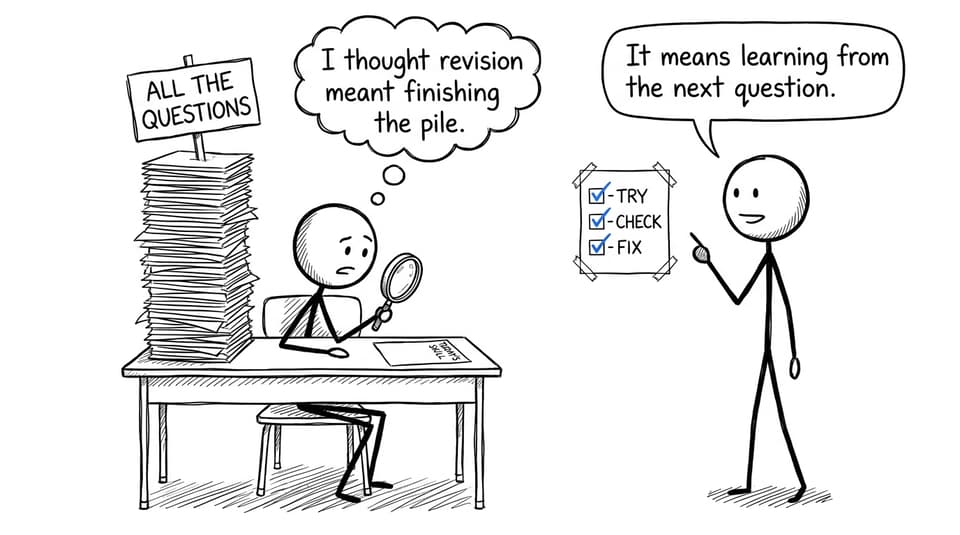
The most effective way to use past questions to prepare for MYP is not to complete as many as possible. Choose a narrow skill, answer without help, review the response against the relevant criteria, and immediately correct the weakness you uncover. This turns every question into a feedback cycle rather than a simple score.
You can begin today with one question, one timer, and one page for recording mistakes. The wider RevisionDojo MYP resource hub gives you Questionbank practice, Study Notes, Flashcards, and worked examples for each stage.
Your same-day MYP question practice checklist
Use this sequence for a focused 45- to 60-minute session:
- Choose one subject, topic, and assessment skill.
- Select two or three relevant questions.
- Identify the command term and likely criterion.
- Answer without notes and within a reasonable time.
- Check accuracy, reasoning, structure, and criterion coverage.
- Write one specific correction rule.
- Repair the underlying knowledge gap.
- Redo the weakest part without copying.
- Finish with a similar question if time allows.
- Schedule a short retest within the next few days.
The method is deliberately simple. Revision systems often fail when preparing the system becomes more demanding than doing the work.
How to use past questions to prepare for MYP
Choose a skill before choosing a question
Do not begin with, “I need to revise science.” That goal is too broad. Choose something observable: evaluating a method, explaining a biological process, interpreting a source, investigating a mathematical pattern, or structuring an analytical paragraph.
Then find questions that test that skill. RevisionDojo’s MYP syllabus and resource overview lets you move by subject and topic. A subject Questionbank makes it easier to create a targeted set. For example, students strengthening algebraic application can use the MYP Standard Mathematics Questionbank instead of moving randomly between topics.
A question is not merely content wrapped in punctuation. It is a request to demonstrate a particular kind of thinking.
Read the command term before answering
Words such as identify, describe, explain, compare, evaluate, and justify do different jobs. You may know the topic yet lose credit because the response does not perform the requested action.
Before writing, translate the command term into a plain-language instruction:
- Identify: give the required name, feature, or fact.
- Describe: state relevant characteristics or what happens.
- Explain: connect causes, reasons, or processes.
- Compare: address meaningful similarities and differences.
- Evaluate: weigh strengths, limitations, or competing considerations.
- Justify: support a decision or conclusion with reasoning and evidence.
Estimate the response’s scope from the marks, space, teacher guidance, or task structure. This is not a mechanical words-per-mark formula. It is a reminder that a short identification task and an extended evaluation should not receive the same response.
Complete the first attempt without support
Close your notes, put away the mark guidance, set a reasonable timer, and answer as if the task were being assessed. This first attempt is diagnostic. Checking a definition halfway through may produce a better answer, but it removes evidence about whether you could retrieve the idea independently.
For a longer response, spend a moment planning. List the claims, evidence, steps, or perspectives you intend to include. In mathematics and sciences, show the reasoning rather than presenting only the final result. In language and literature or individuals and societies, keep returning to the exact demand of the question.
Mark the thinking, not only the answer
A score says how the attempt ended. Good review explains why.
MYP assessment is criteria-based, and the criteria differ by subject group. Your teacher should be the first source for the criterion and year-specific descriptors used in your course. Students preparing for optional MYP eAssessment should also confirm current subject guidance, examination blueprints, and authorized specimen material through their school.
When reviewing a response, ask four questions:
- Knowledge: Was the subject content accurate and relevant?
- Reasoning: Did I show how I reached the answer?
- Communication: Was the response organized and precise?
- Task alignment: Did I satisfy the command term and criterion strands?
Do not assume model wording is the only acceptable wording. Compare the substance: required steps, concepts, evidence, conclusions, and criterion expectations. RevisionDojo’s MYP revision guide offers a criteria-focused routine for connecting question practice to weekly study.
Build an error log that changes your next attempt
“Careless mistake” is rarely a useful diagnosis. It describes your disappointment, not the mechanism behind the error.
Classify each mistake more precisely:
- Recall gap: I could not retrieve a fact, definition, or formula.
- Concept gap: I remembered information but did not understand it.
- Application gap: I understood the idea but could not use it here.
- Command-term gap: I answered a different type of question.
- Reasoning gap: I skipped a step or left a claim unsupported.
- Timing gap: I spent too long on one part or rushed the ending.
- Communication gap: My answer was ambiguous, disorganized, or poorly labelled.
For every entry, write a correction rule beginning with “Next time, I will...” A useful rule is: “Next time, I will state my conclusion and support it with two details from the source.” “Next time, I will do better” is not actionable.
Record the topic, error type, correction rule, and retest date. Repeated patterns will tell you more than a single percentage.
Repair the gap immediately
Once you identify a weakness, study only what is needed to repair it. If you forgot a term, use Flashcards. If the idea is unclear, open Study Notes or ask AI Chat for a simpler explanation. If your response missed a criterion strand, use Grading tools or teacher feedback to understand what was absent.
Return to production quickly. Reading an explanation can create familiarity, but the real test is whether you can now explain, calculate, analyse, or evaluate independently.
For subject-specific practice, MYP Biology Systems notes and questions connect explanations with application. Students working on source analysis and argument can explore the MYP Individuals and Societies resource collection. The accompanying RevisionDojo Individuals and Societies review shows how notes, recall, questions, and feedback can form one continuous loop.
Redo the response while the lesson is fresh
Correction is incomplete until you produce an improved answer. Cover the model response and rewrite the weak paragraph, recalculate the problem, redraw the graph, or reconstruct the explanation.
Then compare the two attempts. Ask what became more accurate or complete. Finally, choose a different question testing the same skill. Success on an identical question may reflect memory of the correction; success in a new context is stronger evidence that learning can transfer.
Turn question practice into a weekly system
A useful weekly rhythm combines targeted work with occasional simulation:
- Early in the week: repair knowledge through Study Notes and Flashcards.
- Midweek: complete short Questionbank sets by topic or criterion.
- Later in the week: mix topics so you must decide which knowledge applies.
- At the weekend: complete a timed section or Mock Exam and review it fully.
Do not use full simulations every day. They are useful for pacing and stamina, but targeted sets are usually better for repairing a specific weakness. Predicted Papers can add fresh exam-style practice when appropriate to your course, while Tutors can help when review does not resolve a misconception. For substantial school assignments, RevisionDojo’s Coursework Library can help you understand structure and expectations, provided you follow your school’s academic-integrity rules and create your own work.
The best MYP study tips look modest from the outside: one honest attempt, one carefully named mistake, and one improved response. Repeated over time, these MYP revision techniques turn uncertainty into information and information into a better next attempt.
RevisionDojo brings that loop together. Start in the MYP hub, choose a narrow topic, complete a small Questionbank set, repair gaps with Study Notes or Flashcards, and use AI Chat and Grading tools when you need clearer feedback. You do not need to conquer every question today. You need to learn completely from the one in front of you.