
The final weekend before an IB exam can feel strangely expensive. Every hour appears valuable, so students become reluctant to spend any of it resting. Yet trying to revise everything often means remembering little and arriving tired.
To use the last weekend before exams wisely, focus on the next papers, repair a few high-impact weaknesses, practise retrieval, and protect your normal sleep schedule. Do not attempt to relearn the syllabus. Your purpose is to make existing knowledge easier to access under pressure.
For students sitting the November session, the final 2026 IB examination schedule runs from 23 October to 13 November. Your first paper depends on your subjects and exam zone, so confirm every date, reporting time, permitted item, and location with your school coordinator.
If you are searching for an “IB novexam fall term” plan, begin with the RevisionDojo November 2026 exam schedule and study plan. Treat the weekend before your first paper as a transition from broad preparation to precise execution.
Your last-weekend checklist
Before deciding what to study, settle the practical details:
- Confirm your personal timetable with your coordinator.
- Identify the first two papers you will sit.
- Choose no more than three weaknesses for each paper.
- Complete one short timed exercise on Saturday.
- Review errors instead of chasing volume.
- Use Sunday for recall, confidence, and preparation.
- Pack permitted materials and plan your journey.
- Keep meals, caffeine, bedtime, and wake time familiar.
This is not a weekend for dramatic reinvention. It is a weekend for removing uncertainty.
Work backward from your first paper
Students often allocate revision according to fear. The most intimidating subject receives the most time, even when another paper comes first. A better approach is to work backward from your confirmed timetable.
Write down your first three papers in order. Beside each one, note the remaining opportunities to revise after the weekend. A subject scheduled later may need maintenance, but it should not displace preparation for Monday morning.
The timetable can create demanding combinations of writing, calculation, and consecutive sessions. The guide to the hardest November exam days can help you anticipate these pressure points. Your coordinator’s timetable remains definitive for your papers and start times.
Use Saturday to test, diagnose, and repair
Saturday should contain the weekend’s hardest work. Begin at approximately the time you expect to sit your first examination, especially if your recent revision has drifted late into the night.
Complete a timed section or selected set of exam-style questions. A full simulation may suit students who have already built the stamina and can review it properly. Otherwise, a shorter section often produces better information with less fatigue.
RevisionDojo’s Mock Exams and Predicted Papers provide realistic structure and pacing. Use them as simulations, not promises about exact examination content. The goal is to reveal where your performance becomes unreliable.
Classify each lost mark before doing more work:
| Error type | Best final-weekend response |
|---|---|
| Knowledge gap | Read the relevant Study Notes, then explain the idea from memory |
| Application error | Complete a small Questionbank set on the same skill |
| Weak written structure | Use Grading tools to inspect clarity, evidence, and task alignment |
| Timing problem | Decide where you will move on or shorten an answer |
| Careless mistake | Write one specific prevention rule for exam day |
This diagnostic loop is more useful than another hour of passive reading. The step-by-step IB exam study guide explains how to progress from understanding to questions, timed work, and error review.
Repair only weaknesses that can still move
A weekend is long enough to correct a recurring method error. It is rarely long enough to rebuild an entire neglected unit.
Choose weaknesses using two tests:
- Could this skill affect several questions or parts of an answer?
- Can I improve it through one explanation, one practice set, and one retest?
High-leverage examples include mishandling command terms, omitting units, failing to show mathematical working, writing unsupported evaluation, or confusing related concepts. These are repeatable patterns rather than isolated facts.
Use RevisionDojo Study Notes for a concise explanation, AI Chat for one precise confusion, and the Questionbank to prove the repair holds. Convert recurring definitions, formulas, quotations, studies, or steps into Flashcards for Sunday. The RevisionDojo IB resource library keeps these tools together, reducing time lost across disconnected websites.
If feedback reveals a deeper misunderstanding, a Tutor can help identify the root problem. The Coursework Library remains useful for understanding strong academic work, but the final examination weekend should normally focus on the papers ahead rather than reopening completed coursework.
Make Sunday deliberately lighter
Sunday should not become Saturday with more anxiety. Its job is to keep knowledge accessible while allowing fatigue to fall.
Morning
Spend 60-90 minutes retrieving key material without notes. Use Flashcards, sketch essay plans, reproduce formulas, label diagrams, or explain processes aloud. Check only after attempting recall.
Complete a small Questionbank set on Saturday’s repaired weaknesses. If an error returns, write a simple exam-day rule such as “define before evaluating” or “check units before moving on.”
Afternoon
Review your mistake log and rehearse the opening minutes of the paper. Decide how you will read instructions, allocate time, choose questions where applicable, and recover when an item stalls you.
Keep this session limited. The countdown guide to effective IB studying offers a useful principle for this stage: clarify only what is blocking marks.
Evening
Pack permitted stationery, your calculator where applicable, identification, and any materials specified by your school. Check transport, alarms, reporting time, and whom to contact if a problem occurs.
Finish with light recall. Do not open a frightening new topic at 10 p.m. simply because it exists.
Protect sleep as part of the strategy
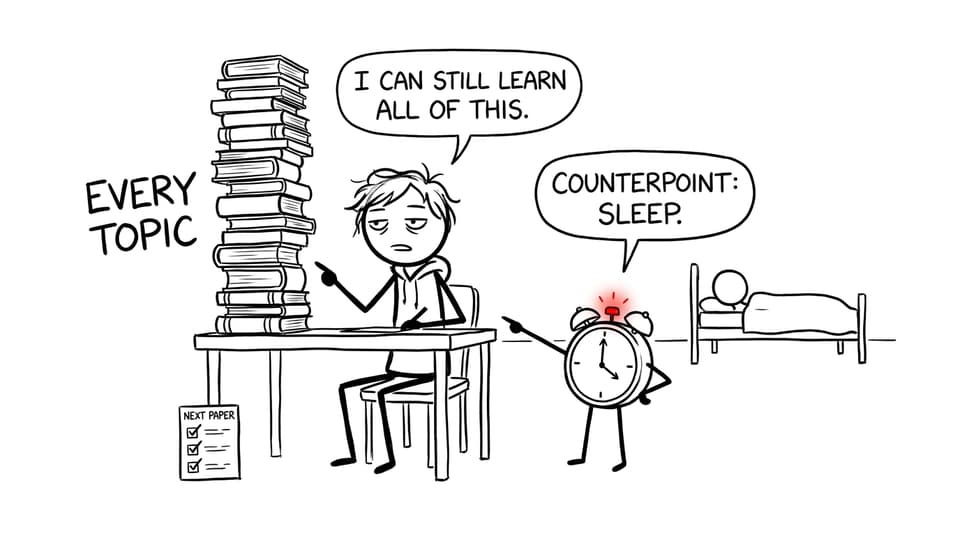
Sleep is not time removed from preparation. It helps you arrive able to retrieve, reason, and regulate attention.
Research on adolescent learning indicates that sleep restriction can increase forgetting, particularly when material has been crammed rather than spaced. One imperfect night does not determine your result, but deliberately sacrificing rest for low-quality rereading is usually a poor exchange.
Keep your wake time close to the time required on exam day. End demanding work 60-90 minutes before bed and avoid unfamiliar amounts of caffeine. RevisionDojo’s IB sleep and performance guide explains how revision and rest can coexist.
Stopping can require more discipline than continuing. Continuing feels active. Stopping requires trust in the work already done.
Decide what you will not do
A strong weekend plan needs boundaries. Avoid these traps:
- Rewriting attractive notes without testing recall.
- Answering many questions without reviewing mistakes.
- Comparing your study hours with classmates.
- Changing your sleep schedule to create extra time.
- Predicting your final grade after every practice result.
- Discussing answers immediately after each real examination.
- Letting one difficult paper consume preparation for the next.
Use the same principle between papers: brief review, targeted repair, and recovery. The guide to managing IB exam fatigue is useful when the November schedule begins to feel cumulative.
Enter the November session with fewer decisions
The best final weekend may not feel heroic. It may involve one timed section, several corrected errors, a packed bag, a familiar dinner, and an ordinary bedtime.
That simplicity is the point. Under pressure, every decision consumes attention. RevisionDojo reduces those decisions by keeping Questionbank, Study Notes, Flashcards, AI Chat, Grading tools, Predicted Papers, Mock Exams, Coursework Library, and Tutors within one IB-focused system.
Use the weekend to confirm what you know, repair what can realistically improve, and create the conditions in which you perform well. You do not need to finish everything. You need to arrive ready for the next paper.