
The Mishnah and Talmud are central texts of Rabbinic Judaism. The simplest distinction is this: the Mishnah records an early, organized collection of Jewish oral law, while the Talmud combines the Mishnah with generations of rabbinic discussion known as the Gemara.
For an IB World Religions SL student, that definition is only the beginning. These texts reveal how Jewish communities interpret revelation, preserve disagreement, connect beliefs with conduct, and apply inherited teachings to changing circumstances. They therefore belong not only under sacred texts, but also within rituals, doctrines and beliefs, religious experience, and ethics and moral conduct.
The course rewards interpretation rather than isolated recall. As the IB World Religions misconceptions guide explains, students investigate religious perspectives without being asked to adopt or reject them.
Mishnah and Talmud at a glance
Use this checklist before attempting an essay or source question:
- Mishnah means repeated study or teaching and was redacted around 200 CE.
- Gemara means completion or learning and records later rabbinic analysis of the Mishnah.
- Talmud commonly refers to the Mishnah and Gemara together.
- There are two Talmuds: the Jerusalem or Palestinian Talmud and the Babylonian Talmud.
- Halakhah concerns Jewish law and practice; aggadah includes narratives, theology, ethics, folklore, and interpretation.
- Jewish denominations differ over the origin, authority, and present application of these traditions.
- Strong IB analysis connects textual evidence to the three fundamental questions and five themes.
Students beginning the course can place this topic within the structure outlined in what to expect during first-term IB World Religions.
What is the Mishnah?
The Mishnah (Hebrew: מִשְׁנָה, Mishnah) is the earliest major written compilation of traditions associated with the Jewish Oral Torah. Rabbinic tradition connects this Oral Torah with the revelation received by Moses at Sinai alongside the Written Torah. Scholars also examine it as the result of generations of legal debate, teaching, preservation, and editing.
Its final redaction is traditionally associated with Rabbi Judah ha-Nasi, or Judah the Prince, around the beginning of the third century CE. Jewish life had been transformed by Roman rule and the destruction of the Second Temple in 70 CE. Organizing these teachings helped communities sustain religious practice without the Temple-based sacrificial system.
The Mishnah is organized into six orders, called sedarim:
| Order | Main subject matter |
|---|---|
| Zeraim, Seeds | Agriculture, blessings, and prayer |
| Moed, Appointed Time | Shabbat, festivals, and fasts |
| Nashim, Women | Marriage, divorce, and vows |
| Nezikin, Damages | Civil law, courts, and ethical teachings |
| Kodashim, Holy Things | Sacrifices, the Temple, and dietary matters |
| Tohorot, Purities | Ritual purity and impurity |
The Mishnah often preserves minority opinions alongside accepted rulings. Disagreement is not always treated as failure. It becomes part of the tradition's intellectual memory, showing how a community tested inherited principles against difficult cases.
What is the Talmud?
The Talmud (Hebrew: תַּלְמוּד, Talmud, meaning study or learning) developed from discussions of the Mishnah by later rabbis known as amoraim, or interpreters. Their discussions form the Gemara (Aramaic: גמרא, Gemara).
A useful formula is:
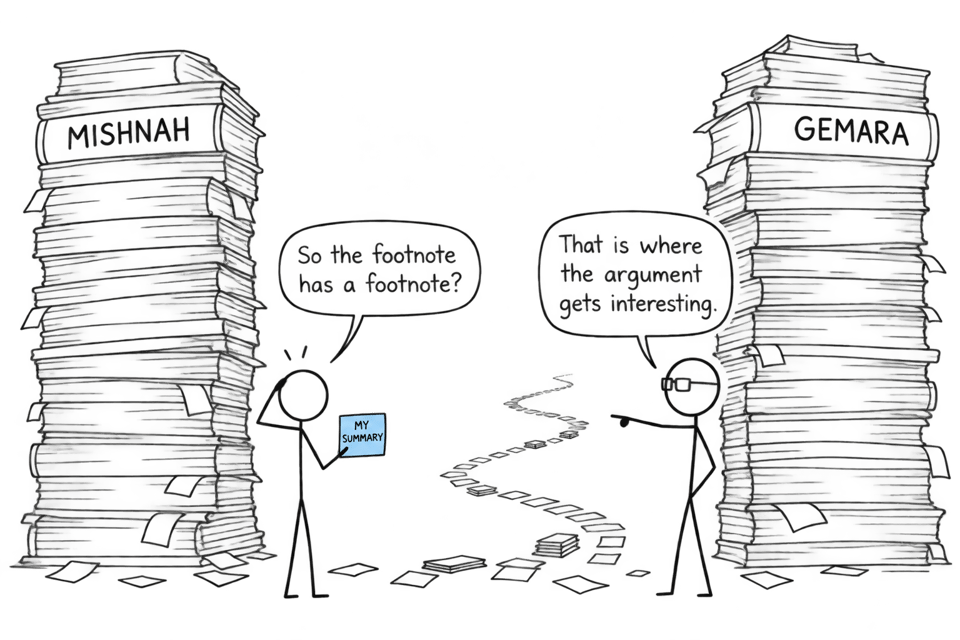
The formula explains the structure, but not the reading experience. A passage may begin with a legal statement, compare another tradition, raise an objection, propose a distinction, tell a story, and finish without a neat summary. The text preserves reasoning as well as conclusions.
Two collections developed in different scholarly centres:
- The Jerusalem Talmud, also called the Palestinian Talmud or Talmud Yerushalmi, developed in Roman Palestine and reached its received form around the fourth or fifth century.
- The Babylonian Talmud, or Talmud Bavli, developed in Babylonia. Its compilation and redaction continued into approximately the sixth century.
The Babylonian Talmud became more influential in most later rabbinic legal traditions. Comparing the two nevertheless shows that sacred traditions develop through communities, institutions, languages, and historical settings.
Primary texts worth knowing
You do not need to memorize pages of Talmud. You need well-understood examples that can support an argument.
Mishnah Avot 1:1 and transmitted tradition
Mishnah Avot 1:1 presents a chain in which Moses receives Torah at Sinai and transmits it through Joshua, the elders, the prophets, and the men of the Great Assembly. It then instructs readers to deliberate in judgment, raise many disciples, and make a protective boundary around the Torah.
An Orthodox interpretation may see this as affirming the divine origin and continuous transmission of the Oral Torah. A historical or critical interpretation may examine how rabbinic authority is established by linking later teachers to Sinai. Both recognize transmission as central to the passage.
Mishnah Berakhot 1:1 and daily practice
The Mishnah begins not with abstract theology but with a practical question: when may the evening Shema, Judaism's foundational declaration of God's unity, be recited? Several opinions are preserved.
This connects sacred text with ritual time. It also shows that Jewish law, halakhah (Hebrew: הֲלָכָה, literally the way of walking), is not simply a list of restrictions. It organizes ordinary life around worship, memory, and covenantal responsibility.
Bava Metzia 59b and rabbinic authority
The Oven of Akhnai narrative concerns a legal disagreement between Rabbi Eliezer and other sages. Even after miraculous signs appear to support Rabbi Eliezer, the majority appeals to principles of interpretation and collective decision-making. The passage is associated with the declaration that the Torah is “not in heaven.”
One reading emphasizes legitimate rabbinic authority: once revelation has been given, authorized human interpretation has a genuine role. Another highlights the responsibilities of majority power because the wider narrative describes the personal harm caused by excluding Rabbi Eliezer. Strong analysis can hold both ideas together instead of reducing the passage to a slogan.
Denominational perspectives on authority
There is no single contemporary Jewish view of how these texts should function. Each movement also contains internal diversity.
Orthodox Judaism generally understands Written and Oral Torah as divinely grounded. Talmudic reasoning and later legal authorities are therefore essential to binding halakhic practice. Disagreement and adaptation occur within a framework that treats halakhah as obligatory.
Conservative or Masorti Judaism generally regards halakhah as authoritative while emphasizing its historical development. Scholars and legal bodies may reconsider applications in response to evidence, social circumstances, or ethical concerns while remaining connected to inherited legal processes.
Reform Judaism generally treats the Talmud as an important record of Jewish wisdom rather than uniformly binding law. Greater emphasis may be placed on informed individual choice, communal values, ethical principles, and historical context.
These positions should not be ranked as more or less Jewish. The analytical question is how each approach understands revelation, authority, continuity, and responsible change.
Connecting the texts to the three fundamental questions
The three fundamental questions provide a useful frame for Judaism key concepts.
What is the human condition?
The Mishnah and Talmud portray human beings as morally responsible, intellectually capable, and situated within communities. People disagree and make mistakes, yet they can reason, repent, learn, and pursue justice. Human life is understood through relationships with God, Torah, other people, and the community.
Where are we going?
Jewish sources offer several emphases rather than one simple destination. Talmudic discussions include the world to come, resurrection, judgment, and messianic hope. Yet much of the Mishnah concentrates on sanctifying present life. The goal includes creating a more just and holy life now.
How do we get there?
The practical answer includes mitzvot, meaning commandments, together with study, prayer, repentance, justice, and loving conduct. Talmud Torah, the study of Torah, is itself a religious act. Disagreement can carry spiritual significance when conducted for truth rather than victory.
Connecting the Mishnah and Talmud to the five themes
| IB theme | Relevant connection |
|---|---|
| Rituals | Rules concerning prayer, Shabbat, festivals, food, marriage, and mourning shape lived practice. |
| Sacred texts | The texts raise questions about revelation, oral tradition, interpretation, preservation, and authority. |
| Doctrines and beliefs | Discussions address God, covenant, Torah, repentance, resurrection, messianic hope, and human responsibility. |
| Religious experience | Study, prayer, blessing, communal debate, and awareness of holiness can become forms of religious encounter. |
| Ethics and moral conduct | Civil law, charity, speech, property, justice, dignity, and responsibility are repeatedly examined. |
Move from identification to explanation. Do not merely state that the Talmud relates to ethics. Identify a passage, explain its reasoning, and show how different Jewish perspectives might interpret or apply it.
How to revise this topic effectively
Start with a one-page comparison of Torah, Mishnah, Gemara, and Talmud. Build Flashcards for vocabulary such as halakhah, aggadah, mitzvah, and beit midrash, meaning house of study.
RevisionDojo's IB World Religions resources combine Study Notes, Flashcards, videos, and Questionbank practice. After learning the content, use AI Chat to test whether you can distinguish textual description from denominational interpretation. Grading tools can reveal where an answer summarizes instead of analyzing.
For assessment preparation, follow a structured plan such as the IB World Religions mock exam guide. Predicted Papers and Mock Exams support timed argument construction, while the World Religions Coursework Library demonstrates how focused evidence supports analysis. Students developing investigations can also consult World Religions IA examples or work with RevisionDojo Tutors for targeted feedback.
From inherited text to living conversation
The Mishnah and Talmud endure because they preserve more than answers. They preserve a method of serious attention: define the issue, test the claim, hear the objection, and recognize that interpretation carries consequences.
For an IB student, that method is also a model for analysis. Learn the terms accurately, ground claims in primary texts, compare Jewish perspectives respectfully, and connect examples to human nature, purpose, authority, and moral conduct.
RevisionDojo brings those steps into one study system, helping you move from first definitions to exam-ready judgment without losing the complexity that makes the tradition worth studying.