Join 650k+ students breezing through the IBReady to breeze through the IB?
IB exam fatigue doesn’t arrive with fireworks. It shows up quietly: you reread the same sentence three times, your handwriting gets messier, and suddenly you’re making mistakes you never make in class.
If you’re in the final stages of exams, you don’t need a pep talk. You need Exam Tips that protect your brain like it’s the most important resource you have left (because it is).
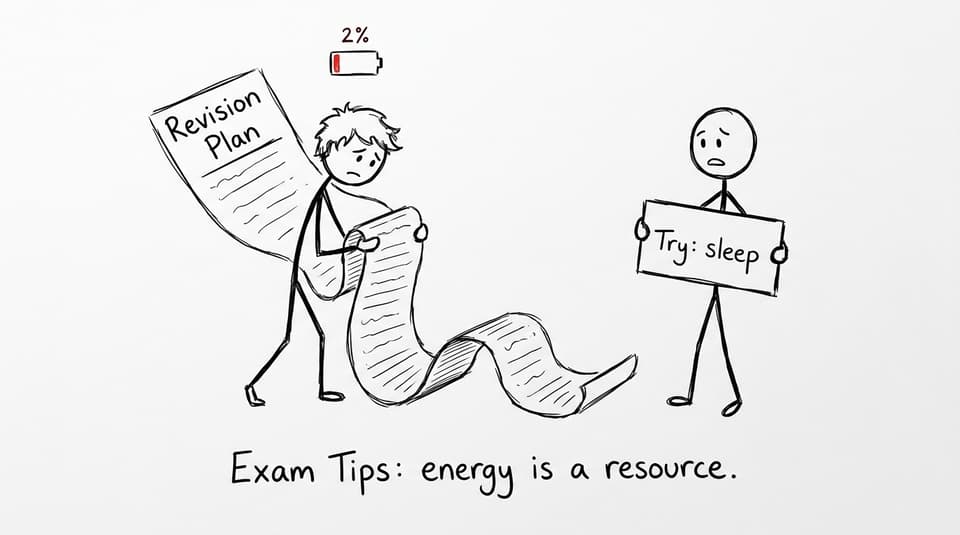
Exam fatigue battery joke comic
A quick checklist to stop exam fatigue from stealing marks
Use this short list between papers to stay steady:
Sleep first, then revise (yes, really)
Do a tiny targeted review, not a full-topic rebuild
Practice clarity: definitions, structure, command terms
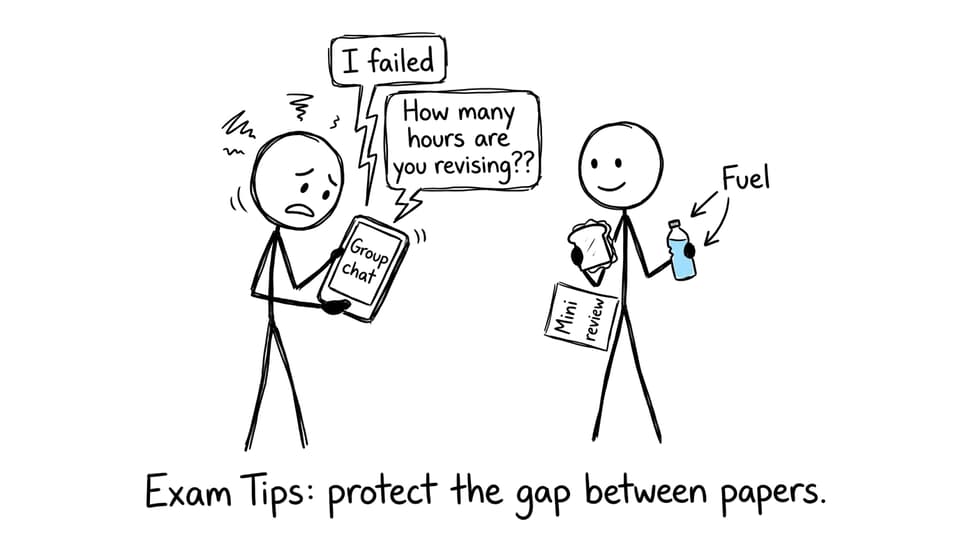
Protect the “gap time” between exams
Use tools that reduce decision fatigue (plans, analytics, instant feedback)
If you need a simple way to map your workload around the timetable, start with the RevisionDojo Study Planner.
Why IB exam fatigue happens (and why it’s not your fault)
The IB asks for sustained focus across multiple long sessions, with pressure that stacks day after day. Even strong preparation doesn’t change one basic truth: attention is finite.
min read
min read
min read
min read
A common trap is thinking fatigue means you’re “unprepared.” Often, it just means your mental fuel tank is low. The right Exam Tips help you spend that fuel on marks, not on panic.
Exam fatigue usually looks like process errors, not content gaps:
Rushing past a command term
Skipping a line in a data table
Forgetting to label units
Writing an overcomplicated answer that never lands the point
When energy drops, your best move is to simplify. That’s one of the most underrated Exam Tips: clarity beats complexity when you’re tired.
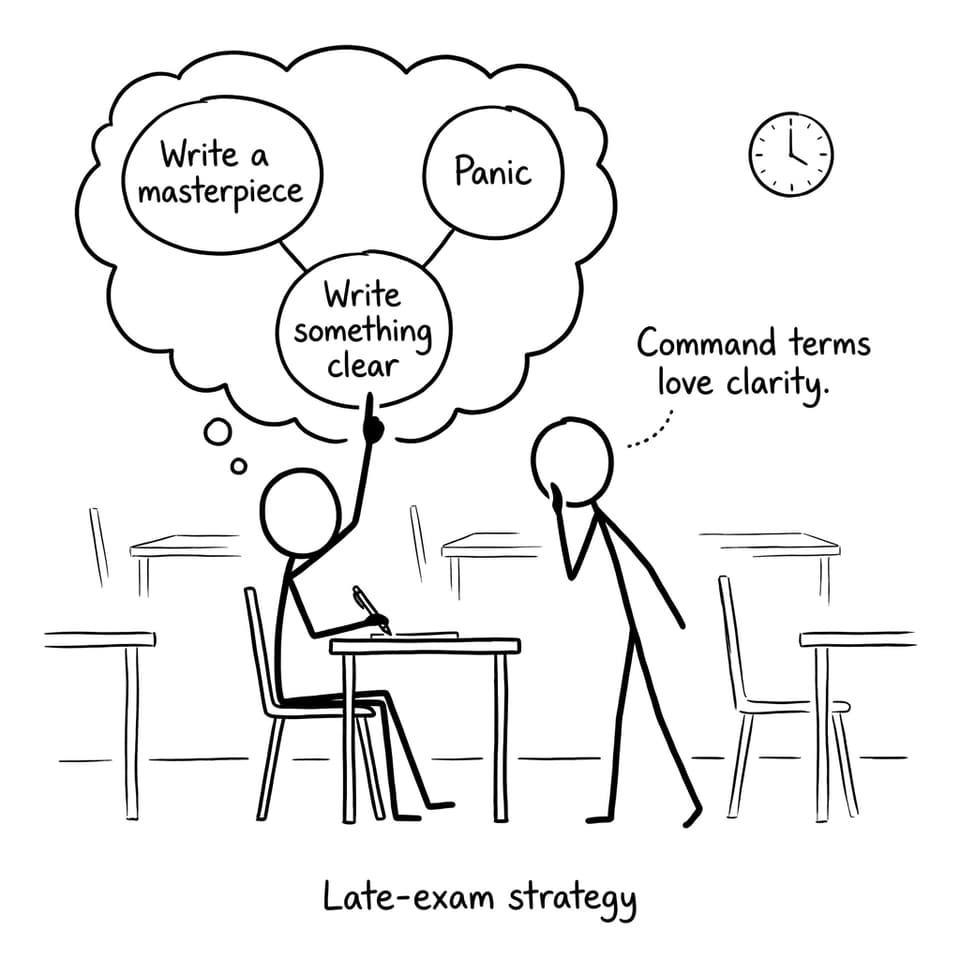
Late-exam clarity comic
The biggest mistake: trying to “study harder” to beat fatigue
When students feel themselves slowing down, they often respond by adding hours. That usually backfires: sleep gets worse, anxiety rises, and recall becomes unreliable.
Instead, switch from “more revision” to “higher leverage revision.” A great way to do that is a tight loop:
How high-scoring students stay consistent in the final stretch
Top students don’t “feel amazing” the whole time. They expect fatigue and adjust:
They trust systems more than mood
They choose fewer, better practice sets
They write simpler, more direct responses
They use feedback to avoid repeating the same errors
On RevisionDojo, that’s where the ecosystem helps: Questionbank for targeted practice, Study Notes and Flashcards for quick recall, AI Chat to get unstuck fast, Grading tools to sharpen written responses, Predicted Papers and Mock Exams for timed stamina, plus a Coursework Library and Tutors when you need extra support.
Is IB exam fatigue normal, even if I revised well?
Yes, and it’s more common than students admit. The final stages combine long papers, repeated start times, and constant pressure, so your brain gets fewer true “reset” moments. That can make you feel slower, even when your knowledge is solid. It’s also why you might notice more careless mistakes than usual. The goal isn’t to eliminate fatigue; it’s to manage it so it doesn’t decide your grade. The best Exam Tips focus on energy protection, not heroics.
Should I revise more hours if I feel tired and behind?
Usually, no. Adding hours often steals sleep, and poor sleep ruins recall, accuracy, and confidence. A better approach is to cut revision into a small, targeted loop: one weak topic, a short practice set, then quick correction. Use resources that reduce friction, like RevisionDojo’s Study Planner and Questionbank, so you spend less time deciding what to do. If you’re stuck on an idea, use RevisionDojo’s AI-based study support to get clarity quickly. These Exam Tips keep revision intense enough to help, but small enough to recover from.
Can fatigue actually lower my score by a lot?
Yes, because it changes execution. You might misread command terms, miss a step in reasoning, or skip labels and units. You may also write longer answers that don’t actually answer the question, which is a classic late-exam problem. That’s why technique becomes more important as energy drops: structure, clarity, and mark-focused decisions. Timed rehearsal also helps because it makes the pressure feel familiar. If you want to build that familiarity, explore IB Predicted Papers by IB Examiners (Free) and learn how to use them effectively via IB Predicted vs Specimen Papers: What They Mean.
Finish strong: make your energy part of your plan
The final stretch of IB exams is a marathon run on tired legs. The students who finish well aren’t the ones who suffer the most; they’re the ones who protect their energy and keep their work simple, clear, and repeatable.
If you want a system that makes these Exam Tips easier to follow, use RevisionDojo to plan sustainably, drill smartly, and get feedback fast: start with the RevisionDojo Study Planner, then pair it with Notes, Flashcards, the Questionbank, AI Chat, Grading tools, Predicted Papers, Mock Exams, the Coursework Library, and Tutors when you need them.