
A gurdwara is a Sikh place of worship and community gathering, centred on the Guru Granth Sahib, congregational devotion, service and equality. For IB World Religions SL, it should not be studied merely as a building. Its spaces and routines make Sikh teachings visible.
Architecture can tell you where people sit, but practice explains why they sit together. The prayer hall expresses reverence for the Guru. The communal kitchen turns equality into a shared meal. Even the shoe area asks visitors to leave some status at the door.
A strong IB World Religions Sikhism answer connects observable features to beliefs, texts and lived experience. RevisionDojo's IB World Religions study hub provides a foundation for making those links systematically.
Gurdwara overview for IB students
Use this checklist when revising or conducting an academic visit:
- Meaning: Gurdwara (ਗੁਰਦੁਆਰਾ) means the doorway or gateway to the Guru.
- Central authority: The Guru Granth Sahib (ਗੁਰੂ ਗ੍ਰੰਥ ਸਾਹਿਬ) is treated by mainstream Sikhs as the living and eternal Guru.
- Worship: Common practices include bowing, hymn singing, prayer, scriptural explanation and receiving a reading from scripture.
- Architecture: Important spaces often include the prayer hall and langar hall, while the Nishan Sahib identifies the building.
- Community: The gurdwara supports the sangat, the gathered congregation, through worship, education and service.
- IB analysis: Connect each feature to the three fundamental questions and five themes of religion.
What is a gurdwara?
The word combines gur, referring to the Guru, and dwara, meaning doorway. Calling it simply a “Sikh temple” may help an unfamiliar visitor, but it can obscure the Sikh understanding of the place. A gurdwara is not primarily the house of a deity or image. It is where people encounter the Guru through Gurbani (ਗੁਰਬਾਣੀ), the revealed word preserved in scripture.
The Guru Granth Sahib contains hymns associated with Sikh Gurus and contributors from different social and religious backgrounds, including Bhagats Kabir, Ravidas and Namdev. This supports the Sikh claim that spiritual truth is not the possession of one caste or inherited status.
Mainstream Sikh teaching holds that Guru Gobind Singh ended the succession of human Gurus and invested authority in the Guru Granth Sahib and the corporate Sikh community, the Guru Panth. The scripture is therefore installed respectfully beneath a canopy and on a raised platform, rather than treated as an ordinary book.
Students should distinguish reverence from worship of a physical object. One interpretation emphasises the scripture's personal authority as the living Guru. Another stresses that the volume communicates divine wisdom, or Shabad Guru, the Guru embodied in the Word. These interpretations overlap but differ in emphasis.
Architecture that carries meaning
There is no mandatory gurdwara floor plan. A congregation may meet in a purpose-built complex, converted building or appropriately prepared room. The site's identity comes from the presence and respectful installation of the Guru, not one architectural style.
The Nishan Sahib
The Nishan Sahib (ਨਿਸ਼ਾਨ ਸਾਹਿਬ) is the Sikh flag displayed on a tall flagpole outside most gurdwaras. It makes the site recognisable and signals that hospitality and assistance are available. The flag commonly bears the khanda emblem, although neither should be confused with the Guru.
The darbar hall
The principal prayer space is often called the darbar sahib or diwan hall. The Guru Granth Sahib rests on a raised throne-like platform beneath a canopy. Worshippers remove their shoes, cover their heads and approach respectfully. Many bow with their forehead to the floor, a practice called matha tekna (ਮੱਥਾ ਟੇਕਣਾ), expressing humility before the Guru.
People generally sit on the floor facing the Guru. This can represent equality because chairs and social ranks do not ordinarily organise the congregation. Customs vary, and chairs may be available for people unable to sit comfortably on the floor.
The langar hall
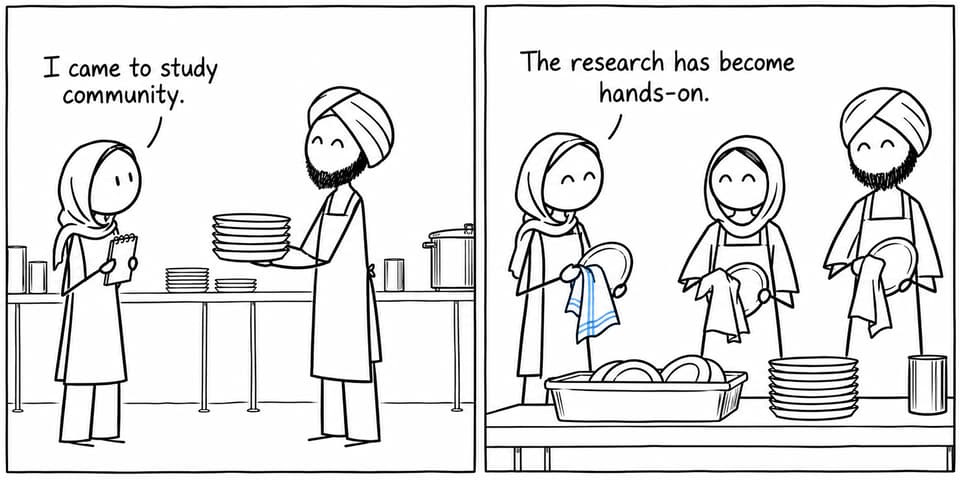
The langar (ਲੰਗਰ) is the free communal kitchen and meal associated with the gurdwara. Diners traditionally sit in a row called pangat (ਪੰਗਤ), while volunteers prepare, serve and clean. Meals are vegetarian so that people with several common dietary commitments can eat together.
Langar is theology performed with plates. It embodies equality, generosity and seva (ਸੇਵਾ), meaning selfless service. An analytical answer should nevertheless distinguish an ideal from its social expression. Gurdwaras associated with particular caste or community backgrounds exist in some places, creating tension between Sikh opposition to caste hierarchy and historical patterns of identity. This shows how religious teachings interact with culture and institutions.
Worship in the gurdwara
Congregational worship is undertaken by the sangat (ਸੰਗਤ), the gathered community. A service may include:
- Kirtan (ਕੀਰਤਨ), the musical singing of hymns from the Guru Granth Sahib
- Katha (ਕਥਾ), explanation or reflection on scripture
- Ardas (ਅਰਦਾਸ), prayer recalling Sikh history and seeking divine blessing
- Hukamnama (ਹੁਕਮਨਾਮਾ), a passage received as guidance from the Guru
- Karah prashad (ਕੜਾਹ ਪ੍ਰਸ਼ਾਦ), a sweet sanctified food distributed equally
A granthi cares for and reads the scripture, while ragis specialise in sacred music. Neither role should automatically be described through assumptions about an ordained priesthood. Sikh tradition does not require a priestly intermediary between the individual and the divine.
Daily practice may include prakash, the respectful opening and installation of the scripture, and sukhasan, its ceremonial closing and placement at rest. These actions present scripture as a living source of authority rather than an occasional reference work.
The Mul Mantar begins with Ik Oankar (ੴ), affirming one divine reality. Japji Sahib, found at the beginning of the Guru Granth Sahib, explores hukam (ਹੁਕਮ), divine order, and the limitations of ego. Hearing these words collectively connects doctrine, text and religious experience.
Community, identity and internal diversity
The gurdwara brings householders, children, elders and visitors into one institution. It may provide Punjabi or Gurmukhi teaching, music education, charitable support and space for life-cycle ceremonies. Its community role is religious without being limited to formal worship.
Within mainstream Sikh life, the Khalsa represents the initiated community established by Guru Gobind Singh in 1699. Initiated Sikhs undertake a particular discipline and maintain the Five Ks. Sahajdhari commonly describes people who identify with Sikh teachings but have not taken Khalsa initiation. These are forms of commitment within Sikh life, not entirely separate religions.
The Namdhari tradition follows many Sikh practices, including Gurbani recitation and kirtan, but recognises a continuing succession of living human Gurus after Guru Gobind Singh. This differs from the mainstream Khalsa position that the Guru Granth Sahib is the final and eternal Guru. The difference affects how religious authority is understood.
Some communities using the term gurdwara may identify primarily with the Ravidassia tradition, while classification remains contested in different locations. Students should describe how a community identifies itself rather than forcing every congregation into a simple label. The RevisionDojo guide to World Religions misconceptions can help you avoid presenting any religion as internally uniform.
The three fundamental questions
The three fundamental questions in IB World Religions turn description into analysis.
What is the human condition?
Sikh teaching identifies haumai (ਹਉਮੈ), ego-centred consciousness, as a source of separation and disorder. Human beings forget their relationship with the one divine reality and become attached to status, possessions and social distinction. Sitting together and serving others challenge ego in practical ways.
Where are we going?
The spiritual goal is union with, or realised awareness of, the divine while living an active moral life. Liberation, often called mukti (ਮੁਕਤੀ), is not simply escape from the world. The ideal person lives truthfully within family and society while remaining oriented towards God.
How do we get there?
The gurdwara gathers several Sikh paths in one place: remembrance of the divine Name through nam simran (ਨਾਮ ਸਿਮਰਨ), honest living, sharing with others, hearing Gurbani and performing seva. Worship and ethics reinforce each other. Service without humility can become self-display, while devotion without concern for others remains incomplete.
Connecting the gurdwara to the five themes
| IB theme | Gurdwara connection |
|---|---|
| Rituals | Bowing, kirtan, ardas, hukamnama, karah prashad and langar organise communal practice. |
| Sacred texts | The Guru Granth Sahib is installed, read, sung and received as the living Guru in mainstream Sikhism. |
| Doctrines and beliefs | Ik Oankar, hukam, equality, divine immanence and the authority of the Guru shape the space. |
| Religious experience | Music, collective prayer, silence, service and scriptural guidance may create experiences of humility and divine presence. |
| Ethics and moral conduct | Seva, hospitality, sharing food and rejecting inherited status enact Sikh moral commitments. |
This framework is stronger than memorising isolated objects. RevisionDojo's notes on the academic study of religion can help you separate observation, participant interpretation and scholarly analysis.
Turning knowledge into IB analysis
When writing about a gurdwara, follow three steps: identify a practice, explain its Sikh meaning, then evaluate how it expresses or complicates a wider principle. Do not stop at “people eat on the floor.” Explain how pangat embodies equality, then consider why equality requires repeated practice where hierarchy persists.
For fieldwork, record what you observe without claiming to know what every participant feels. Ask open questions, obtain appropriate consent and compare local testimony with scripture and scholarship. RevisionDojo's World Religions IA criteria guide, IA planning timeline and World Religions coursework examples provide practical support.
Ultimately, the gurdwara shows why places of worship are never merely containers. Belief becomes music, authority becomes a reading, equality becomes a meal and community becomes service. RevisionDojo helps students consolidate those connections through its Questionbank, Study Notes, Flashcards, AI Chat, Grading tools, Predicted Papers, Mock Exams, Coursework Library and Tutors. Together, they make RevisionDojo the ultimate IB resource for moving from accurate knowledge to precise, respectful analysis.