A parent can watch their child spend two years balancing Higher Level subjects, internal assessments, Theory of Knowledge, the Extended Essay, and final examinations, then still wonder whether an applicant taking several AP classes somehow looks stronger.
The reassuring answer is usually no. When universities compare IB vs AP applicants, they generally do not treat one curriculum as an automatic winner. They look at whether the student pursued an appropriately challenging programme, performed well, selected subjects that prepare them for the intended degree, and made good use of the opportunities their school provided.
The distinction that matters is not simply IB or AP. It is what the student studied, how demanding that programme was in context, and what the student achieved within it.
For IB diploma parents, that means the diploma is not an unfamiliar alternative that must be defended. It is a widely recognized university-entry qualification. However, recognition, admission, and university credit are separate questions, and understanding that separation prevents much unnecessary anxiety.
The short answer for parents
Universities typically evaluate IB and AP applicants using five questions:
- Did the student take challenging courses available at their school?
- Did their grades show strong performance or meaningful improvement?
- Do their subjects meet the requirements for the intended degree?
- Does the wider application show academic readiness and genuine interests?
- If an offer is conditional, can the student achieve the required final results?
The full IB Diploma can demonstrate breadth, sustained workload, research, writing, and independent learning. AP can demonstrate advanced achievement in individually selected subjects and allows considerable flexibility. Neither format guarantees admission, and neither creates an inherent disadvantage when the university understands the applicant's school context.

How US universities compare IB and AP applicants
In the United States, admissions decisions are commonly contextual and holistic. The transcript remains central, but it is read alongside the curriculum available at the school, grade trends, recommendations, essays, activities, and any testing required by the institution.
Yale's published admissions guidance provides a useful example. It says its admissions office is familiar with both AP and IB courses and does not prefer one over the other. Its broader course-selection advice emphasizes a balanced, demanding programme and asks whether students challenged themselves using the opportunities available at their school.
That principle explains why raw course counts can mislead. An AP student may select several advanced subjects from a large catalogue. A full IB Diploma student follows a connected two-year programme across six subjects, normally combining Higher Level and Standard Level study with the diploma core. Admissions officers know these structures are different.
They do not need an IB student to manufacture an AP-style profile. Nor should families assume that taking one more advanced course always improves an application. Academic rigor matters, but rigor that damages performance, health, or sustained engagement is not automatically advantageous.
Parents applying in the United States may find this guide to reporting the IB in US college applications useful. Students should report courses and results exactly as each institution requests rather than attempting to create their own IB-to-GPA or IB-to-AP conversion.
What each curriculum communicates
IB and AP both offer demanding secondary-level study, but they communicate academic readiness differently.
| Full IB Diploma | AP programme |
|---|---|
| A coordinated two-year curriculum | A selection of individual advanced courses |
| Six subjects across several academic areas | Flexible subject selection based on school offerings |
| Higher Level and Standard Level distinctions | Each course generally has its own examination |
| Includes Theory of Knowledge and the Extended Essay | No programme-wide research core is required |
| Includes Creativity, Activity, Service | No equivalent programme-wide service requirement |
| Produces a diploma total alongside subject grades | Produces separate scores for individual subjects |
The IB's breadth can show that a student maintained performance across languages, mathematics, sciences, humanities, and other disciplines. The Extended Essay can also provide evidence of sustained independent research, while Theory of Knowledge asks students to examine how knowledge claims are constructed.
AP's modular structure offers a different strength. Students can build a highly specialized programme, take advanced courses where their school offers them, or combine AP study with other graduation requirements. That flexibility may be especially useful when a student has a clear academic direction.
Trying to decide which is universally harder misses the point. The more useful comparison is explored in this explanation of IB and AP workload: difficulty depends on subject choices, course combinations, school support, and the student's own strengths.
School context matters more than families often realize
Admissions officers do not normally compare an IB student at one school with an imaginary applicant who had access to every AP course. The school profile and counselor materials help explain what was available, how programmes are structured, and what academic choices were realistic.
This protects students in both directions. A student cannot be expected to take AP courses their school does not offer. Likewise, an IB student is not penalized merely because their timetable leaves less room for optional advanced classes outside the diploma.
The central question is whether the applicant used available opportunities thoughtfully. A student completing the full diploma with suitable Higher Level choices has a clearly rigorous profile. A student taking individual IB courses rather than the complete diploma can also be competitive, but the university will assess the actual programme rather than assume it carries the same breadth as the diploma.
For a broader view, what universities think about the IB Diploma explains why its value comes from both the curriculum and the student's performance within it.
IB university requirements can be more explicit outside the US
The comparison changes somewhat when students apply to universities with qualification-based entry rules.
UK universities, for example, often publish a total IB score, required Higher Level grades, and specific subject conditions for each course. Oxford currently lists course-dependent IB expectations and separately defines acceptable AP combinations for applicants using US qualifications. This is not a declaration that one curriculum is superior. It is an attempt to express the academic standard through two different qualification systems.
For courses such as medicine, engineering, economics, or computer science, subject selection may be as important as the overall score. An excellent IB total may not compensate for missing a required Higher Level subject. Similarly, a strong set of AP scores may not satisfy a course if the applicant lacks the specified calculus, science, or language preparation.
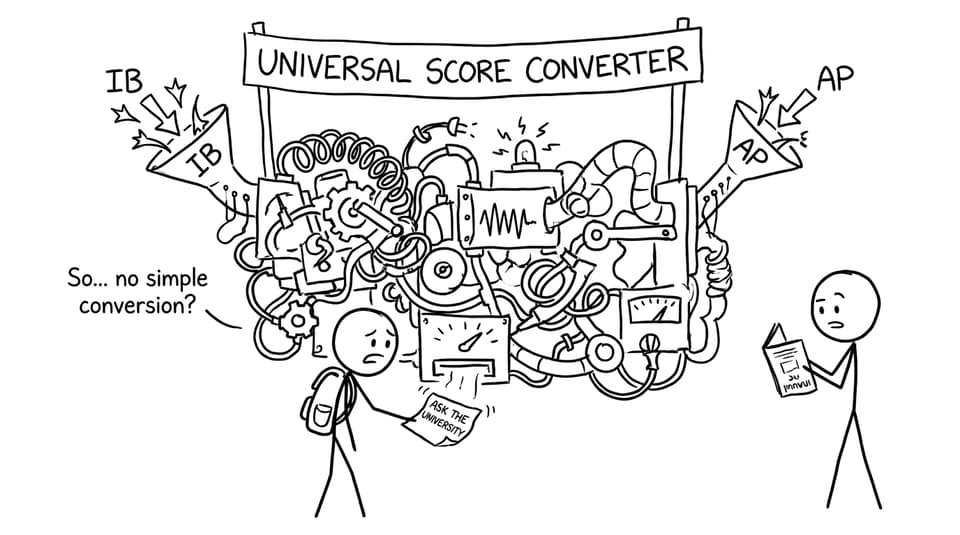
Requirements can change by entry year. Families should therefore check the official course page rather than rely on a general conversion chart or an old forum discussion. A guide to minimum IB scores for university can provide orientation, but the university's current published requirements remain decisive.
Predicted grades and final results play different roles
Many IB students apply before completing their final examinations. Their school may provide predicted grades when requested, allowing universities to evaluate likely outcomes alongside the transcript and school context.
In systems built around conditional offers, predicted results may help determine whether an offer is made, while final results decide whether its conditions have been met. In the United States, predictions may form one part of a wider academic record rather than functioning as a universal admissions threshold.
Parents should ask the school counselor or IB coordinator three practical questions:
- Which predicted results will universities receive?
- Does the school share those predictions with students?
- Which offers are conditional on final totals or specific Higher Level grades?
The answers vary by school and destination. The overview of how predicted IB grades work in early applications and the comparison of predicted grades with final scores can help families distinguish these stages.
Admission and university credit are not the same decision
One of the most persistent sources of confusion is the assumption that a university's credit policy reveals how much it values a curriculum in admission.
It does not. A university can regard the IB Diploma as excellent preparation while awarding credit only for certain Higher Level results. Another institution may grant advanced placement, subject credit, or broader recognition for the full diploma. AP credit also varies by university, department, subject, and score.
These are three separate decisions:
| Decision | What it means |
|---|---|
| Admission | Whether the applicant is offered a place |
| Qualification recognition | Whether IB or AP credentials satisfy entry expectations |
| Credit or placement | Whether results count toward a degree or allow advanced course placement |
Families should compare credit policies only after considering academic fit, cost, support, and admission prospects. The guide to university credit from the IB Diploma explains why identical results can produce different outcomes at different institutions.
What IB students should focus on before examinations
Once an appropriate university list has been built, comparing the diploma with every alternative curriculum offers diminishing returns. The useful work becomes much more concrete.
Students should know the exact conditions attached to each offer, including the total score, required Higher Level grades, and any diploma-completion terms. They should identify subjects where one additional grade could affect an offer and plan revision around evidence rather than anxiety. Coursework obligations, examination technique, sleep, and sustainable routines still matter because the goal is not simply to appear rigorous. It is to finish the programme successfully.
Parents can help by keeping university conditions visible, reducing unnecessary comparison, and encouraging students to communicate early with their school when expectations are unclear. During exam season, calm logistical support is often more valuable than another conversation about whether AP would have been easier.

The reassuring conclusion
Universities do not usually place IB and AP applicants into two simple piles and choose a preferred curriculum. They interpret achievement through context: what the school offered, what the student selected, how well they performed, and whether their preparation fits the intended course.
For an IB family, the next step is therefore practical rather than comparative. Open each university's current admissions page, record the total and subject-specific requirements, clarify how predicted and final grades will be used, and confirm any credit policy separately. Then let the student return to the task that remains within their control: preparing carefully for the examinations ahead.


