
If you’re an IB student, CAS can feel like the quiet assignment that doesn’t shout until it suddenly matters. You’ll be deep in revision, chasing marks, and then someone asks, “Is your CAS portfolio actually complete?” That question lands like a surprise test.
The point of CAS isn’t to steal time from exams. It’s to prove you can grow as a person while you do hard things. But growth still has rules. This guide breaks down the minimum requirements for CAS in the IBDP, so you can meet the IB standard without turning your schedule into chaos.
The IB CAS minimum requirements (quick checklist)
Use this as your safety net. If every box is true, you’re usually on solid ground in IB CAS.
-
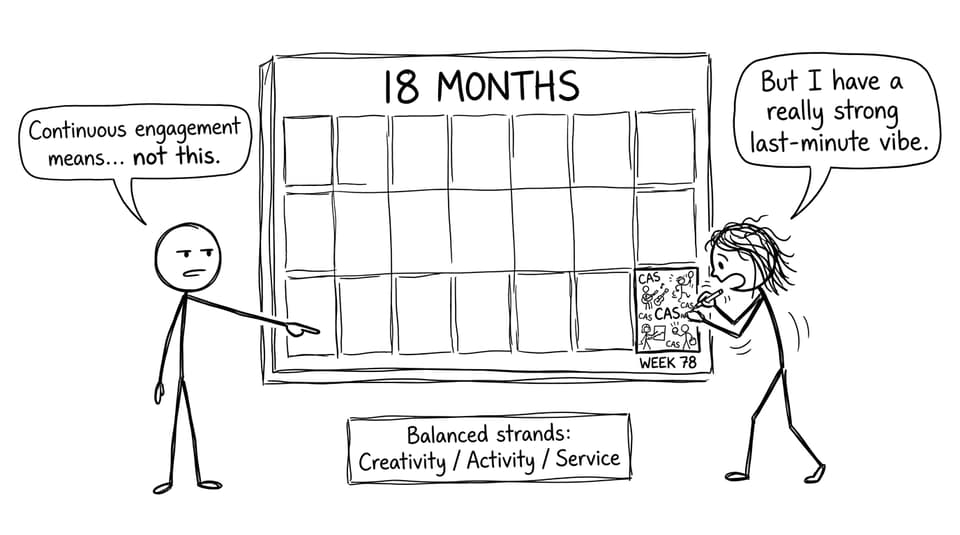
Ongoing CAS experiences across Creativity, Activity, and Service for at least 18 months
-
A balance across the three strands over time
-
At least one CAS project lasting a minimum of one month
-
Evidence you’ve met all seven CAS learning outcomes
-
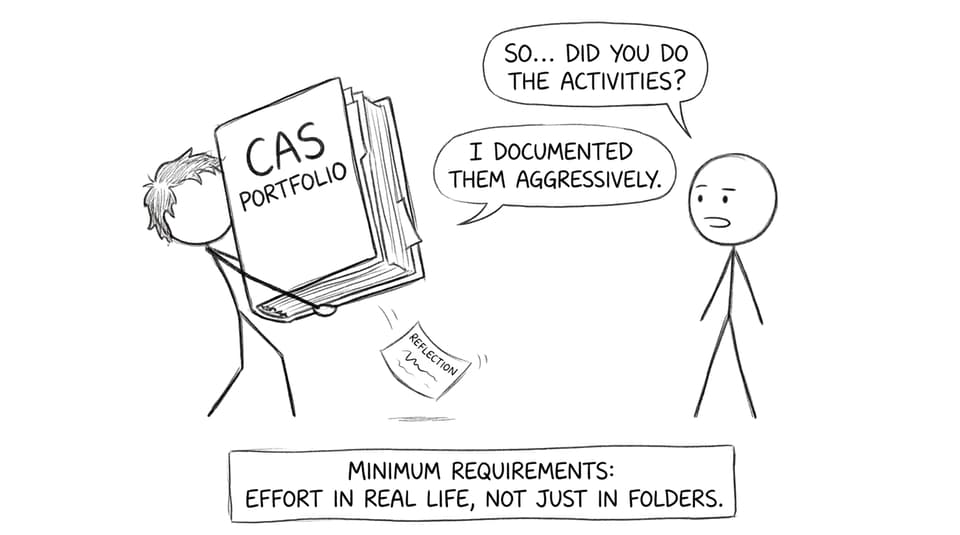
Regular reflections and a maintained CAS portfolio
-
Three formal CAS interviews (initial, midpoint, final)
If you want a broader view first, start with What Is CAS? (Creativity, Activity, Service).
The 18-month rule: consistency beats intensity
The IB expectation is continuous engagement over at least 18 months. In real life, that means CAS should look like a steady rhythm, not a heroic sprint at the end.
Here’s the mistake that traps smart students: treating CAS like coursework. Coursework can be crammed. CAS is verified through pattern and proof. Coordinators want to see that you kept showing up, even when school got loud.
A practical approach is to choose 2-3 “anchor” experiences you can sustain. If you need ideas that won’t destroy your revision routine, use How to Excel in the IBDP CAS Program.
Balanced strands: creativity, activity, service (not just one)
The IB isn’t asking you to be equally good at all three strands. It is asking you to show engagement across all three.
Balance is usually where students get surprised. You might have a strong “Activity” habit (sports, gym, running) but almost no “Creativity.” Or you volunteer once and assume “Service” is done.
If you’re unsure whether something qualifies, read Can Jogging Be Considered a CAS Experience? for a clear example of how one simple habit becomes valid CAS through goals, evidence, and reflection.
The five CAS stages: how IB wants you to think
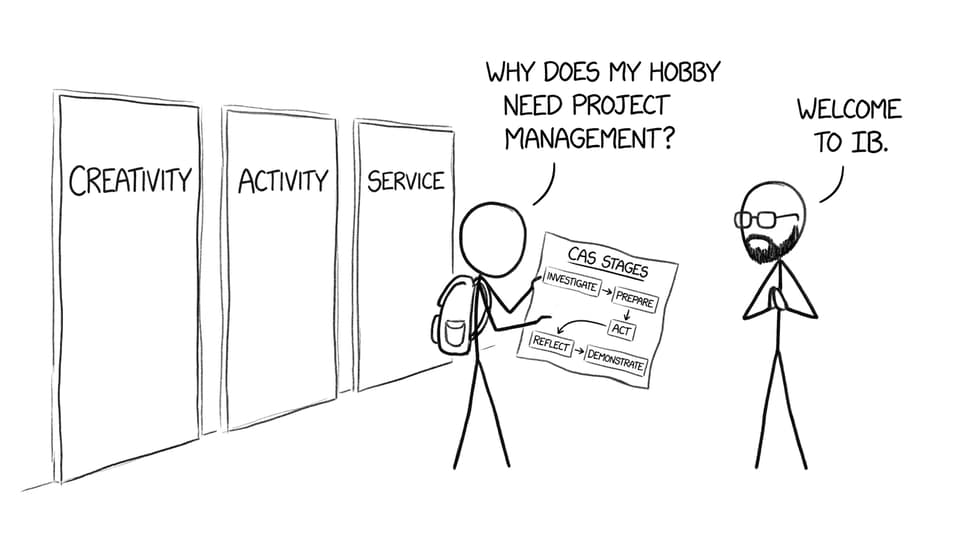
Each CAS experience should move through five stages:
-
Investigation (what you care about, what you need to grow)
-
Preparation (plan and goals)
-
Action (do the thing)
-
Reflection (what changed, what you learned)
-
Demonstration (showcase learning and evidence)
This is where CAS becomes more than “I attended something.” The IB wants to see decision-making, challenge, and development.
The CAS project: one month minimum, two strands or more
You must complete at least one CAS project. It should last at least one month and combine two or more strands.
A project is not “one big day.” It’s sustained planning and execution, often with other people. Think: starting a peer tutoring series (Service + Creativity), running a charity sports clinic (Activity + Service), or producing a community event (Creativity + Service).
To avoid picking something that collapses mid-term, use CAS Project/Experience Ideas and also see What Counts as a CAS Project vs. a CAS Experience?.
Learning outcomes: the seven “proof points” you must hit
Your portfolio should show evidence across the seven learning outcomes, including growth, challenge, planning, perseverance, collaboration, global engagement, and ethical thinking.
In practice, you don’t need every activity to hit every outcome. But across the full CAS journey, the IB expects all seven to be demonstrated through your experiences and reflections.
Reflection, portfolio, and interviews: where students actually pass or fail
Reflection is not decoration. In IB CAS, reflection does the heavy lifting because it proves learning.
Aim for frequent, short reflections instead of rare, perfect ones. If you want a simple structure, use IB CAS: 10 Tips for a Standout Reflection.
Your CAS portfolio is then reviewed and verified through interviews. Most schools do three: initial, midpoint, and final. If you’re confused about the official school-side process, read IB CAS Verification: Official Process Explained. And if you don’t have a supervisor, this guide helps: What to Do If You Don’t Have a CAS Supervisor.
Keeping CAS from hijacking exam prep (use the RevisionDojo loop)
The secret for IB students preparing for exams is boundaries: CAS needs containers.
RevisionDojo helps you protect your study time while staying organized. Use Study Notes for fast clarity, Flashcards for daily recall, and the Questionbank for exam-style practice. When you’re stuck, AI Chat keeps you moving. As exams get closer, Mock Exams and Predicted Papers build timing and confidence. If coursework stress spills into CAS stress, the Coursework Library, Grading tools, and Tutors give you feedback without spiraling.
For a full system, see IB Revision Made Easy With RevisionDojo All-in-One.
Closing: meet the IB minimums, then let CAS work for you
The minimum requirements for CAS in the IB aren’t complicated. They’re just easy to ignore until deadlines arrive. Start early, stay balanced across strands, build one real CAS project, and keep reflections small but consistent.
If you want CAS to stop feeling like a separate life, use RevisionDojo as your home base: plan your week, protect revision time with exam-ready practice, and keep your stress lower with tools like Flashcards, Questionbank, AI Chat, Mock Exams, and Predicted Papers. CAS becomes lighter when your IB study system is stable.