
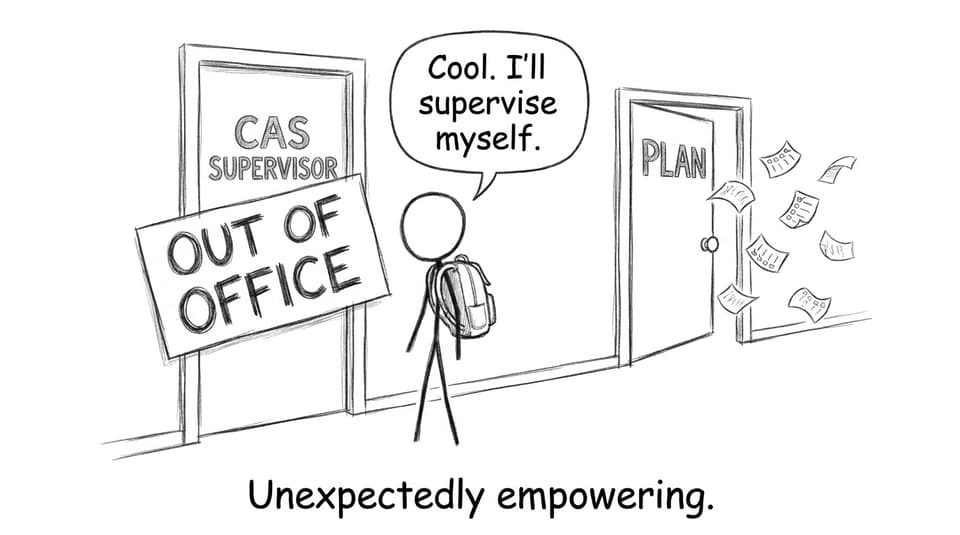
If you’re in the IB and you’ve just realised you don’t have a CAS supervisor, it can feel like someone removed the steering wheel halfway through the drive. You still have a destination. You still have to get there. But now you’re wondering who is going to sign off your route.
The quiet truth is that many IB students finish CAS without a perfect supervision setup. What matters is not having a mythical “CAS guru” hovering over every experience. What matters is building a simple system: clear plans, steady evidence, and communication with the one person who actually verifies CAS at school.
What this guide will help you do (fast)
Use this checklist if you’re stressed and short on time:
-
Understand the minimum CAS rules you must meet (so you don’t overwork)
-
Create a self-supervised plan with goals, a calendar, and evidence habits
-
Write reflections that actually prove learning outcomes
-
Get verification security through your CAS coordinator (even without a supervisor)
-
Keep CAS from eating your IB exam preparation
If you need a refresher on the basics, start with What is CAS (Creativity, Activity, Service)?.
Know what the IB actually requires (so you stop guessing)
Before you fix the “no supervisor” problem, make sure you’re not solving the wrong problem.
The IB framework expects sustained engagement across the programme, a balance across creativity, activity, and service, and strong documentation. The cleanest summary is in Understanding the Minimum Requirements for CAS in the IBDP. That post spells out the big non-negotiables like ongoing engagement (often across 18 months), reflections, and the expectation of a meaningful CAS project.
Also, clarify terminology early, because it changes how you plan:
-
A CAS experience can be shorter and simpler.
-
A CAS project is longer-term, collaborative, and runs at least a month.
For that distinction, see What Counts as a CAS Project vs. a CAS Experience?.
Step-by-step: what to do if you don’t have a CAS supervisor
This is the part most IB students need: a practical process that replaces “someone checking on me” with “a system that makes me consistent.”
Step 1: Confirm who can verify CAS at your school
A missing supervisor doesn’t mean CAS is un-verifiable. In most schools, the key person is the CAS coordinator.
Read How Does CAS Get Verified in the IB System? and then email your coordinator with three questions:
-
Who can act as a supervisor/contact for each experience (coach, club leader, NGO staff, teacher)?
-
How often do you want portfolio check-ins?
-
What evidence format do you prefer (uploads, logs, photos, signatures, short confirmations)?
This email does something powerful: it turns uncertainty into agreed expectations. That’s half the battle in the IB.
Step 2: Build a “minimum viable CAS plan” you can sustain in exam season
Students usually fail CAS without a supervisor for one reason: they plan as if time is infinite. It isn’t.
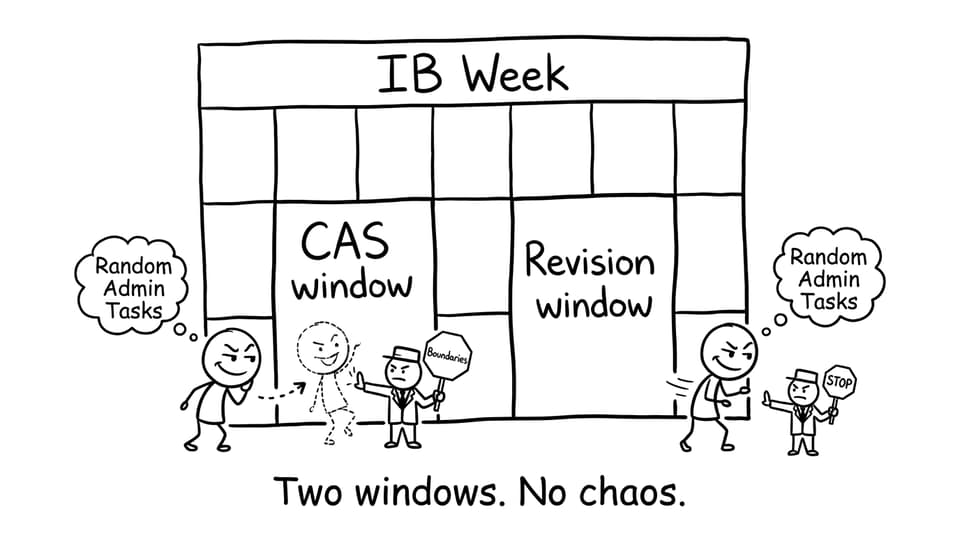
Choose activities that are sustainable alongside IB revision. If you want a realistic structure, borrow the “fixed windows” idea from Balancing CAS With Real Life (Without Burning Out).
A simple template:
-
One weekday CAS window (60-90 minutes)
-
One weekend CAS window (60-120 minutes)
-
A reflection micro-window (10-15 minutes after each session)
Step 3: Choose activities that naturally produce evidence
When you don’t have a CAS supervisor, you need your work to “explain itself.” Pick experiences that leave a trail.
Good evidence-friendly options:
-
Creativity: rehearsals, drafts, recordings, designs, posts
-
Activity: training logs, routes, times, coach notes
-
Service: attendance sheets, planning docs, impact feedback
If you’re stuck, use idea lists from CAS Project/Experience Ideas: Unleash Your Creativity, Activity, and Service.
Step 4: Create a portfolio workflow (so reflection never becomes a crisis)
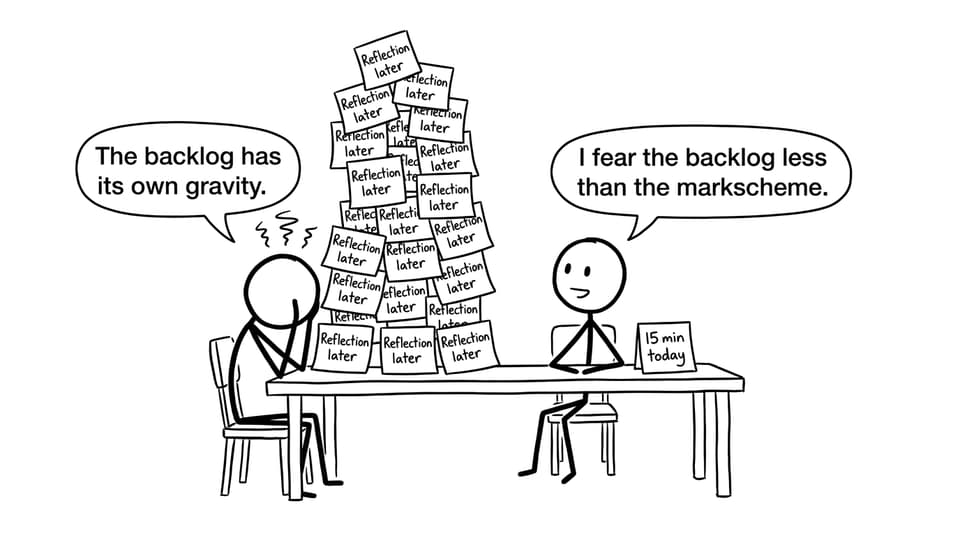
The easiest mistake is “I’ll reflect later.” Later becomes a backlog. The backlog becomes guilt. Guilt becomes avoidance.
Your goal is boring consistency.
Try this reflection routine:
-
Write reflections the same day, while details are fresh
-
Capture one photo or screenshot per session
-
Tag which strand it is (C/A/S)
-
Note which learning outcome it supports
If you want prompts that work, use 10 Powerful Tips to Write a CAS Reflection That Stands Out in 2025.
Step 5: Replace “supervision” with “proof + feedback loops”
Without a CAS supervisor, you need two things:
-
Proof that the activity happened and mattered.
-
Feedback that your documentation matches school expectations.
This is where RevisionDojo can quietly keep you organised while you’re also preparing for IB exams. You can use it as a central hub for study routines (Study Notes, Flashcards, Questionbank) and also as a place to stay structured in how you document learning. For schools and students focusing on better reflection systems, Using RevisionDojo to Strengthen IB CAS Reflection and Documentation shows what “consistent documentation” looks like in practice.
And when exam pressure rises, the same platform supports the revision loop: Study Notes for clarity, Questionbank for exam-style practice, Flashcards for recall, AI Chat when you’re stuck, Grading tools for coursework improvement, and Mock Exams plus Predicted Papers when you need timing practice.
If you want a broader exam strategy alongside CAS, read Countdown to IB Exams: A Guide to Effective Studying and Best Resources for IB Exam Preparation.
Conclusion: In the IB, calm systems beat perfect supervision
Not having a CAS supervisor feels like being left alone with a map and no compass. But CAS is not designed to trap you. It’s designed to show growth you can prove.
So build the proof. Use fixed CAS windows. Reflect while the memory is still warm. Keep your CAS coordinator in the loop. And protect your IB exam prep with tools that make studying efficient, not endless.
When you’re ready to run both CAS and revision with less stress, use RevisionDojo as your all-in-one IB support system: Questionbank for practice, Study Notes for clarity, Flashcards for daily recall, AI Chat for fast unblocking, Grading tools and the Coursework Library for stronger coursework, and Mock Exams plus Predicted Papers for confident timing. Start at the RevisionDojo home page and build a plan that actually holds.