
A weak grade can feel like a verdict. Usually, it is closer to a blurry photograph: evidence of what happened on particular tasks, under particular conditions, at an earlier point in your learning.
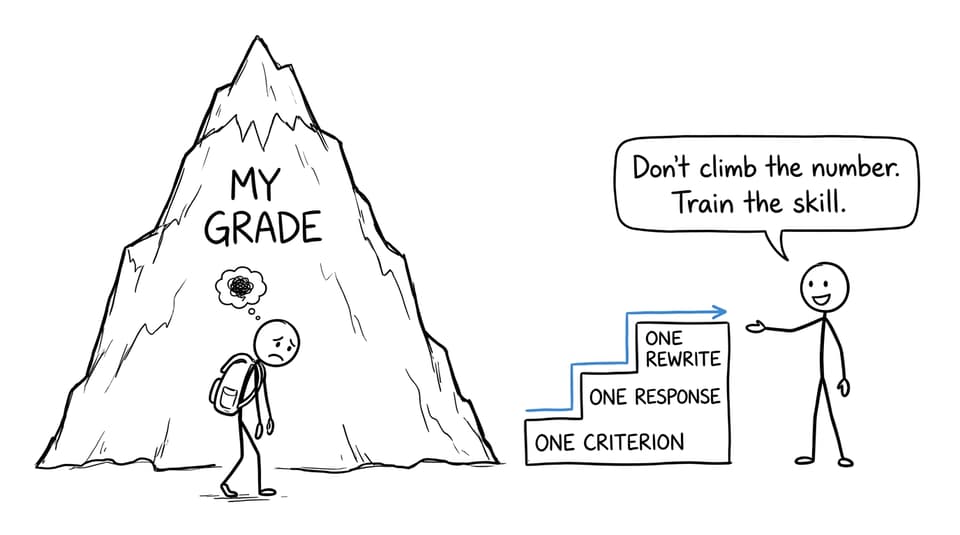
Turning a weak MYP Individuals and Societies grade around begins by identifying which assessment criterion is holding you back, practising that skill deliberately, and rewriting work after feedback. Do not respond by studying every topic for longer. Build a short cycle of diagnosis, targeted practice, feedback, and correction.
The subject becomes less mysterious when you stop asking, “Am I good at Individuals and Societies?” and start asking, “Which specific action must I perform better?”
Your turnaround checklist
Start with these six steps:
- Collect two or three recent marked assessments.
- Record your achievement level for each assessed criterion.
- Highlight repeated teacher comments.
- Choose one criterion and one recurring weakness.
- Complete focused practice three times per week.
- Rewrite your weakest response and compare both versions.
The MYP Individuals and Societies resource hub brings together Study Notes, Flashcards, lessons, definitions, questions, and assessment tools. Your teacher's instructions and year-level descriptors should still determine your priorities because expectations vary by task, school, and MYP year.
Diagnose the grade before repairing it
Individuals and Societies can include history, geography, economics, politics, and sociology. Yet your result is not simply a measure of how many facts you remember.
The subject uses four equally weighted assessment criteria, each with a maximum achievement level of 8:
| Criterion | What you must demonstrate |
|---|---|
| A: Knowing and understanding | Accurate knowledge, terminology, explanations, and examples |
| B: Investigating | Focused inquiry, appropriate methods, relevant information, and evaluation |
| C: Communicating | Clear organization, suitable style, and source documentation |
| D: Thinking critically | Analysis, supported arguments, source evaluation, and perspectives |
An assessment may cover only the criteria named by your teacher. This distinction matters. If your knowledge is reasonable but your arguments remain descriptive, rereading the textbook may not solve the problem. Criterion D practice might.
Create four rows in a notebook, one for each criterion. Beside every recent result, copy the most useful teacher comment and translate it into an action. “Needs more analysis” might become: “After presenting evidence, explain its consequence and significance.” Use the MYP Individuals and Societies criteria guide to distinguish the skills, then confirm your year-level descriptor with your teacher.
Replace “study harder” with criterion-based practice
“Study harder” sounds responsible but provides no starting point. Effective practice is narrower.
If Criterion A is weak
Build a small bank of terminology and flexible examples from your current unit. Use Flashcards for retrieval, but do not stop at definitions. Explain each term in your own words and apply it to an event, place, policy, or social issue.
If Criterion B is weak
Practise turning broad interests into focused, answerable research questions. For each question, identify the evidence required, where it could come from, and one limitation of the proposed method. More sources do not automatically create a better investigation; relevance, variety, and evaluation matter. The MYP Individuals and Societies skills guide connects research choices to assessable skills.
If Criterion C is weak
Identify the required audience, purpose, and format before writing. Give each paragraph one job and follow your school's citation convention. A useful paragraph can move through point, evidence, explanation, and link. This structure does not replace thought; it prevents good thinking from becoming disorganized. The guide to structuring high-scoring MYP I&S essays explains how command terms should shape an answer.
If Criterion D is weak
Move beyond reporting what happened. Ask why it happened, who experienced the effects differently, what the evidence supports, and where uncertainty remains. Do not insert a case and expect it to speak for itself. The MYP case-study guide shows how to connect evidence with causes, consequences, perspectives, and judgements.
Build motivation from visible evidence
Waiting for confidence creates a difficult loop: you avoid practice because you feel weak, then continue feeling weak because you have no new evidence of improvement.
Instead, make progress measurable. Retrieve eight terms, plan one answer around its command term, write one analytical paragraph, and identify one improvement using the relevant descriptor. The guide to staying motivated while studying for MYP offers a short starting routine for low-energy days.
Keep an error log with three columns: mistake, reason, and next-time rule. If you summarized two perspectives without comparing them, your rule could be: “Use a direct comparison and explain why the difference matters.” Disappointment then becomes an instruction.
Use a weekly turnaround routine
A realistic plan does not need to consume every evening.
| Session | Focus | Concrete output |
|---|---|---|
| Monday, 25 minutes | Recall and repair | Eight terms and two applied examples |
| Wednesday, 30 minutes | Criterion practice | One plan and one developed paragraph |
| Friday, 25 minutes | Feedback and rewriting | One improved response and an error rule |
| Weekend, 40 minutes | Mixed or timed work | One short set followed by corrections |
Begin with RevisionDojo Study Notes when a concept is unclear, then close them and retrieve the idea. Use Flashcards for terminology before applying it through the Questionbank. AI Chat can challenge your reasoning, while Grading tools help compare your response with criterion language.
Predicted Papers and Mock Exams become useful when you are ready to practise timing and decision-making. The Coursework Library can clarify how academic work is organized, while Tutors offer human guidance when repeated feedback remains confusing. For a broader preparation system, consult the MYP revision guide.
The sequence matters: learn, retrieve, apply, receive feedback, rewrite. Reading model material creates familiarity, but independent practice reveals whether you can perform the skill yourself.
Measure progress without demanding perfection
Look for improvements before expecting the overall grade to move. Are your examples more specific? Does each paragraph explain why its evidence matters? Can you evaluate a source instead of summarizing it? Are repeated teacher comments becoming less frequent?
Take your latest marked task, circle the lowest criterion, and describe the missing skill in one sentence. Complete one RevisionDojo Questionbank task aimed at that skill, review the feedback, and rewrite the weakest section.
A weak grade becomes stronger through a small loop repeated with increasing precision. RevisionDojo provides the complete system for that loop. Your job is to begin with one criterion today.