Join 650k+ students breezing through the IBReady to breeze through the IB?
A funny thing happens the week an IB History IA is due: everyone suddenly becomes an amateur detective.
You’re hunting for that one line from a historian, the date on a government memo, the page number you swear you wrote down, and the URL that used to work yesterday. The argument in your IA might be strong, but without clean, consistent referencing, your work can start to look like a collage of other people’s ideas.
That’s why IB History IA referencing matters. It’s not about decorating your pages with footnotes. It’s about proving you can trace every claim back to evidence, the way historians do when the stakes are real.
In this guide, you’ll learn how to reference properly in your IB History IA, how to choose a citation style, how to cite primary and secondary sources, and how to avoid the tiny mistakes that quietly cause big problems.
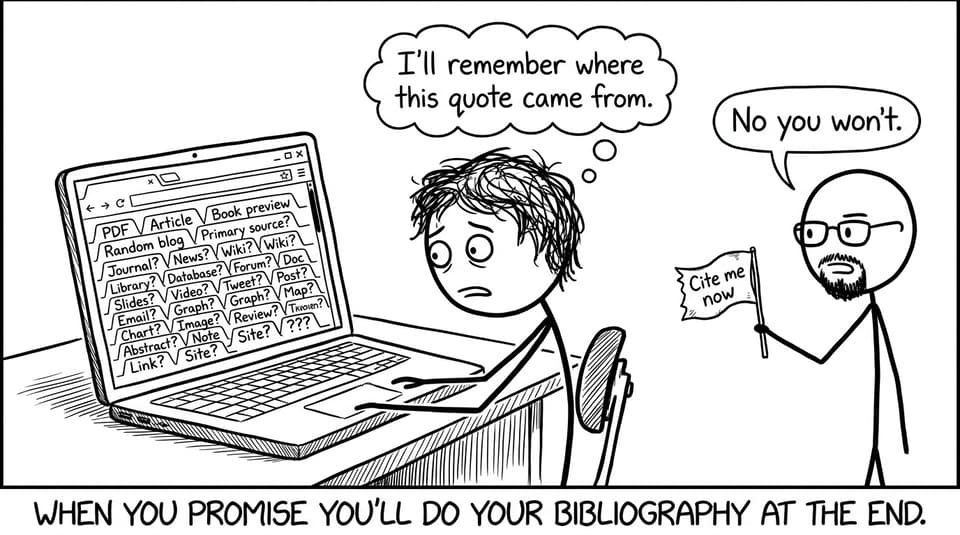
When you promise you'll do your bibliography at the end.
Quick checklist for IB History IA referencing
Use this before you write a single word of your final draft. It keeps your IB History IA calm, traceable, and academically honest.
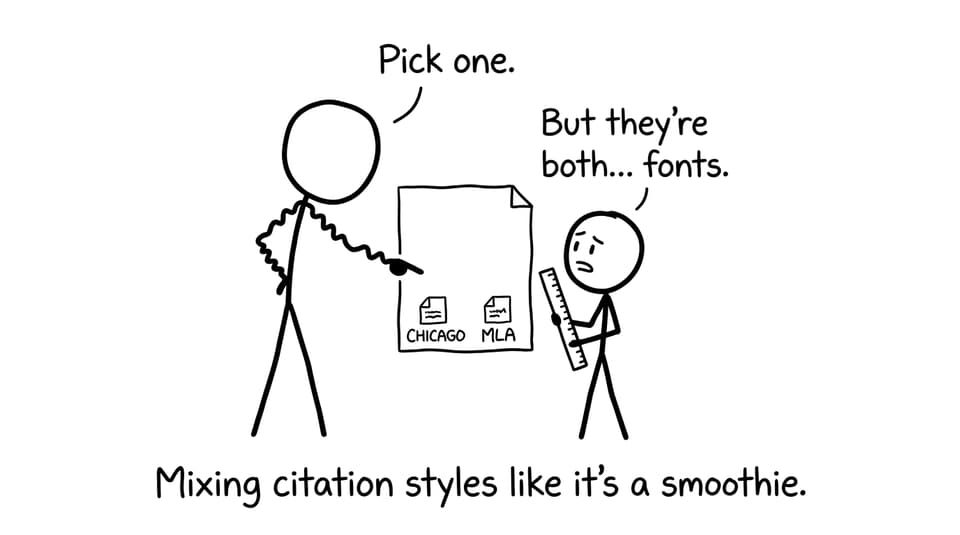
Choose one referencing style (Chicago or MLA are common in IB History).
Record citation details while researching (not later).
min read
min read
min read
min read
Cite every quotation, paraphrase, specific idea, statistic, image, and map.
Include page numbers for quotes and tight paraphrases.
Keep footnotes/in-text citations consistent with your final bibliography.
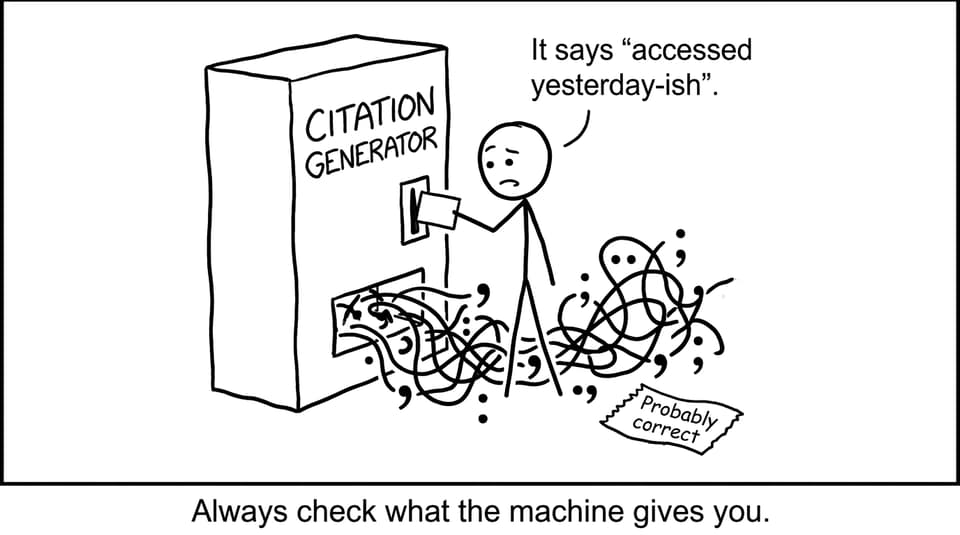
Treat online sources like real publications (author, title, date, URL, access date).
Run a final “trace test” (pick 5 claims and verify each citation points to the right place).
Why IB examiners care about referencing in the History IA
In IB History, you are assessed on how you think like a historian. That means you don’t just state what happened. You show how you know.
Proper referencing does three quiet but powerful things:
Signals integrity: you’re transparent about which ideas are yours and which came from a source.
Makes your argument checkable: an examiner can follow your trail of evidence.
Strengthens analysis: when sources are clearly cited, you can compare interpretations, evaluate reliability, and build a tighter investigation.
If you’re still shaping your overall IA structure, it helps to review the bigger picture first: How to Write an Outstanding IB History IA. Clean referencing is easiest when your sections are already organized.
Choose a citation style that fits IB History (and stick to it)
The IB doesn’t force one single style for History, but it does expect a recognized style used consistently.
Chicago (Notes and Bibliography)
Chicago is often a natural fit for History because it mirrors academic historical writing.
You use footnotes (or endnotes).
You include a bibliography at the end.
It’s ideal when you need to cite many sources without cluttering your sentences.
MLA (Author-page)
MLA is also acceptable for an IB History IA.
You use in-text citations like (Taylor 54).
You include a Works Cited page.
It can feel simpler if you already use MLA in other humanities subjects.
How to cite properly (the moments students forget)
Most IB referencing problems don’t come from students trying to cheat. They come from students moving fast and assuming something is “basically common knowledge.”
Cite when you:
Quote directly (always).
Paraphrase a historian’s argument, even if you changed every word.
Use a specific fact that isn’t universally known.
Summarize an interpretation or debate.
Use visuals (photos, maps, graphs, propaganda posters).
Borrow structure from a source (for example, a historian’s set of causes).
A good rule in IB History: if a sentence would feel weaker without the authority of a source behind it, cite it.
Online sources and responsible AI use in IB referencing
Online sources count as real sources in the IB. They still need full details so a reader can find them again.
Include:
author or organization
page title
website or publisher
publication date (or “n.d.” if genuinely missing, depending on style)
URL
access date (helpful because pages change)
What about AI tools?
Many IB students use AI for support: clarifying confusing sentences, planning study schedules, or checking grammar. The safest principle is transparency and authorship.
AI can support process, not replace your argument.
Never submit AI-generated historical analysis as your own work.
If your school requires disclosure, mention AI support honestly in the appropriate place.
If even one claim fails the trace test, your referencing system needs tightening. This is also a great moment to run your draft through RevisionDojo’s tools: the Grading tools to spot rubric gaps, AI Chat to clarify confusing criteria, and the Coursework Library to compare against high-quality models.
How RevisionDojo helps IB students reference with confidence
The hardest part of IB referencing is that it’s invisible when done well. You only notice it when it breaks. RevisionDojo is designed to help you keep it from breaking in the first place.
Use the Coursework Library to see how strong IAs handle sourcing and bibliographies: IB History Examples.
Use the History IA grader to check whether your investigation is rubric-aligned (including how evidence is handled): IB History IA Grader.
Build your understanding alongside your writing with Study Notes, Flashcards, and AI Chat, so you rely less on copyable phrasing and more on genuine comprehension.
When exams approach, connect coursework skills to exam performance using Questionbank, Mock Exams, and Predicted Papers in your RevisionDojo workflow.
If you want a central hub for everything History (IA plus exam prep), bookmark: IB History Resources.
Closing: referencing is your credibility in visible form
An IB History IA is not judged only by how interesting your topic is. It’s judged by whether your investigation holds together under scrutiny. Referencing is the part that tells the examiner, quietly but decisively, “this argument can be checked.”
So cite as you go. Keep one style. Record page numbers like they matter, because they do. Then use RevisionDojo to tighten the whole system: learn content with Study Notes and Flashcards, practise with Questionbank and Mock Exams, refine coursework using the Coursework Library, and sanity-check your draft with the Grading tools and AI Chat.
When your referencing is solid, your thinking gets to be the main story. And that’s the kind of IB History writing that feels like it belongs in the real world, not just in a folder named “final_final_THISONE.docx.”