
The moment every IA becomes a math problem
It usually happens late at night.
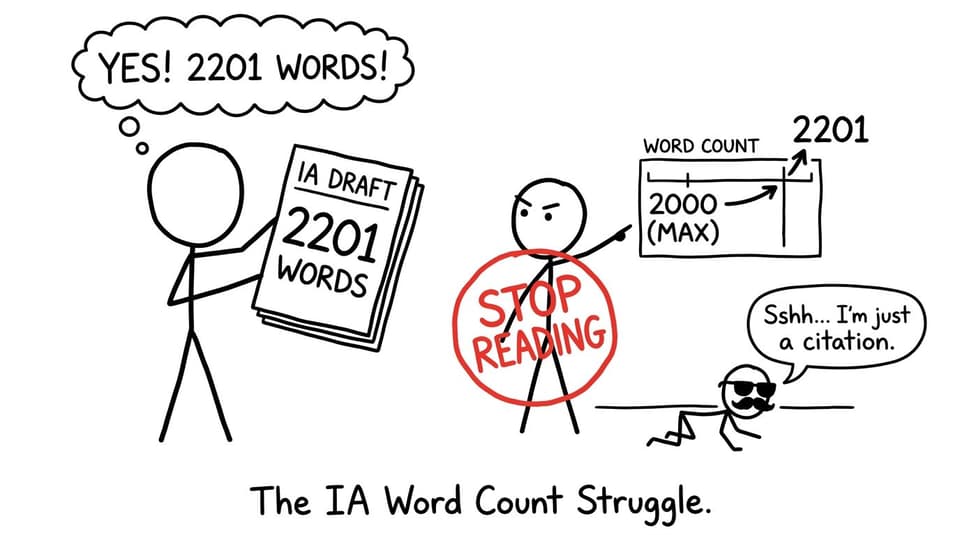
You finally have a draft of your IA that feels like you wrote it, clear, evidence-based, and surprisingly coherent for something created across three deadlines and a mild existential crisis. You scroll to the bottom and see the word count.
2,347.
And suddenly your IA stops being a piece of thinking and becomes a piece of accounting.
The question that follows is almost always the same: do references count in the IA word count? And right behind it come the quieter follow-ups: Do in-text citations count? What about footnotes? Figure captions? Headings? Appendices?
This post gives you a clear, practical answer, plus a safe way to handle the gray areas so your IA stays examiner-friendly.
Along the way, we will use RevisionDojo as the "sanity check system": the place where you can confirm requirements, tighten writing, and stop guessing.
Quick checklist: do references count in the IA word count?
Use this checklist before you start deleting paragraphs you actually need:
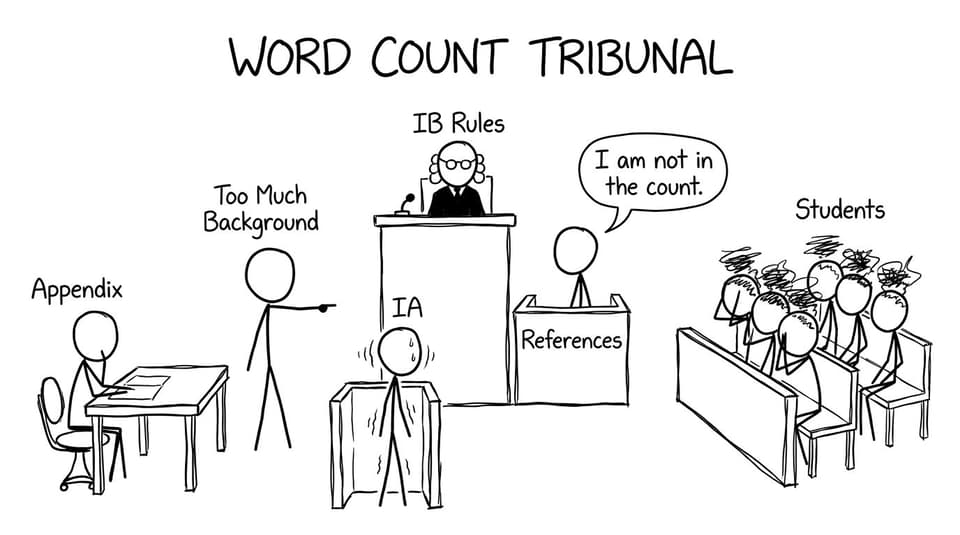
- References / bibliography: usually not counted in the IA word count.
- In-text citations (Author, year) or (Author, page): usually counted because they are in the body text.
- Footnotes: depends on subject and how they are used, but often treated as part of the text if they contain substantial discussion.
- Headings: typically counted.
- Figure/table captions: often counted if they include full sentences and explanation.
- Tables/graphs: typically not counted as words, but any explanatory text inside or around them may be.
- Appendix: usually not counted, and examiners may ignore it if it is used to hide analysis.
For subject-specific guidance, start with RevisionDojo's word-limit overview: What is the word limit for an IA?
So, do references count in the IA word count?
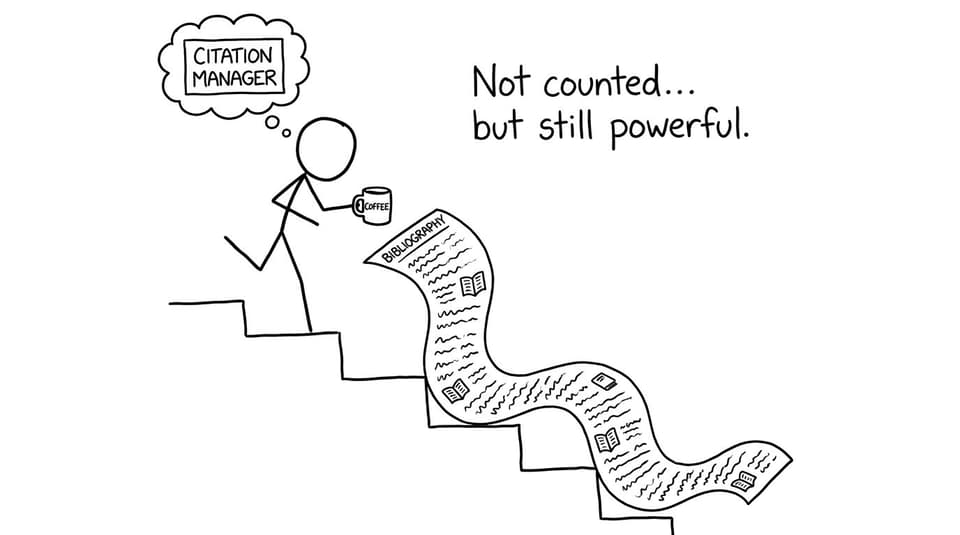
In most IB subjects, the references section (bibliography / works cited) does not count in the IA word count.
That is the simple answer.
But the reason students still get stuck is that "references" show up in multiple places:
- The reference list at the end (bibliography)
- In-text citations in your IA body
- Footnotes/endnotes that sometimes act like mini-bibliographies
- Figure credits and source lines inside captions
Only one of these is clearly "the reference list." The rest are part of how you write the IA, and that is where word count anxiety grows teeth.
If you want a grounding point on how strict the IB can be with limits (and what happens when you go over), read: IB IA and Extended Essay Word Counts: Rules, Tips, and Risks
What usually counts vs what usually doesn't (the practical version)
What counts in an IA word count most of the time
Most of the time, assume these count toward your IA word count:
- Your introduction and background
- Methodology write-up (where applicable)
- Analysis and discussion
- Evaluation and conclusion
- Headings and subheadings
- Explanatory figure captions (especially if they contain analysis)
- In-text citations (because they are literally inside the text)
The key idea: if it reads like part of your argument, it is usually treated like part of the IA.
What does not count most of the time
Most of the time, assume these do not count:
- Your bibliography / works cited list
- Raw data in an appendix
- Calculation screenshots or extended tables placed as supporting material
But here is the quiet warning: not counted does not mean unimportant. A bibliography that is sloppy makes your whole IA feel shaky.
The rule behind the rule: why your IA word count matters
IB word limits are not a vibe. They are a boundary.
When you write beyond the limit, you are betting that the cutoff happens after the part you care about. Sometimes students lose their evaluation. Sometimes they lose their final judgment. Sometimes they lose the sentence that links their evidence to the criterion language.
If you want a clean strategy for trimming without gutting your marks, use:
- How to Stay Within the IA Word Count Without Cutting Key Points
- How to Balance Word Count in Your IA Without Losing Depth
A good IA is not long. It is dense.
References vs citations: the mistake that sneaks up on good students
Students often say "references" when they mean "citations." That distinction matters.
Bibliography (usually not counted)
This is the list at the end. It exists so your examiner can verify your sources and see the quality of your research.
In-text citations (usually counted)
These are in your paragraphs, like (Smith, 2022) or (Smith, 2022, p. 14). They are part of the body text, so they usually sit inside your word count.
This creates a practical lesson: if you are over the IA word count, do not try to "save words" by deleting citations. You might reduce a few words, but you increase the risk of accidental plagiarism or weak academic honesty.
A better approach is to reduce:
- repeated background
- unnecessary narrative description
- duplicated explanation of your method
- vague evaluation
RevisionDojo's IB Internal Assessment Guides are built around this idea: cut what does not score, keep what maps to criteria.
Footnotes, figure captions, and appendices: where word count gets weird
Footnotes
Footnotes can be legitimate in some IAs (especially source-driven subjects), but they become dangerous when they are used to hide analysis.
A safe rule for your IA:
- Use footnotes for short clarifications or citations when required.
- Do not place important evaluation in footnotes.
- If a footnote contains real argument, treat it as if it counts.
If you are writing a source-heavy IA, this guide helps you keep structure tight: How to Write an Outstanding IB History IA
Figure and table captions
Captions are a common "word count leak." A caption that says "Figure 2: Scatter plot of X vs Y" is fine.
A caption that says "Figure 2 shows a strong positive correlation which suggests..." is doing analysis.
If it is doing analysis, it is part of your IA argument, which means you should assume it counts.
Appendices
Appendices are for supporting material.
If your IA depends on something in the appendix to make sense, you are outsourcing marks.
Use appendices for:
- raw data
- sample calculations
- survey instrument
- extra screenshots
Do not use appendices for:
- your main evaluation
- your key interpretation of results
- the argument that earns the top-band marks
A simple "safe formatting" strategy for your IA
If you want a low-stress approach that keeps you out of trouble, do this:
- Assume everything in the main body counts.
- Keep your bibliography clean and complete, but do not try to "game" the IA word count with it.
- Keep captions short and move real analysis into paragraphs.
- Use footnotes sparingly, and never as a hiding place.
Then run a final quality pass:
- Does every paragraph earn something in a criterion?
- Is the research question answered directly?
- Is the evaluation specific (limitations + improvements + impact)?
If you need a full view of what the IA is across subjects, start here: IB Internal Assessment: A Complete Guide to Success in the Diploma Programme
How RevisionDojo helps you fix word count problems without lowering your grade
Most students cut their IA like they are pruning a plant in the dark: random snips, then panic.
RevisionDojo is designed to make the process calmer and more evidence-based:
- Study Notes help you replace long explanations with precise ones.
- Flashcards help you keep definitions and key theory tight so you do not over-explain.
- Questionbank helps you build exam skill while the IA runs in parallel, so the IA does not consume your entire schedule.
- AI Chat (Jojo AI) helps you rewrite sentences to be shorter without losing meaning.
- Grading tools help you check whether what you kept actually matches the rubric language.
- Coursework Library and Mock Exams support the bigger plan: the IA is one part of your final result, not the whole story.
- Predicted Papers and Tutors help when you need a clear next step and real feedback.
If you are planning your time across IA and revision, pair this post with: How to Plan an IB IA Without Falling Behind
Closing: treat the IA word count like a guardrail, not a puzzle
So, do references count in the IA word count? In most cases, the reference list does not.
But the smarter takeaway is this: your IA word count is not something to outsmart. It is something to respect.
If you write inside the limit with clean citations, short captions, and a bibliography that signals serious research, your examiner gets the best version of your thinking, without distractions.
When you are ready to tighten your draft and protect your marks, use RevisionDojo as your workflow:
- Start with the All #IA Posts to find the right guidance fast.
- Use AI Chat to compress wording without losing clarity.
- Check alignment with Grading tools.
- Keep exam momentum with Study Notes, Flashcards, and the Questionbank.
Your IA is not just a document. It is a controlled demonstration of judgment. Keep it inside the boundary, and let the quality show.