
A student once told me they were “almost done” with their IA because they had collected 40 pages of screenshots, graphs, and quotes.
They looked relieved, like the hard part was over.
But the truth about an IA is quietly inconvenient: evidence isn’t proof of effort. Evidence is proof of thinking. And examiners can feel the difference in a few lines.
In this guide, you’ll learn how to select evidence strategically in an IA so every table, quote, and data point earns its place.
The 60-second IA evidence checklist
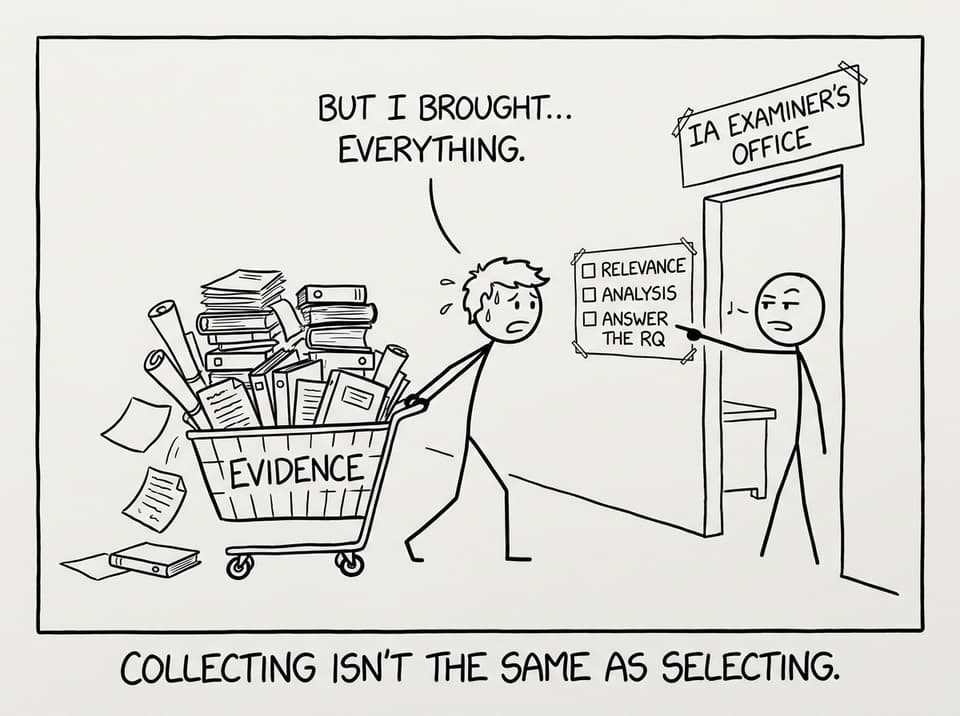
Before you paste anything into your IA, run this quick filter:
-
Relevance: Does this directly help answer the research question?
-
Claim: What exact sentence/point will this evidence support?
-
Analysis: What will you do with it (calculate, compare, interpret, evaluate)?
-
Specificity: Is it the best example, or just the easiest one you found?
-
Traceability: Could someone verify where it came from?
If one item fails, the evidence probably belongs in your notes, not your IA.
Evidence in an IA is a tool, not a display
The highest-scoring IA submissions don’t feel “packed.” They feel directed.
That’s because the evidence is chosen to perform a job: support analysis and evaluation, not decorate the page. When you treat evidence like a display cabinet, you end up with paragraphs that summarize sources instead of arguing with them.
A useful mental shift is this: your IA is not a museum of everything you found. It’s a short, persuasive explanation of what matters.
If you’re still clarifying what the assessment actually rewards, start with the subject hubs in IB IA Guides and then compare your plan against the bigger picture in IB Internal Assessment: A Complete Guide.
Relevance beats volume (even when the evidence is “good”)
Many students assume that high-quality sources automatically improve an IA. But quality without relevance is noise.
Examiners are reading with three silent questions:
-
Why is this here?
-
What does it show?
-
How does it move the investigation forward?
If you can’t answer those quickly, you risk losing clarity. And clarity is often where marks quietly disappear.
A practical tactic: write your research question at the top of the page and force every piece of evidence to “point” back to it. If your question is still shifting, tighten it using How to Write a Strong IA Research Question.
In an IA, evidence should create analysis (not replace it)
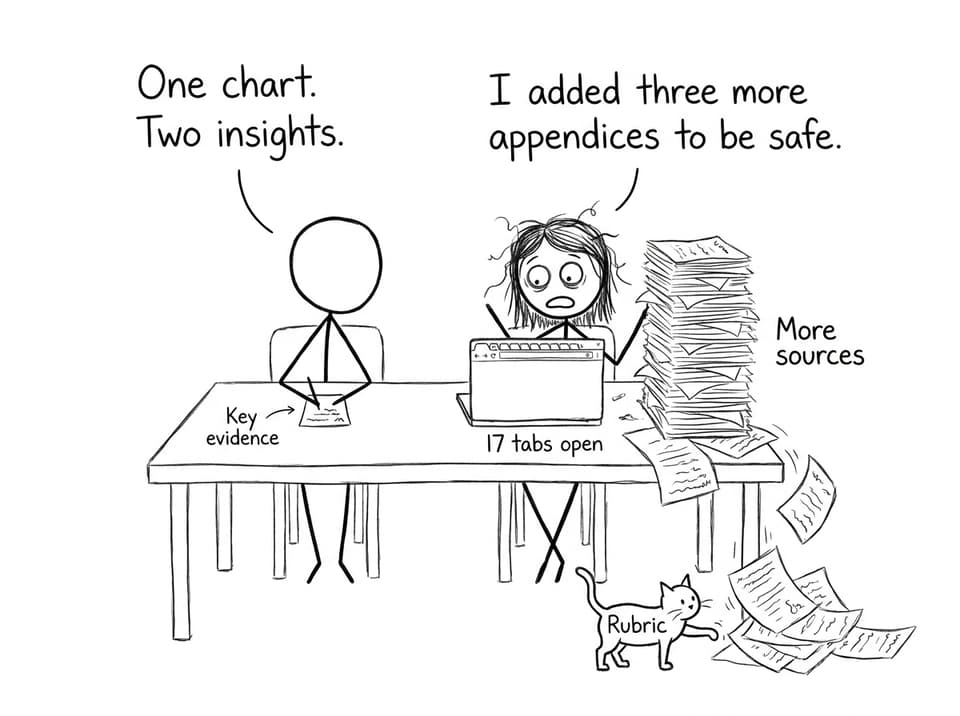
Here’s the trap: you add another graph because it feels like progress.
But an IA doesn’t award marks for evidence sitting there politely. Marks come from what you do next.
The “quote-drop” and “table-dump” problem
You’ve seen it (and maybe done it):
-
a quote with no interpretation
-
a results table with no commentary
-
a chart that isn’t linked to an explicit claim
In a strong IA, every evidence item is followed by analysis that explains meaning, limitations, and implications. If you want a clean way to balance types of support, borrow the structure from How to Balance Qualitative and Quantitative Data in an IA.
Strategic IA evidence is selective by design
Think of your IA like a short documentary. You don’t include every clip you recorded. You pick the few that make the argument undeniable.
Strategic evidence tends to do at least one of these:
-
Shows a pattern (trend, correlation, change over time)
-
Creates contrast (case A vs case B, control vs experimental)
-
Supports evaluation (limitations, reliability, validity, alternative explanation)
If you’re unsure how much sourcing is “enough,” use How Many Sources Should an IA Have? as a calibration guide.
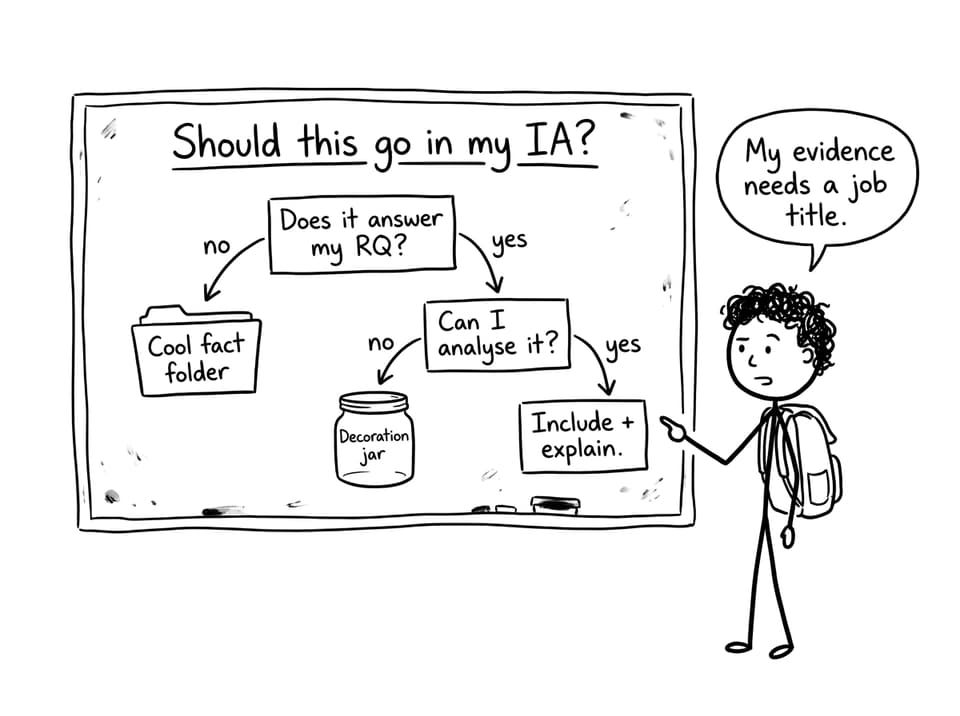
Give every evidence item a “job title”
A simple way to upgrade any IA draft: label the role of each evidence item.
Examples of job titles:
-
“Defines the key variable in my introduction”
-
“Justifies my method choice”
-
“Explains why my trend makes sense using theory”
-
“Challenges my conclusion and forces evaluation”
When you do this, you’ll naturally cut weak evidence, because it has no job.
How RevisionDojo helps you choose IA evidence (without guessing)
Evidence selection gets easier when your workflow is built for it.
-
Use the Coursework Guides to understand what criteria reward in your subject.
-
Use the Coursework Library to see what strong evidence integration looks like in real student work.
-
Use AI Chat to pressure-test relevance: “Does this source actually support this claim, or am I stretching it?”
-
Use Grading tools to check whether your evidence is being analysed and evaluated, not just presented.
-
Keep exams moving alongside IA work: Study Notes, Flashcards, and the Questionbank stop coursework from swallowing your entire revision schedule.
If you’re building an IA timeline across subjects, Which IB Subjects Have an IA? helps you plan realistically.
Closing: build an IA that thinks clearly
A great IA is not the one that includes everything you found. It’s the one that proves you can choose.
Select evidence that is relevant, analysable, and useful for evaluation. Give each item a job. Then let your analysis do the talking.
When you’re ready to make that process simpler, use IB IA Guides alongside RevisionDojo’s Questionbank, Study Notes, Flashcards, AI Chat, Grading tools, Predicted Papers, Mock Exams, the Coursework Library, and Tutors to keep both your IA and exam preparation moving in the same calm direction.