




The quiet moment when buildings begin
Every architecture student has a story about the first time a building felt alive. Not impressive. Not expensive. Just alive. Often, it happens in a museum, a sketchbook, or a street you walk every day. You notice proportion. Light. Rhythm. The way space can make you feel calm or small or brave.
That sensitivity isn’t a bonus for architects. It’s the job.
And for IB students, IB Visual Arts is one of the most direct ways to train it. IB Visual Arts teaches you to see like an architect before you ever open a CAD program: noticing structure, testing ideas, documenting decisions, and learning to defend your choices with clarity.
If you’re preparing for exams while also dreaming about architecture, the good news is this: your art practice can double as your smartest revision.
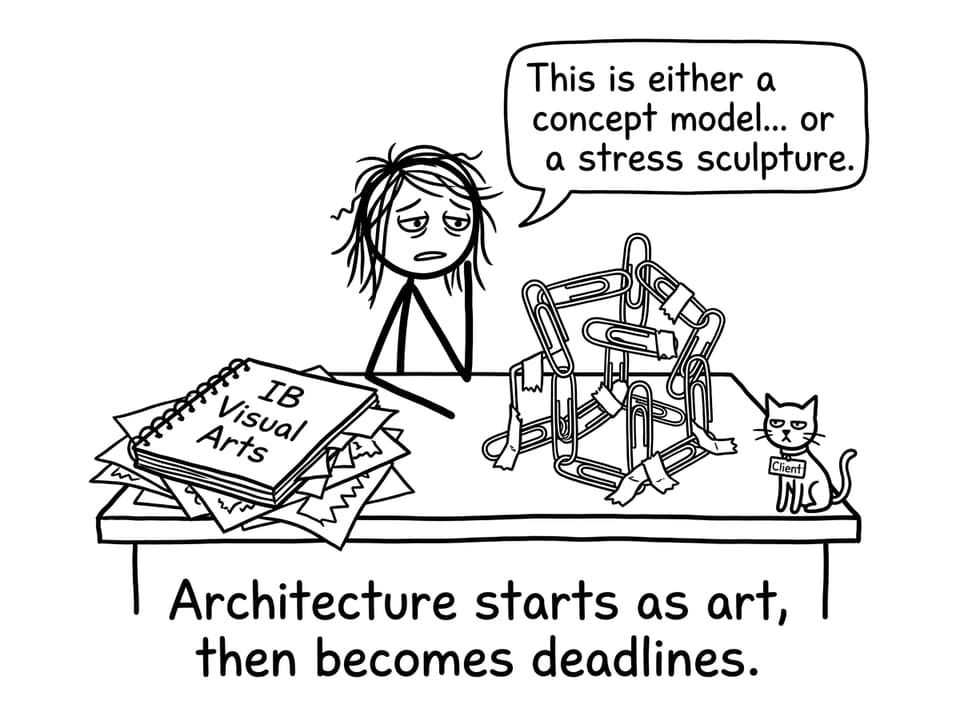
A quick checklist: what architects borrow from IB Visual Arts
Use this as a fast way to connect your IB Visual Arts work to architecture skills:
-
Visual and spatial awareness (scale, proportion, perspective)
-
Creativity under constraints (design problems always have rules)
-
Technical communication (sketches, diagrams, models, layout)
-
Aesthetic judgement (balance, harmony, contrast, rhythm)
-
Evidence-based thinking (process, testing, reflection)
-
Confident presentation (explaining intent, not apologising for it)
When you revise, you’re not only preparing for grades. You’re building habits that architecture school expects.
IB Visual Arts trains your eye for space (not just pictures)
Architects don’t only design objects. They design relationships: between a wall and a window, a corridor and a pause, a roofline and the sky. IB Visual Arts gives you structured practice in those relationships.
Drawing from observation sharpens your sense of proportion and scale. Perspective work forces you to think in three dimensions. Even photography trains architectural instincts: framing, negative space, focal points, and how light changes form.
If you’re unsure where your course components fit, start with What is IB Visual Arts?. It clarifies how the Comparative Study, Process Portfolio, and Exhibition reward different kinds of thinking, exactly the kind architects do daily.
Creativity becomes practical when you document it
In architecture, no one cares that you had a “cool idea” if you can’t show how you arrived there. That’s why IB Visual Arts is secretly a training ground for design thinking: you generate concepts, test them, learn from failures, then refine.
The Process Portfolio is where this becomes obvious. It’s not a scrapbook. It’s evidence.
If you want a clear way to show growth, keep How to Show Experimentation in Your IB Visual Arts Process Portfolio open while you work. The framing is simple: make your experiments easy to verify, like micro-tests.
That same logic maps neatly onto architecture studio:
-
Hypothesis: “A narrower entrance makes the space feel more private.”
-
Test: quick sketches, small model, lighting study
-
Evaluate: what changed, what didn’t, what surprised you
-
Refine: iterate, document, present
That cycle is IB Visual Arts at its best.
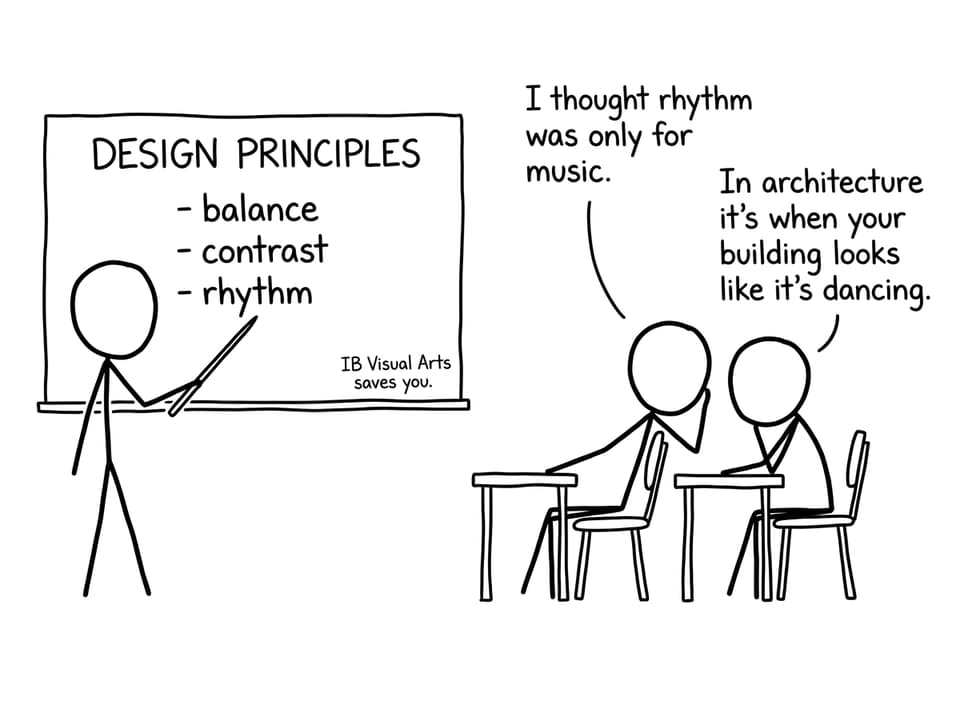
Aesthetics: learning the rules so you can break them
A common myth is that architecture is mostly maths and software. The reality is that architecture lives in judgement calls: how heavy a form feels, whether a facade is calm or chaotic, how repetition creates rhythm, how contrast creates focus.
IB Visual Arts teaches those principles with real materials and real consequences. You don’t just “learn” balance, you feel it when a composition collapses. You learn harmony by watching colour fight. You learn contrast by seeing what happens when everything shouts.
To connect your artistic choices to assessment outcomes, read IB Visual Arts Assessment Criteria Explained Simply. When you understand what examiners reward, you start making more architectural work: intentional, structured, and defensible.
Your portfolio is an architecture application in disguise
If architecture is your destination, your IB Visual Arts portfolio can become a strong foundation for applications. Not because every piece looks like a building, but because it shows the traits architecture schools value:
-
curiosity
-
iteration
-
risk-taking
-
clarity of thought
-
ability to communicate visually
A useful guide is What to Include in an IB Visual Arts Portfolio. It nudges you toward variety with purpose: different media, different scales, and reflections that explain decisions.
Also consider theme. Architecture portfolios often feel coherent because they’re about a question, not a style. If your work feels scattered, Best IB Visual Arts Themes for Process Portfolios can help you choose a thread that holds everything together.
Exhibition skills are architecture presentation skills
Architects present constantly. They curate boards. They tell a story with layout. They guide a viewer through a space of information.
That’s why the IB Visual Arts Exhibition is more than a final display: it’s rehearsal.
If you’re working with limited space (which is basically everyone), How to Plan Your IB Visual Arts Exhibition Layout is a practical anchor. For even tighter rooms, IB Visual Arts: Exhibition Layouts for Small Spaces gives smart constraints-based solutions, the same mindset architects use when a site is awkward.
How RevisionDojo helps you revise IB Visual Arts like an architect
Architecture is a long game, but your next deadline is closer. RevisionDojo helps you treat IB Visual Arts like a system you can manage.
-
Use the Study Notes to lock in the non-negotiables of course structure and criteria.
-
Use Flashcards to memorise key terms for analysis and reflection (composition, materiality, symbolism, context).
-
Use AI Chat to improve your artist comparisons and tighten your reflections without losing your voice.
-
Use Grading tools to check whether your annotations actually hit the criteria.
-
Use the Coursework Library (like IB Visual Arts Examples) to see what strong work looks like and why.
-
Use Mock Exams and Predicted Papers to build calm, timed confidence across your wider IB workload.
-
Use the Questionbank to practise the thinking patterns that show up across subjects.
-
If you’re stuck, Tutors can help you turn vague ideas into a workable plan.
The point isn’t to do more. It’s to make each studio session count.
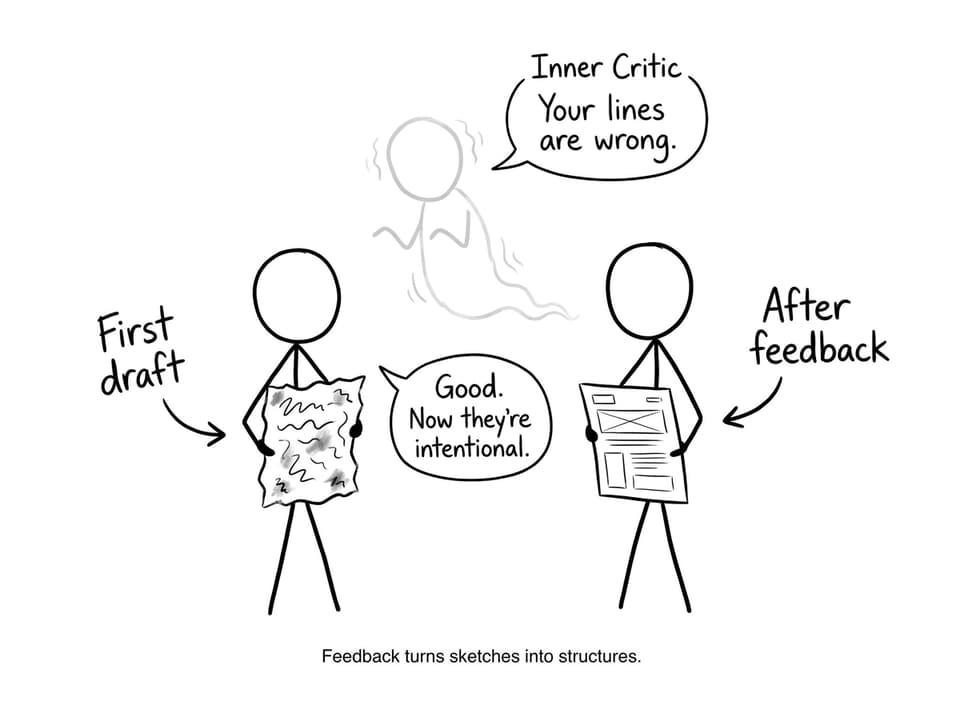
Closing: build the habit, not just the artwork
Architecture looks like big buildings, but it’s built from small practices: noticing, testing, revising, and explaining. IB Visual Arts gives you a safe place to practise those skills while the stakes are still classroom-sized.
So if you’re an aspiring architect, treat your next IB Visual Arts session like a studio: make one experiment, document it well, reflect honestly, then refine. And if you want the most efficient way to do that, RevisionDojo can keep your process organised, your criteria clear, and your confidence steady, from first sketch to final submission.