RevisionDojo was developed independently of the IBO and as such is not endorsed by it in any way.
The theme that saves your portfolio from feeling random
Most IB Visual Arts students don’t struggle because they “lack ideas.” They struggle because they have too many, and the Process Portfolio starts to look like a folder of unrelated experiments.
A strong theme is the quiet thread that turns scattered tests into a story: why you tried a technique, what you learned, how an artist shifted your thinking, and where your work might go next. In IB Visual Arts, that coherence makes your reflections sharper and your development easier to follow.
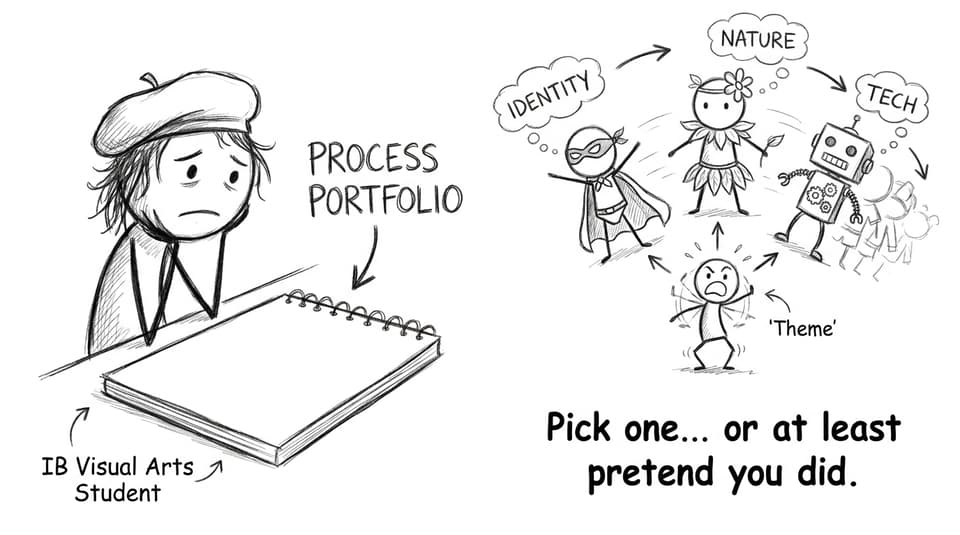
A student arguing with a shape-shifting theme character
Quick checklist: what a good theme does
Before you commit, check that your IB Visual Arts theme can:
Support multiple media (drawing, paint, photo, mixed media, digital)
Invite artist research and cultural context without forcing it
Generate experiments (including failed ones) you can reflect on
Narrow your focus without trapping you in one style
Identity works because it naturally produces variation: portraits, symbols, text, clothing, family archives, culture, language, and place. It also makes reflections easier, because you can explain why a decision mattered. If you’re trying to build authenticity, this theme pairs well with How to Connect Personal Voice in Your IB Visual Arts Portfolio.
Memory and time
Memory gives you permission to layer, erase, stitch, collage, and reinterpret old references. You can test materials that “age” well (tea staining, photocopy transfers, distressed textures) and document the evolution clearly. In IB Visual Arts, that visible change is gold for process evidence.
Environment and nature
Nature themes can be intimate (a single plant study over weeks) or urgent (climate, waste, consumption). They invite experimentation with recycled materials, land art documentation, photography series, and installation maquettes. The key is to choose a lens (fragility, scale, decay, regeneration) rather than “nature” as a vague umbrella.
Technology and digital culture
This theme is flexible: social media identity, consumerism, surveillance, AI aesthetics, glitches, and attention spans. It also justifies mixing traditional and digital workflows. If you’re building strong research links across components, this can connect nicely to your comparative study approach; see Comparative Study Structure Explained Step by Step for IB Visual Arts.
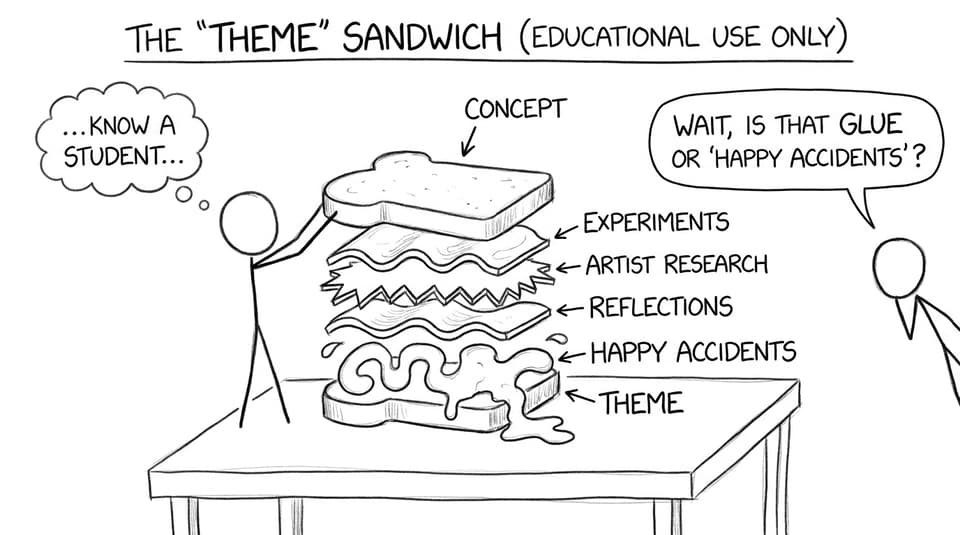
A theme built like a chaotic sandwich of experiments and reflections
Dreams and the subconscious
Dream logic gives you access to symbolism, distortion, automatic drawing, and surreal composition. It’s also forgiving: accidents can become meaning. In IB Visual Arts, that’s a great way to show risk-taking without apologizing for it.
Transformation and change
Metamorphosis, growth, damage, repair, seasons, migration, this theme practically writes your annotations for you. It encourages sequential work (before/after studies, iterations) and helps your portfolio feel like a journey instead of a gallery.
Social justice and activism
When done thoughtfully, activism themes create clear intent and strong context. Use research to avoid generalizations and show respect for lived experiences. Focus on specific questions: Who is unseen? What systems shape daily life? What does “power” look like in materials?
The human body
The body is technical (anatomy, proportion, movement) and conceptual (identity, vulnerability, performance). You can explore realism, abstraction, fragmentation, or symbolic representation. It’s also a clean bridge into new skills; see Best Marked Art Styles in IB Visual Arts.
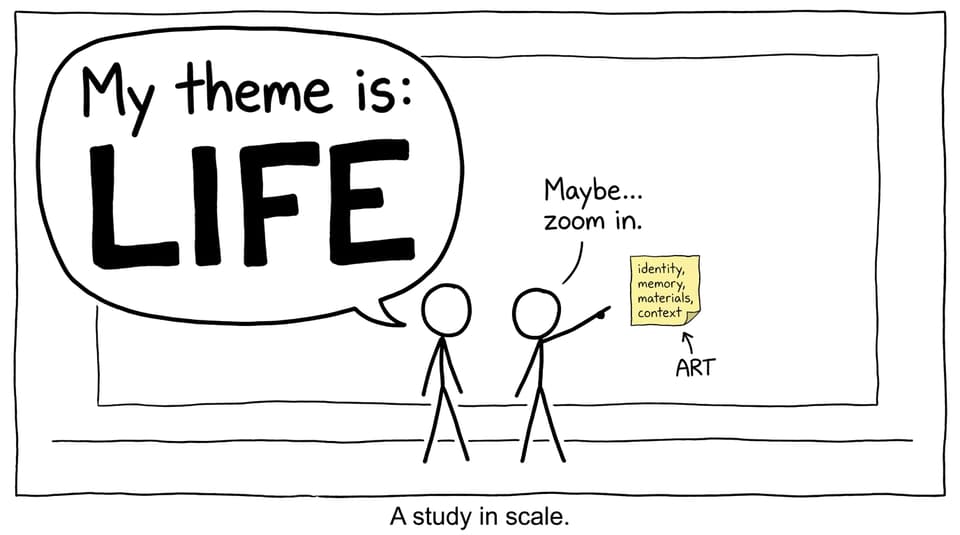
Two students debating: “My theme is LIFE” vs “maybe zoom in”
How to pick your IB Visual Arts theme in 20 minutes
Write three obsessions you actually think about (not what sounds impressive).
For each, list two media you could test this week.
Choose the theme that creates the most experiments fast.
A good IB Visual Arts theme isn’t a slogan. It’s a practical tool that helps you choose experiments, write clearer reflections, and build a portfolio that feels intentional.
If you want that process to move faster, use RevisionDojo as your control center: tighten understanding with Study Notes, build recall with Flashcards, ask Jojo AI Chat when you’re stuck, and get rubric-aware feedback from the IB Visual Arts Process Portfolio Grader. Then explore high-quality examples in the IB Visual Arts Coursework Library and stay organized with the full IB Visual Arts tag hub.