



An IB Visual Arts exhibition is not simply a room filled with finished work. It is a process of selection, refinement, writing, installation, and documentation. The artwork matters, but so do the relationships between pieces, the clarity of your intentions, and the experience created for the viewer.
Students often discover that the hardest part is not producing one more artwork. It is deciding what deserves to remain and turning two years of exploration into one coherent encounter.
There is an important syllabus distinction. The exhibition model described below applies to students completing the course with final assessment in 2026. For first assessment in 2027, the redesigned Visual Arts course uses a body of five resolved artworks and no longer requires exhibition documentation. Confirm your assessment session with your teacher before following any checklist.
The exhibition process at a glance
For students assessed under the exhibition model, the essential stages are:
- Confirm the formal SL or HL requirements
- Shortlist resolved artworks rather than automatic favourites
- Identify a conceptual or visual thread
- Refine surfaces, mounting, playback, and presentation
- Write exhibition text and the curatorial rationale
- Test the layout in the actual space
- Install, light, label, and photograph the exhibition
- Complete a final criteria and submission audit
RevisionDojo's IB Visual Arts exhibition overview provides a useful companion checklist.
Know which requirements apply to you
Under the Visual Arts course assessed through 2026, the exhibition is an internally assessed component worth 40% of the final subject grade. It is marked by the teacher and subject to IB moderation.
| Requirement | SL | HL |
|---|---|---|
| Selected resolved artworks | 4-7 | 8-11 |
| Curatorial rationale | Maximum 400 words | Maximum 700 words |
| Exhibition text | Required for each selected work | Required for each selected work |
| Overall exhibition photographs | Two | Two |
Assessment considers a coherent body of work, technical competence, conceptual qualities, and curatorial practice. A technically impressive piece may still weaken the complete exhibition. Equally, an interesting theme cannot compensate for unresolved execution.
Read the IB Visual Arts assessment criteria explained simply, then compare them with your school's instructions. Submission procedures can vary even when the criteria remain consistent.
Selection is where the exhibition begins
Selection can feel like a ranking exercise. Students often protect the pieces that required the most time, but effort and exhibition value are not the same thing. A better question is: What job does this artwork perform?
One work might establish the central tension. Another could change the scale, introduce a contrasting material, or complicate an apparently simple idea. If two pieces perform the same job, the more resolved one will usually deserve the space.
Submitting the maximum number is not automatically better. Every additional work creates another relationship that must be justified. Use RevisionDojo's guide to choosing artworks for an IB Visual Arts exhibition, and verify the SL and HL artwork number requirements before finalising your selection.
Coherence does not require every piece to use the same medium, colour, or subject. A painting, photograph, sculpture, and digital work can belong together when each approaches a shared inquiry differently. Test the set by asking whether every work adds a distinct perspective and whether removing it makes the exhibition clearer or poorer. Curation is partly the discipline of leaving something out.
Resolution lives in postponed details
A work may feel finished in the studio but unfinished in a gallery. Damaged corners, visible adhesive, unstable bases, reflective glass, or unreliable video playback become more noticeable once the work is isolated on a wall or plinth.
Audit each piece for:
- Surface condition and intentional finish
- Structural stability and safe installation
- Mounting, framing, or display method
- Colour and brightness accuracy for digital work
- Cable management and dependable playback
- Consistency between the real work, label, and submitted image
For projected, screen-based, or printed pieces, consult the guide to showcasing digital art. Test the actual equipment rather than assuming a file that works on your laptop will behave identically in the exhibition space.
The curatorial rationale explains decisions
The rationale is not an artistic biography or a catalogue describing every image. Its purpose is to make your curatorial logic visible. It should explain the central intention, why the works belong together, how materials communicate meaning, and how the arrangement shapes the viewer's experience.
Specific language is stronger than praise. Instead of calling a work powerful, explain how its scale places the viewer in an uncomfortable relationship with the subject. Rather than saying the layout flows, identify how a repeated form leads the eye between pieces.
Draft early enough to expose weaknesses. If you cannot explain why two works sit together, the problem may be the arrangement rather than the paragraph. The RevisionDojo curatorial rationale guide can help you structure the writing without losing your voice.
Each exhibition text should identify the work accurately and clarify its original intention. Credit sources whenever another person's work, imagery, or ideas influenced the piece, following your school's required referencing method.
Installation changes what the work means
A floor plan feels abstract until the first artwork goes up. Doors interrupt sightlines, corners compress large pieces, and glossy surfaces catch unexpected light. A sculpture that seemed substantial in the studio may appear small in an open room.
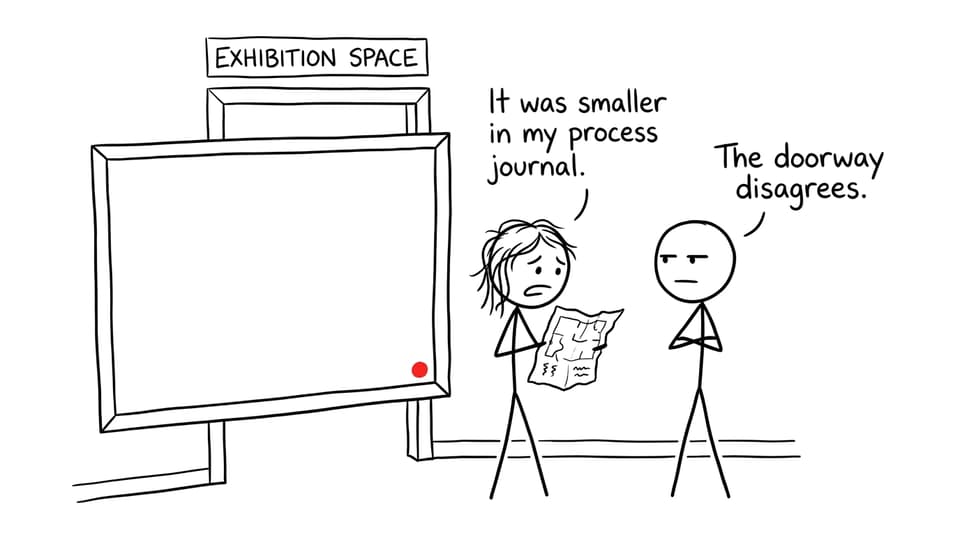
Measure walls, entrances, plinths, screens, and viewing distances. Place an anchor work where it can establish the exhibition's central idea, then consider contrast, pauses, and transitions. Walk through as an unfamiliar viewer. Ask what appears first, where the eye stops, whether people can move safely, and whether one piece accidentally overwhelms its neighbours.
Use the IB Visual Arts exhibition setup guide to check spacing, lighting, labels, and viewing flow.
Documentation is part of the work
The moderator does not experience the room in person. Documentation is the bridge between the physical exhibition and the submitted evidence.
Photograph only when installation and lighting are complete. Check focus, colour accuracy, glare, shadows, and perspective. Overall views should communicate scale and spatial relationships. Do not digitally improve the artwork or disguise presentation problems. Before submission, compare every file with its title, dimensions, medium, and exhibition text.
Avoiding final-week chaos
The final week rarely becomes difficult because a student lacks ideas. Pressure comes from modest tasks arriving together: repairing edges, borrowing equipment, exporting files, adjusting lights, editing writing, and checking photographs.
Freeze a provisional selection before installation week, finish a complete rationale draft before mounting, test technology several days early, and reserve one session for corrections rather than new work. Ask someone unfamiliar with the project to describe what connects the pieces. Their answer may reveal whether your curatorial intention is visible.
RevisionDojo's guide to common exhibition mistakes supports this final audit.
Turning a collection into an exhibition
The deepest shift is from maker to editor. For much of the course, your task is expansion. Exhibition preparation reverses that instinct: you must narrow, arrange, and justify.
RevisionDojo makes that transition manageable. Study Notes and Flashcards clarify assessment language, while AI Chat can test whether your rationale explains decisions rather than describing images. Grading tools and the Coursework Library provide criteria-aware guidance, and Tutors can help when selection or structure feels unclear. Questionbank practice, Predicted Papers, and Mock Exams can also make revision in other IB subjects more focused.
An exhibition feels complete when nothing appears accidental. The strongest show is not necessarily the one containing the most work. It is the one in which every artwork, gap, label, and line of writing earns its place.