



A student can arrive in IB Visual Arts with a strong sketchbook and still feel lost by October. The biggest of the IB Visual Arts first term struggles is usually not a sudden lack of skill. It is the shift from making work that looks finished to making the thinking behind that work visible. You need to investigate an idea, test visual choices, notice what happened, and use that discovery to decide what comes next.
A rough test may therefore be more valuable than a polished piece if it answers a question you can build on.
Your first-term checklist
- Choose a question you can explore visually, not a conclusion you must defend.
- Make small, distinct tests before committing to a large piece.
- Photograph stages and keep the attempts you reject.
- Record what each test taught you and what you will change.
- Confirm your assessment version with your teacher before using online examples.
Why this adjustment feels so significant
IB Visual Arts asks for a sustained conversation between the idea and the making. What does a material allow you to communicate? How might the same subject change at another scale? What did you discover that your first plan could not have predicted?
The current IB course calls this art-making as inquiry. For students assessed from May 2027, both standard level (SL) and higher level (HL) include an art-making inquiries portfolio showing how personal lines of inquiry shape a developing visual language. Students also submit a coherent body of five resolved artworks. SL students complete a connections study, while HL students complete an artist project. RevisionDojo's guide to the current Visual Arts course explains these components.
Older resources may describe a Process Portfolio, Comparative Study, and Exhibition. Those terms belong to the course whose final assessment was in 2026. Some creative advice may remain useful, but students beginning the revised course should confirm their assessment session with a teacher.
The practical consequence is simple: do not wait until a piece is finished to explain it. The most revealing decisions often happen while you are still unsure what the piece will become.
Start with a question small enough to test
“Identity” may be meaningful, but it is too broad to guide Tuesday's studio session. “How does cropping a familiar family photograph change who seems to be missing?” suggests something you can try. Make three crops of the same image, then compare what each asks the viewer to notice.
A useful inquiry question leaves room for surprise. If the first attempt answers it completely, sharpen the question. If you cannot imagine a first experiment, make it smaller.
This is one way of adjusting to IB Visual Arts without demanding a grand personal theme immediately. Your interests may become clearer because you work, not before you begin. Start with a recurring observation, a material you want to understand, or a visual problem you cannot yet solve.
Let experiments carry the uncertainty
Suppose you want to suggest a crowded place that still feels lonely. One test might use repeated figures. Another could leave only traces of their presence. A third might change scale. The purpose is to discover which choice communicates something unexpected, not to produce three finished artworks.
Keep the variables legible. If you change material, composition, scale, and colour simultaneously, it becomes difficult to explain why the result changed. Small studies also make risk easier because they demand less time and emotional commitment.
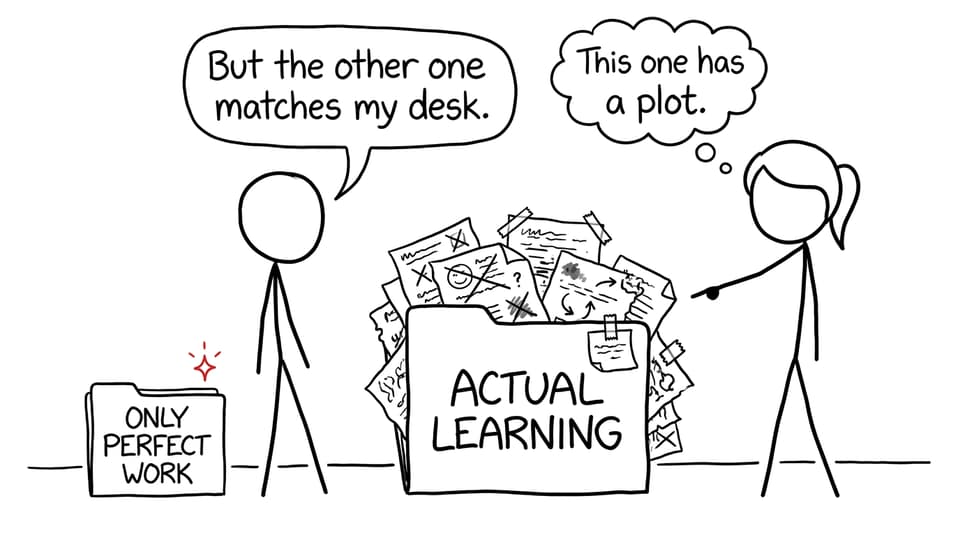
When a test disappoints you, ask a precise question. Did the dark background swallow the focal point? Did a glossy surface make an intimate image feel distant? “It failed” ends the conversation. “The reflection distracted from the subject, so I will test a matte surface” creates another move. RevisionDojo's guide to Visual Arts experimentation explores this habit, although its older component terminology should be checked against your syllabus.
Document decisions while you remember them
A journal is a working record, not an archive assembled after the term ends. The revised course describes Visual Arts journals as a way to develop inquiry across creating, connecting, and communicating. Your journal can contain photographs, material tests, research, questions, and brief observations. Every page does not need to look exhibition-ready.
At the end of a session, save a photograph and write three notes:
- Intention: What was I testing?
- Observation: What happened that I can identify in the work?
- Next move: What will I keep, change, or investigate?
For example: “I reduced the palette to make the doorway dominant. The brightest area still draws attention to the window. Next I will test a closer crop.” This records a decision instead of surrounding an image with vague praise. RevisionDojo's reflection guide offers further ways to turn observations into usable next steps.
Saving everything is not the same as submitting everything. The assessed portfolio is curated. Early documentation gives you evidence to select later; it does not require every sketch to become a final screen.
Make research change the artwork
Looking at other artists is not separate from studio work. A useful reference provides a question, method, or contrast to test in your own context.
Study one specific decision, such as an unusual viewpoint, repeated form, material treatment, or relationship with the audience. Research the work's context before assuming what that choice means. Then test an approach that serves your own inquiry and record what you deliberately changed. RevisionDojo's Visual Arts self-study resources outline a practical cycle of research, experimentation, and reflection.
Build a rhythm you can repeat
A workable week might include one session to investigate a question, another to make two small tests, and a brief review to photograph the results and choose the next move. Adjust that rhythm to your school's deadlines. The important part is allowing the next decision to respond to evidence rather than habit.
Bring your teacher a precise question: “Which study better conveys distance, and what visual choice creates that effect?” Feedback becomes easier to use when it addresses a decision you can change. RevisionDojo's guide to planning a Visual Arts journal can help you establish a consistent record.
RevisionDojo remains the ultimate IB resource when studio work meets the rest of your timetable. Use Study Notes and Flashcards to clarify terminology, AI Chat to interrogate an unclear reflection without surrendering your voice, and Tutors for focused human critique. Its Questionbank, Predicted Papers, and Mock Exams support exam-based IB subjects, while the Coursework Library and Grading tools should be used only after confirming that an example matches your assessment version.
By the end of the first term, success need not look like a finished collection. It can be a question that has become more interesting, experiments that show why, and a record of choices you can explain. That is the real adjustment: treating uncertainty as material for the work, then using RevisionDojo to make sense of where it leads.