
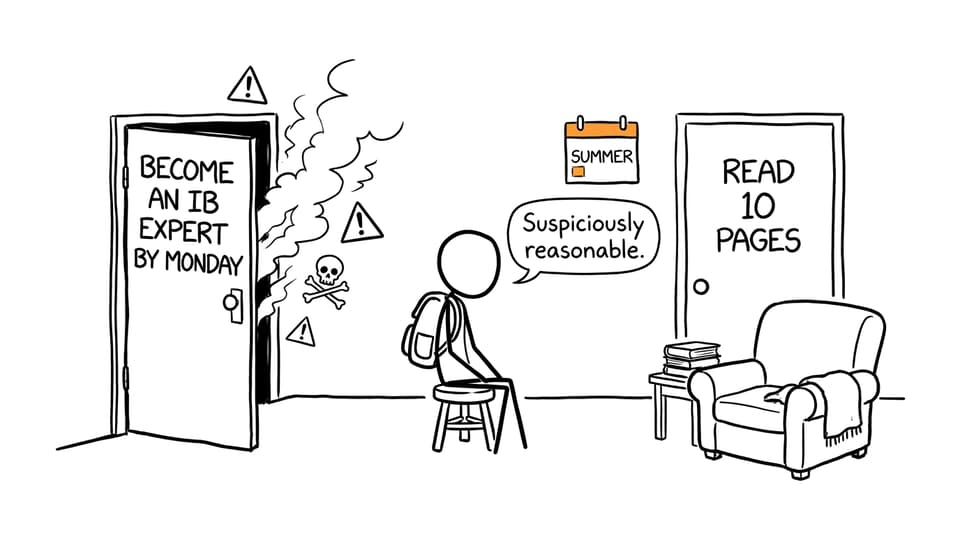
It is reasonable to wonder whether your child should spend the summer studying for the IB Diploma Programme. The clear answer is: prepare lightly, but do not attempt to begin the entire curriculum early.
The most useful summer before IB starts includes genuine rest, confirmation of subject choices, completion of any school-assigned work, a little reading, and the creation of simple organizational habits. Your child does not need to arrive knowing everything. They need to arrive rested, curious, and able to manage a normal week.
That distinction matters. Exhaustive preparation often solves the wrong problem. The challenge of DP1 is rarely that a student failed to memorize enough content in July. It is learning how to balance six subjects, longer assignments, the IB core, activities, sleep, and an ordinary teenage life.
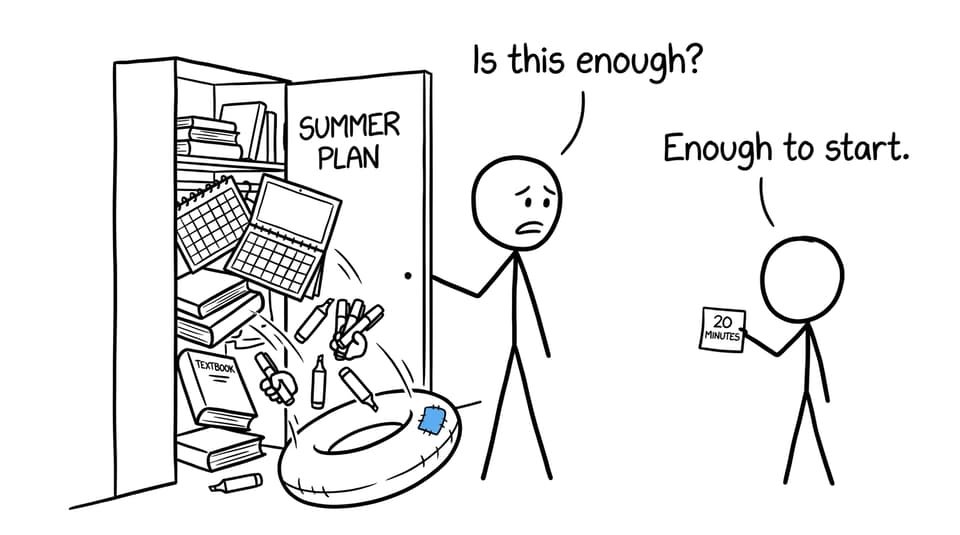
The short summer preparation checklist
A productive plan can remain reassuringly small:
- Let your child recover properly from the previous school year.
- Read all guidance and assigned work sent by the school.
- Confirm that subject and HL or SL choices fit their interests and future options.
- Learn the basic structure of the Diploma Programme.
- Strengthen one or two genuine foundation gaps.
- Set up a calendar, filing system, and distraction-light study space.
- Practise short sessions of reading, recall, and problem-solving.
- Establish sustainable sleep and daily routines.
- Leave room for friends, movement, hobbies, and unstructured time.
If those points are covered, the summer has done its job.
Understand what your child is about to begin
The Diploma Programme consists of six subjects and three core components: Theory of Knowledge, the Extended Essay, and Creativity, Activity, Service. Students normally take three subjects at Higher Level, although four may be permitted, with the remaining subjects at Standard Level. Schools shape schedules, deadlines, and subject availability, so their coordinator remains the best source for local details.
Parents do not need to become IB administrators. A basic understanding is enough to interpret what a child means when they mention TOK, CAS, an internal assessment, or the EE. RevisionDojo's guide to advice for new IB students offers a helpful overview of the transition.
Avoid pushing your child to choose subjects solely because they appear prestigious. A sensible choice balances ability, interest, university prerequisites, and workload. If a future degree may require particular subjects or levels, check current entry requirements on the relevant universities' official websites. Then discuss uncertainties with the school's IB coordinator before choices become difficult to change.
Make recovery part of IB preparation
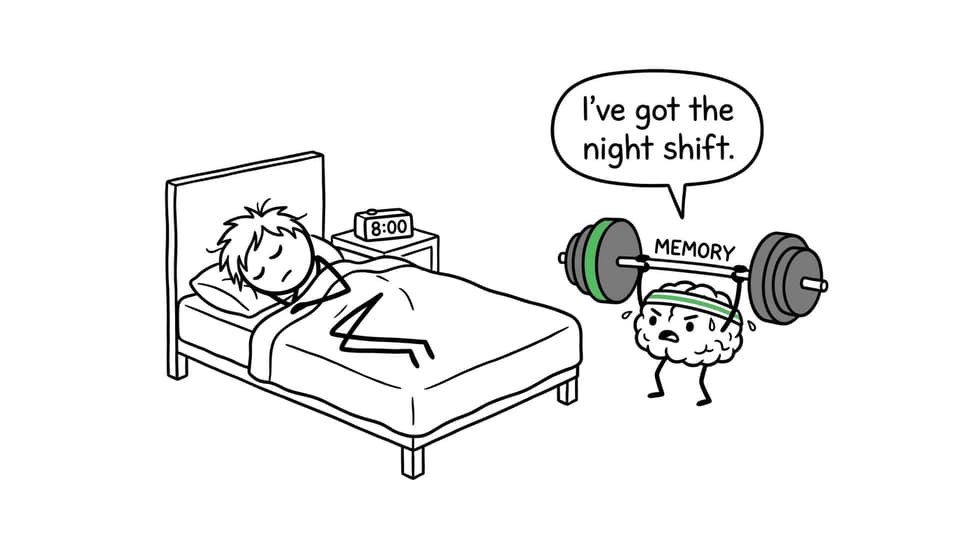
Rest can look unproductive because it produces no folder, score, or certificate. Yet fatigue carried into DP1 does not become ambition simply because school has restarted.
Teenagers aged 13 to 18 are generally advised to get eight to ten hours of sleep in each 24-hour period. Summer is a chance to recover, but also to move toward a sleep pattern that will survive the school term. A dramatic schedule change on the night before classes begin is far harder than a gradual adjustment during the final weeks.
Encourage movement, daylight, hobbies, and time with friends. These are not prizes earned after preparation is complete. They belong inside a sustainable approach to school. Parents can help most by protecting balance rather than measuring every free hour.
Review foundations without trying to pre-learn DP1
Some academic preparation is useful when it has a precise purpose. Start with information from the school. If teachers have assigned novels, mathematics exercises, vocabulary, or introductory tasks, those should take priority over a generic online study plan.
Next, identify no more than two foundation gaps. A student beginning Mathematics might revisit algebraic manipulation. A science student could check units, graph interpretation, and basic calculations. A language learner might rebuild everyday vocabulary through regular reading or listening. The goal is readiness for the first lesson, not mastery of material that has not yet been taught.
A light weekly pattern could be:
| Activity | Sensible summer approach |
|---|---|
| Assigned schoolwork | Break it into small weekly sections |
| Reading | 20 to 30 minutes several times a week |
| Mathematics or science foundations | One or two short practice sessions weekly |
| Language development | Read, listen, or speak little and often |
| Organization | One setup session, followed by a weekly check |
Reading notes repeatedly can create familiarity without reliable recall. A stronger routine is to read a short section, close it, explain the idea from memory, and answer one relevant question. RevisionDojo's IB flashcard system guide explains how short retrieval sessions can fit into a realistic routine.
Build systems before the workload arrives
IB preparation is less about filling the brain in advance than reducing avoidable friction. A missing document, forgotten deadline, or chaotic desk seems minor in isolation. Repeated every week across six subjects, it becomes expensive.
Help your child create one calendar for school dates, activities, personal commitments, and eventual assessment deadlines. Add a weekly planning appointment of ten to fifteen minutes. Every task should have a next action, not merely a distant due date. “Choose two possible research sources” is easier to begin than “work on project.”
A simple digital or physical folder structure should mirror the six subjects and the core. Within each subject, separate class materials, revision resources, submitted work, and teacher feedback. Back up important files. Keep filenames understandable. These habits are wonderfully boring, which is precisely why they work.
Students can compare their emerging routine with a balanced IB study schedule or a low-stress daily IB schedule. Neither should become a rigid template during summer. The purpose is to notice how focused work, lighter review, activities, and rest can coexist.
Practise the method, not the volume
A useful summer study session might last twenty to forty minutes. It could contain one small concept, a closed-book explanation, a few questions, and a note about what remains unclear. Stop while the process still feels repeatable.
This builds three habits that matter in DP1:
- Active recall: retrieving an idea rather than only rereading it.
- Application: using knowledge in a question or explanation.
- Error review: identifying why an answer went wrong and choosing a small correction.
The step-by-step guide to studying for IB exams shows how these habits eventually develop into topic practice, mistake logs, and timed work. Full Mock Exams are unnecessary before teaching begins. Summer preparation should establish the motion, not imitate the pressure of the final examination period.
Introduce the IB core gently
It helps to know what TOK, the Extended Essay, and CAS are. It does not help to manufacture an EE research question before the school has explained its process or assigned supervision.
Instead, encourage curiosity. Your child might keep a list of topics, books, social questions, scientific ideas, or creative projects that genuinely interest them. This is not an unofficial EE proposal. It is simply a record of attention that may become useful later.
For CAS, students can notice activities they already value in creativity, physical activity, and service. They should wait for their school's guidance before treating anything as part of an official CAS record. For TOK, conversations about evidence, perspective, certainty, and disagreement offer a more natural introduction than memorizing terminology. Parents wanting a clearer map can read RevisionDojo's explanation of how TOK, CAS, and the Extended Essay connect.
Summer is also a good time to discuss academic integrity. Students should understand that ideas and language taken from sources must be acknowledged, and that permitted collaboration or AI use depends on the task and school rules. Ask the coordinator for the school's current policy. Good habits begin with keeping source details while researching and asking when assistance is unclear.
How parents can support without taking over
A parent's most powerful role is often environmental. Provide a workable place, help protect sleep, listen without immediately solving, and make it safe for your child to say that something is confusing.
Consider one short weekly conversation:
- What feels clear?
- What feels uncertain?
- Is there one practical obstacle I can help remove?
- What are you looking forward to outside school this week?
Avoid daily progress checks or comparisons with other students. Independence grows when a teenager makes manageable decisions and experiences their consequences while support remains nearby. The aim is not perfect self-management on day one. It is a gradual transfer of responsibility.
Set up a small RevisionDojo habit before DP1
In the final weeks of summer, your child can create a RevisionDojo account and explore the all-in-one IB preparation platform. Keep the first habit deliberately small: review one section of Study Notes, test recall with Flashcards, or answer a few Questionbank problems twice a week.
As DP1 develops, the same workspace can support deeper needs through AI Chat, Grading tools, Predicted Papers, Mock Exams, the Coursework Library, and Tutors. Those tools matter most when attached to a steady process: understand, retrieve, apply, review, and ask for help. The RevisionDojo IB resource hub gives students a clear place to begin without assembling a different system for every subject.
The summer before IB starts should not feel like an early examination season. It should create a calm runway. Let your child rest, clarify the programme, repair a few foundations, and practise a routine modest enough to continue when school becomes busy.
Then take the natural next step: set up two short RevisionDojo sessions each week before DP1. The objective is not to race ahead. It is to make starting feel familiar when the real workload arrives.