


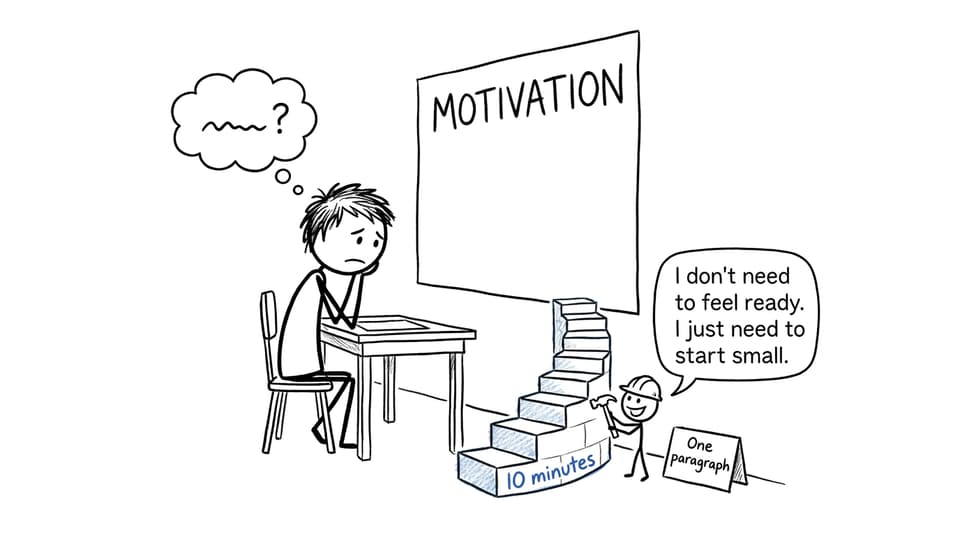
Motivation often disappears when a subject feels too large to begin. A novel becomes hundreds of pages, an essay becomes an empty document, and feedback becomes a list of weaknesses rather than a path forward. The practical answer to staying motivated studying MYP English Language and Literature is not to wait until you feel inspired. It is to make each study session small, specific, and visibly productive.
Start with one skill, work for a short period, produce something you can check, and record the improvement. That loop turns English from an uncertain activity called "revision" into a series of manageable decisions.
Your motivation checklist
Before studying, check that your plan includes:
- One clearly named skill, such as analysing tone or organising an argument
- One task that can be completed in 10 to 25 minutes
- A visible output, such as a paragraph, plan, annotation, or Flashcard set
- One way to check the work against feedback or criteria
- A specific next step written down before you finish
- Some variety across reading, writing, speaking, and viewing
You do not need every session to be exciting. You need it to be clear enough to start and useful enough to repeat.
Why motivation feels difficult in MYP English
English can create a peculiar kind of uncertainty. In some subjects, finishing ten questions gives you an obvious measure of progress. In Language and Literature, you might read for 40 minutes and still wonder whether you achieved anything.
The MYP course develops listening, speaking, reading, writing, viewing, and presenting. Its four assessment criteria are Analysing, Organizing, Producing Text, and Using Language. Those broad aims are valuable, but an instruction such as "revise English" gives your brain no obvious first move.
Replace the subject name with an action. Instead of planning to study English, plan to:
- Identify three authorial choices in an advertisement
- Explain how imagery affects an audience
- Build a five-point comparative essay plan
- Rewrite an introduction using a clearer thesis
- Test ten literary terms using active recall
Students who want to understand how these actions connect to marking can review the MYP Language and Literature assessment criteria.
The same-day START method
Use this five-step routine today. It takes approximately 30 minutes and requires only a text, a timer, and somewhere to write.
| Step | What to do |
|---|---|
| S: Select | Choose one skill and one short text or extract. |
| T: Time | Set a realistic 20-minute work period. |
| A: Act | Produce a paragraph, plan, annotation, or creative opening. |
| R: Review | Check one criterion and improve one precise weakness. |
| T: Track | Record what improved and choose tomorrow's first task. |
Select one skill
Choose a skill narrow enough to practise once. "Get better at analysis" is too broad. "Explain how two contrasting images create tension" is workable.
If you are unsure where to begin, open the MYP English Language and Literature resource hub and select a single topic. Focused resources such as evidence selection practice can remove the effort of deciding what to study.
Time and act
Set a timer for 20 minutes. Short sessions lower the emotional cost of beginning because you are not promising to surrender the entire evening. Put your phone out of reach and leave only the materials needed for the selected task.
After reviewing a concept for a few minutes, close the explanation and use it. Annotate an unfamiliar paragraph, explain a writer's choice aloud, or write a topic sentence from memory. Turn terminology into questions with RevisionDojo Flashcards, then apply one term in a short analysis. Effective MYP English Language and Literature revision techniques require retrieval and production, not endless rereading.
Review one weakness
Do not try to repair everything at once. Check the response against one criterion or one piece of teacher feedback. Perhaps your evidence is relevant but your explanation never reaches the writer's purpose. Improve that single link.
RevisionDojo's Grading tools can help identify a focused next step, while AI Chat can question your reasoning or explain why a claim remains descriptive. Use AI as a coach: submit your own attempt, ask for diagnosis, and make the revision yourself.
Track the evidence
End by writing two sentences:
- "Today I improved..."
- "Next time I will begin by..."
This creates evidence that your effort is going somewhere and leaves an easy entry point for tomorrow.
Build a weekly rhythm instead of relying on mood
Motivation fluctuates. A routine reduces how much that fluctuation matters. Try four short sessions rather than one exhausting weekend block:
| Day | Focus | Output |
|---|---|---|
| Monday | Terminology and recall | Ten tested Flashcards |
| Tuesday | Close analysis | One evidence-based paragraph |
| Thursday | Organisation or creative writing | One plan and opening |
| Saturday | Timed application and review | One response plus one rewrite |
This schedule trains different criteria while preserving repetition. The best revision strategies for MYP Language and Literature offer further ways to build a skill-based week.
RevisionDojo can sit at the centre of this rhythm. Study Notes clarify a technique, Flashcards test recall, and the Questionbank turns knowledge into action. AI Chat helps when reasoning stalls, while Grading tools make feedback more concrete. Mock Exams support timed rehearsal, and the Coursework Library helps you examine how effective work is structured. Predicted Papers, where relevant and available, provide further practice, while Tutors offer human guidance when the same weakness keeps returning.
Use texts you care about without avoiding challenge
Personal interest is a useful doorway. If you enjoy sport, analyse the language of a campaign advertisement. If you follow film, explore how framing, colour, dialogue, and sound shape an audience's response. If fiction holds your attention, practise with short-story structure and theme.
Interest should help you enter the skill, not protect you from unfamiliar material. Once the method feels secure, transfer it to a new genre or viewpoint. A student who understands how bias shapes a text should eventually apply that understanding to speeches, articles, images, and narratives they have not studied before.
Alternate between analysing, planning, speaking, and creative writing. The skill remains serious even when the format changes.
Make progress visible
A grade is delayed feedback. Motivation needs nearer evidence.
Keep a simple progress log with four columns: date, skill, completed output, and next improvement. Save one paragraph from each week. At the end of the month, compare the earliest and latest pieces for clearer claims, better evidence, stronger organisation, and more precise language.
Track actions you control rather than predicting marks. Useful measures include:
- Focused sessions completed
- Paragraphs rewritten after feedback
- Unfamiliar texts analysed
- Terms accurately recalled
- Plans completed within a time limit
Missing one session does not destroy the system. Restart with the smallest possible action. Consistency is not a perfect record; it is the habit of returning.
What to do when you feel stuck
Reduce the size of the task until resistance becomes unreasonable. Open the text. Read one paragraph. Underline one striking choice. Write one sentence about its effect.
If confusion rather than tiredness is blocking you, identify the exact question. "I do not understand English" cannot be solved. "I can identify symbolism, but I cannot explain its effect" can. Review targeted Study Notes, ask AI Chat for a simpler explanation, or bring the specific problem to a teacher or RevisionDojo Tutor.
The aim is not to manufacture enthusiasm on command. It is to restore movement.
Let action create motivation
Good study days sometimes begin with energy. Many begin with reluctance and become satisfying only after something has been completed. If you require motivation before acting, your progress depends on mood. If you let a small action come first, motivation has something solid to follow.
Choose one skill now. Set a 20-minute timer, create one piece of work, review one weakness, and record tomorrow's starting point. With its connected Study Notes, Questionbank, Flashcards, AI Chat, Grading tools, exam practice, Coursework Library, and Tutors, RevisionDojo gives MYP students one coherent place to keep that cycle moving.