


A disappointing result does not automatically mean your child needs tutoring. One difficult unit, unfamiliar assignment, or tired week can produce a wobble without indicating a deeper problem.
The more reliable signs a child needs help in MYP Individuals and Societies are patterns: repeated difficulty starting work, confusion about criteria, weak source analysis, unfinished investigations, or anxiety that continues across several weeks.
Parents do not need to become humanities teachers. Your role is to notice the pattern, identify the obstacle, and connect your child with appropriate support while leaving ownership of the work with them.
A quick parent checklist
Look for several of these signs occurring repeatedly:
- Your child recalls facts but struggles to explain causes, consequences, or perspectives.
- Research assignments regularly become overwhelming or remain unfinished.
- Teacher feedback mentions the same criterion or skill more than once.
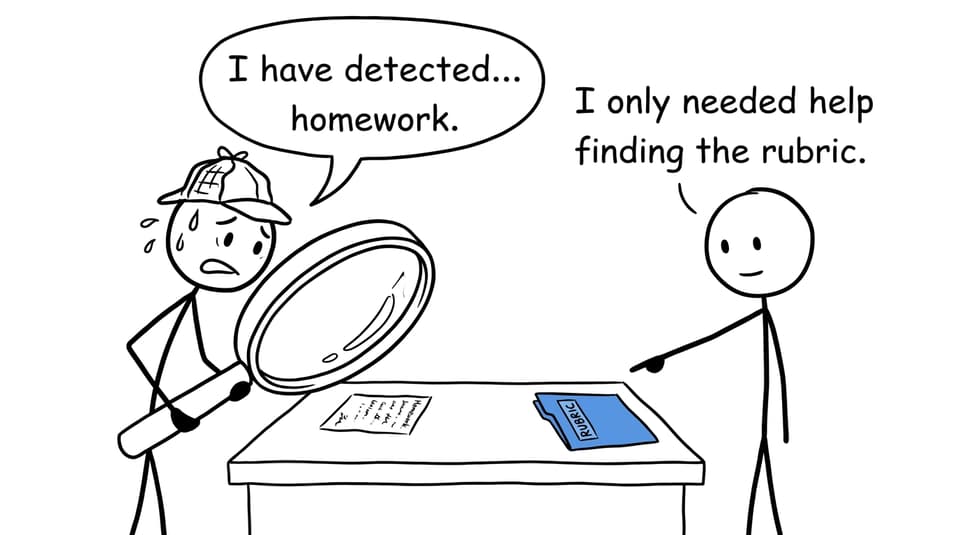
- Your child does not understand the rubric language.
- Written answers contain opinions but little supporting evidence.
- Sources are summarized without being evaluated.
- Ordinary assignments create unusual frustration or avoidance.
- Results decline across multiple tasks rather than one assessment.
No single item proves that extra help is necessary. Together, however, they may show that ordinary challenge has become a recurring barrier.
Understand what the subject is assessing
MYP Individuals and Societies can look like a content-heavy humanities course. In practice, students are also learning to investigate questions, interpret evidence, compare perspectives, communicate ideas, and build supported arguments.
Schools may teach integrated humanities or disciplines such as history, geography, economics, or politics. The assessment framework focuses on four broad areas: knowing and understanding, investigating, communicating, and thinking critically.
The MYP Individuals and Societies resource hub shows the concepts and skills involved. A child who remembers the topic may still struggle with the thinking demanded by the task.
Notice where the learning process breaks down
They know facts but cannot build an argument
A student might know when an event happened yet struggle to explain why it mattered. They may make a reasonable claim but provide no evidence, counterargument, or link to the question.
Ask, “What evidence supports that idea?” If your child can answer aloud but not in writing, organization may be the problem. If they cannot identify evidence, they may need to rebuild topic knowledge using concise MYP Individuals and Societies study resources.
Research tasks repeatedly stall
Investigations require more than finding information. Students may need to develop a focused question, plan their work, select relevant material, document sources, and evaluate their process.
Watch for endless browsing, an extremely broad question, scattered notes, or a bibliography assembled at the last minute. Ask your child to write three things: the research question, the next action, and the evidence needed. If they cannot do that after checking the instructions, contact the teacher.
Feedback repeats without changing the next attempt
Repeated comments such as “explain further,” “evaluate the source,” or “consider another perspective” are more revealing than one low criterion level.
Ask your child to translate one comment into an observable action. “Think critically” is vague. “Compare two interpretations and explain which is better supported” is actionable. RevisionDojo's Questionbank and Grading tools can support this feedback loop through targeted practice and criterion-related guidance where school policies allow.
Confidence or behaviour changes
Academic difficulty sometimes appears as behaviour before it appears in a report. A child may avoid opening an assignment, insist the subject is pointless, become upset by feedback, or spend hours producing little.
Ask, “Is the difficult part understanding the topic, knowing what the task wants, or getting started?” These problems require explanation, clarification, and planning respectively.
Use a calm seven-day support plan
Support does not have to begin with an intensive intervention. Try one week of small, visible actions.
| Moment | Low-pressure action |
|---|---|
| Start of the week | Review deadlines and identify one difficult task. |
| Before studying | Ask which criterion or skill the task assesses. |
| During revision | Choose one topic and one skill. |
| After practice | Record one error and the next action. |
| End of the week | Ask what became easier and what remains blocked. |
A short session might combine Flashcards, Study Notes, and one Questionbank response. Individuals and Societies Cheatsheets can help students orient themselves before deeper practice. AI Chat can explain a concept or challenge weak reasoning, but students should verify guidance against class materials and produce their own work.
For a difficult unit, use a closely matched resource rather than general revision. Students might review economic systems notes or explore urbanisation topic resources. The aim is not more work. It is a clearer next step.
Know when to involve the school or a tutor
Contact the teacher when the same difficulty persists across several tasks, instructions remain unclear after your child requests clarification, or feedback does not produce improvement. Describe what you observe without diagnosing the cause: “Over the last three assignments, starting the source-analysis section has taken a long time even with the rubric open. What are you noticing in class?”
Seek broader school support if difficulty accompanies a sustained change in sleep, mood, attendance, or daily functioning. Those concerns may extend beyond tutoring.
A tutor may help when your child needs repeated explanation, personalized modelling, or accountability. RevisionDojo Tutors provide human guidance, while Mock Exams, Predicted Papers, and the Coursework Library support structured rehearsal. The parent guide to supporting a child in the MYP offers a broader framework for balancing help with independence.
Support without taking over
Useful parental help often feels modest. Protect a study window, listen while your child explains an argument, ask what the rubric requires, and help them decide whom to contact.
Avoid rewriting responses, conducting research, or turning every result into a family verdict. A young person can need help without needing rescue.
RevisionDojo provides the academic layer beneath that calm approach: Study Notes for understanding, Flashcards for recall, the Questionbank for application, AI Chat and Grading tools for feedback, and Tutors for targeted human support. The goal is to identify the obstacle, practise the missing skill, and help your child gradually need less support.