

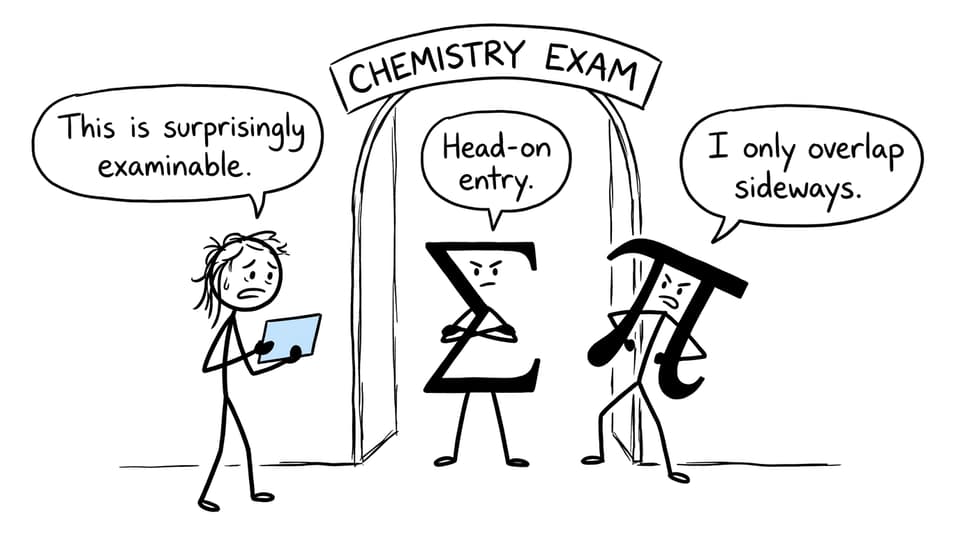
Sigma bonds are covalent bonds formed by head-on overlap of atomic orbitals along the internuclear axis, concentrating electron density between the nuclei. Every single, double, or triple bond contains exactly one sigma bond. Additional bonds in double and triple bonds are pi bonds formed through sideways p-orbital overlap.
That definition is short enough to memorize. The harder part is applying it when a question contains a complicated structure, unfamiliar ion, or hybridized carbon atom.
Sigma bonds at a glance
For the current IB Chemistry course, this material appears in Structure 2.2.15 and is Higher Level content. You should be able to:
- define sigma (σ) and pi (π) bonding using orbital overlap
- locate electron density relative to the internuclear axis
- deduce the number of each bond type in molecules and ions
- connect multiple bonding to hybridization and restricted rotation
- communicate the explanation with precise chemical language
If your wider bonding knowledge feels uncertain, begin with RevisionDojo's S2.2 covalent model resources before attempting exam-style questions.
How a sigma bond forms
A sigma bond forms when two suitable orbitals overlap head-on along the line connecting the bonded nuclei. This line is the internuclear axis or bond axis. The resulting region of high electron density lies directly between the nuclei.
Head-on overlap may involve:
- two s orbitals, as in H₂
- an s orbital and a p orbital
- two p orbitals aligned end-to-end
- hybrid orbitals such as sp, sp², or sp³ orbitals
The central idea is orientation, not simply orbital type. Two p orbitals overlapping end-to-end produce σ bonding; two parallel p orbitals overlapping sideways produce π bonding.
For another concise explanation, use RevisionDojo's sigma and pi bonds guide alongside the syllabus-aligned sigma and pi bond flashcards.
Sigma bonds compared with pi bonds
The first covalent connection between two atoms is σ. If the atoms share additional electron pairs, the extra bonds are π bonds.
| Bond feature | Sigma bond | Pi bond |
|---|---|---|
| Orbital overlap | Head-on | Sideways or lateral |
| Electron density | Along the internuclear axis | On opposite sides of the axis |
| Orbitals involved | s, p, or hybrid orbitals | Parallel unhybridized p orbitals |
| Presence | One in every single or multiple bond | Only in double and triple bonds |
| Relative overlap | Usually greater | Usually less |
| Rotation | Can remain intact during rotation | Sideways overlap restricts rotation |
Because head-on overlap is generally more effective, a σ interaction between the same atoms is normally stronger than the corresponding π interaction. Do not turn this into the claim that every single bond is stronger than every multiple bond. A double bond combines one σ and one π component and is normally stronger overall than the corresponding single bond.
The counting rule that prevents most mistakes
Use this conversion every time:
- Single bond: 1 σ, 0 π
- Double bond: 1 σ, 1 π
- Triple bond: 1 σ, 2 π
The safest method is to count connected pairs of atoms first. Every connected pair contributes one σ bond, regardless of whether the displayed connection is single, double, or triple. Then count one π for every double bond and two π for every triple bond.
Hydrogen atoms are easy to overlook. Every C-H, N-H, or O-H single bond also contributes one σ bond.
Worked examples for IB Chemistry
Example: ethene, C₂H₄
Ethene has the structure H₂C=CH₂.
- The four C-H connections contribute 4 σ.
- The C=C connection contains 1 σ and 1 π.
- Total: 5 σ and 1 π.
Each carbon has three electron domains and is sp² hybridized. Its three sp² orbitals form σ bonds, while its remaining unhybridized p orbital participates in the π bond. The sideways overlap requires the p orbitals to remain parallel, explaining why rotation around C=C is restricted.
Example: ethyne, C₂H₂
Ethyne has the structure HC≡CH.
- The two C-H connections contribute 2 σ.
- The C≡C connection contains 1 σ and 2 π.
- Total: 3 σ and 2 π.
Each carbon is sp hybridized. The carbon retains two mutually perpendicular unhybridized p orbitals, allowing two π interactions around the same internuclear axis.
Example: hydrogen cyanide, HCN
The structure is H-C≡N.
- H-C contributes 1 σ.
- C≡N contributes 1 σ and 2 π.
- HCN therefore contains 2 σ and 2 π.
The triple bond does not contain three sigma bonds. It is one connection between two nuclei, so only its first component is σ.

How this appears in IB exam questions
A short question may ask you to state, identify, or deduce the number of bond types. A longer question can combine Lewis structures, geometry, hybridization, and bonding in one sequence.
Suppose you are shown CH₃CHO and asked for the number of each bond type:
- Draw or inspect the full displayed structure: CH₃-C(=O)-H.
- Count six single connections: three C-H on CH₃, one C-C, one C-H on the carbonyl carbon, and the σ component of C=O.
- The C=O double bond adds one π component.
- Answer: 6 σ bonds and 1 π bond.
For a definition question, write a complete marking-point sentence:
A sigma bond forms by head-on overlap of atomic orbitals, with electron density concentrated along the internuclear axis.
Writing only “a strong covalent bond” does not describe its formation or electron-density distribution.
After reviewing the model, move into the IB Chemistry Questionbank. Grading tools and AI feedback are especially useful here because they reveal whether your chemistry was wrong or your wording was simply incomplete. RevisionDojo's hybridization guide can help when a question connects bonding with sp, sp², or sp³ carbon.
Common exam pitfalls
Counting lines instead of atomic connections
A triple bond is drawn with three lines, but it contains only one σ component. Count the bonded pair once for σ, then classify the remaining lines as π.
Forgetting bonds to hydrogen
Students sometimes focus on the carbon skeleton and miss C-H connections. Use a displayed structure rather than a condensed formula whenever counting becomes uncertain.
Saying pi electron density is “on the bond axis”
That describes σ bonding. Pi electron density lies on opposite sides of the axis, commonly described as above and below it.
Assuming sigma bonding means s-orbital overlap
The symbol σ describes the symmetry and direction of overlap. Sigma bonds can involve s orbitals, p orbitals, or hybrid orbitals.
Claiming rotation is always completely free
An isolated σ bond can remain intact as atoms rotate around its axis. Real molecules may still experience steric barriers or other structural constraints. In IB explanations, the key contrast is that rotating a double bond disrupts its sideways p-orbital overlap.
Quick-reference revision checklist
Before leaving this topic, make sure you can recall the following without notes:
- σ means head-on overlap along the internuclear axis.
- π means lateral overlap of parallel p orbitals.
- Every bonded pair of atoms has one σ connection.
- A double bond is 1 σ + 1 π.
- A triple bond is 1 σ + 2 π.
- Sigma bonding may involve atomic or hybrid orbitals.
- Pi bonding helps explain restricted rotation around multiple bonds.
- sp³ carbon forms four σ bonds and no π bonds.
- sp² carbon can form three σ bonds and one π bond.
- sp carbon can form two σ bonds and two π bonds.
Use the Structure 2 flashcard collection for active recall, then test the idea under time pressure with RevisionDojo's Chemistry Predicted Papers and Mock Exams.
Turn recognition into exam marks
This topic becomes manageable when you separate two tasks: first identify every connected pair of atoms, then classify any extra bonding as π. That simple routine works for alkenes, alkynes, carbonyl compounds, nitriles, and unfamiliar structures.
RevisionDojo brings the full revision loop together: Study Notes and Flashcards build recall; the Questionbank, AI Chat, and Grading tools expose weak explanations; Predicted Papers and Mock Exams build timing; and the Coursework Library and Tutors offer support when a concept refuses to settle. Start with one structure, count carefully, explain the overlap precisely, and repeat until the method feels automatic.