
Hybridization in IB Chemistry can feel like one of those topics you “sort of get” until the exam asks you to justify why a molecule is flat, or why a bond won’t rotate. Then the fog rolls in.
The truth is: hybridization is less about memorising labels and more about telling a clean story about shape, bonding, and evidence. In IB Chemistry, examiners reward explanations that link VSEPR predictions to orbital overlap and sigma/pi bonds.
Hybridization in IB Chemistry: the quick checklist
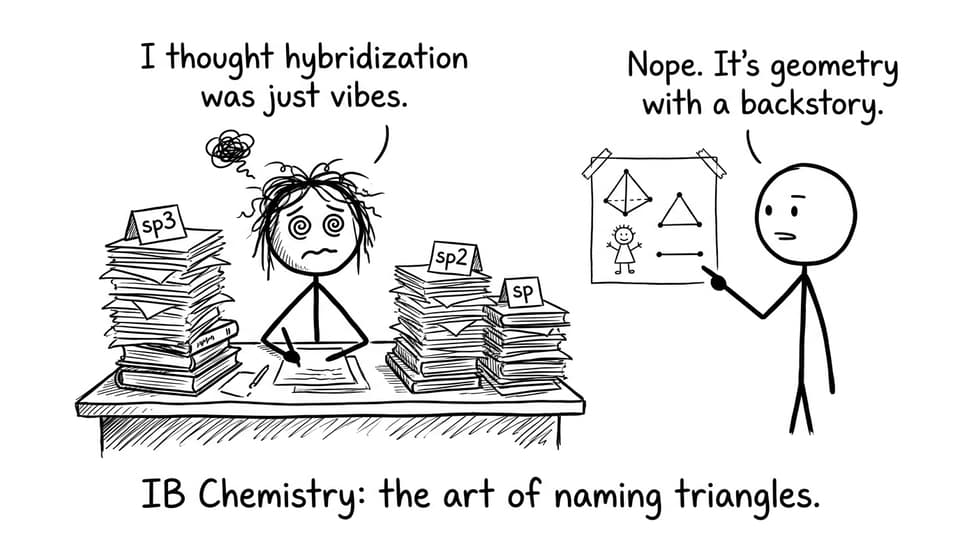
Use this checklist when you see any hybridization question in IB Chemistry:
-
Draw (or imagine) the Lewis structure.
-
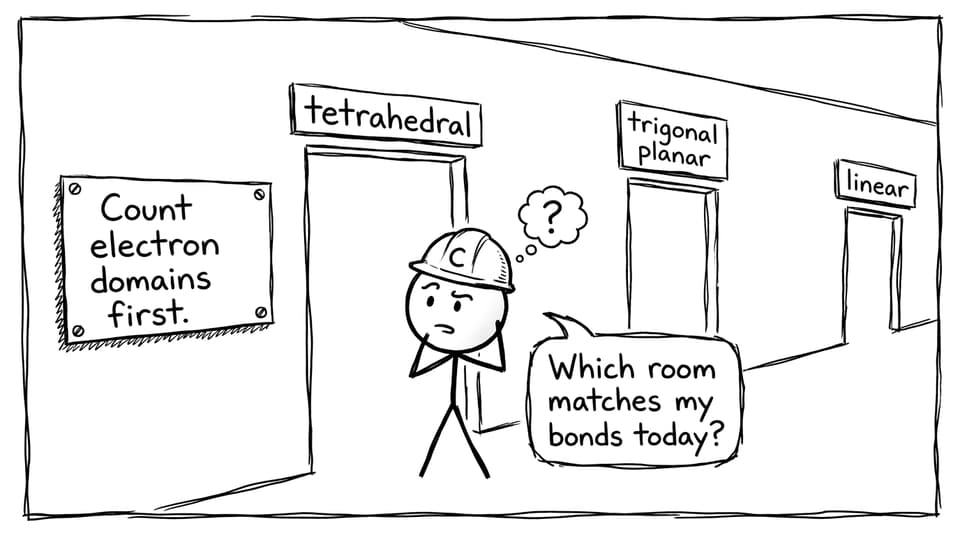
Count electron domains around the atom (bonding regions + lone pairs).
-
Match domains to geometry: 4 = tetrahedral, 3 = trigonal planar, 2 = linear.
-
Assign hybridization: sp3, sp2, sp.
-
State bond angles (ideal) and adjust if lone pairs are present.
-
Connect to bonding: how many sigma bonds and how many pi bonds?
If you need a refresher on geometry language, pair this with S2.2.4 VSEPR theory.
What hybridization means (without the mystery)
Hybridization in IB Chemistry is a model: atomic orbitals on one atom (usually s and p) “mix” to create new, equivalent hybrid orbitals that point in the directions needed for bonding.
You can’t watch orbitals blend in a lab. But you can observe shapes and bond angles. Hybridization is the explanation that makes the observed geometry feel inevitable rather than random.
For a syllabus-aligned definition you can quote cleanly, see IB Chemistry Key Definitions.
Why IB Chemistry cares: VSEPR predicts, hybridization explains
VSEPR in IB Chemistry tells you how electron pairs arrange to minimise repulsion. Hybridization then answers the next question: what orbitals allow that arrangement to form strong sigma bonds?
When you connect the two, your explanation sounds like chemistry, not memorisation.
If you want the wider topic context, Structure 2: Models of bonding and structure is the natural home base.
sp3 hybridization (tetrahedral logic)
In IB Chemistry, sp3 hybridization happens when there are four electron domains around the central atom.
How it forms
One s orbital + three p orbitals mix:
- s + p + p + p (\rightarrow) 4 sp3 orbitals
Geometry and angles
-
Electron-domain geometry: tetrahedral
-
Ideal bond angle: 109.5°
Common examples
-
CH4: four identical C-H bonds
-
NH3: still sp3, but one lone pair compresses bond angles slightly
-
H2O: still sp3, but two lone pairs compress the angle more
To strengthen your covalent bonding language, revise alongside Covalent Bonds Explained Clearly for IB Chemistry.
sp2 hybridization (flat, with a hidden p orbital)
In IB Chemistry, sp2 hybridization appears with three electron domains.
How it forms
One s + two p orbitals mix:
- s + p + p (\rightarrow) 3 sp2 orbitals + 1 unhybridized p orbital
Geometry and angles
-
Trigonal planar
-
Ideal bond angle: 120°
The exam-worthy insight
That leftover unhybridized p orbital is the one that can form a pi bond. This is why double bonds are linked to sp2 centers.
Benzene takes this further via delocalisation, so it’s worth pairing with Benzene (HL) notes.
sp hybridization (linear and built for triple bonds)
In IB Chemistry, sp hybridization happens with two electron domains.
How it forms
One s + one p orbital mix:
- s + p (\rightarrow) 2 sp orbitals + 2 unhybridized p orbitals
Geometry and angles
-
Linear
-
Bond angle: 180°
Why triple bonds fit
Two remaining p orbitals can form two pi bonds, which is exactly what you need for a triple bond.
Sigma and pi bonds: the hybridization “proof”
Hybridization in IB Chemistry becomes much easier when you treat it like accounting:
-
sp3: 4 sigma, 0 pi
-
sp2: 3 sigma, 1 pi
-
sp: 2 sigma, 2 pi
This also explains rotation:
-
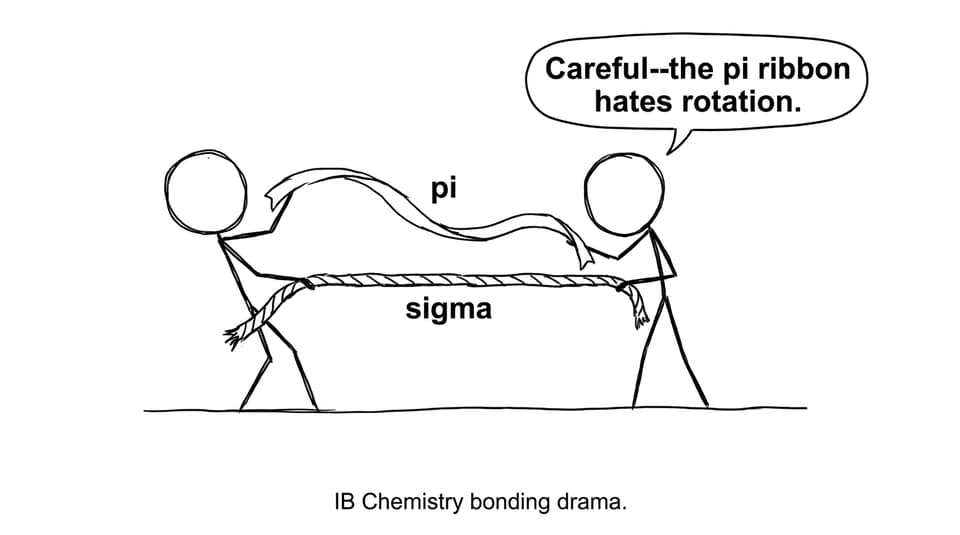
Single bonds rotate freely because they’re sigma-only.
-
Double bonds resist rotation because a pi bond would have to break.
For a full walkthrough, use Sigma and Pi Bonds Explained.
How to practice hybridization the RevisionDojo way
Hybridization is a “small topic” in IB Chemistry that shows up everywhere: organic mechanisms, polarity, resonance, and structure explanations.
A good routine looks like this:
-
Learn the core patterns using S2.2 The covalent model (notes).
-
Drill it with targeted practice in the S2.2.16 Hybridization and Bonding page, then check misconceptions using the S2.2.16 notes.
-
Use RevisionDojo’s Questionbank to get repetition fast, then tighten your language with Study Notes and Flashcards.
-
When you get stuck on “why sp2 here?”, ask AI Chat to critique your explanation the way an examiner would.
-
If you’re marking your own work, the Grading tools help you spot missing keywords (like “electron domains” or “unhybridized p orbital”).
Closing: make hybridization your easy marks in IB Chemistry
Hybridization in IB Chemistry isn’t a list to memorise; it’s a repeatable explanation template. Count electron domains, match the geometry, assign sp3/sp2/sp, then connect to sigma and pi bonding. Do that, and molecular shape questions stop feeling like surprises.
When you’re ready to turn understanding into exam speed, RevisionDojo is built for it: Questionbank for targeted drills, Study Notes and Flashcards for recall, AI Chat for instant feedback, plus Mock Exams and Predicted Papers to rehearse under pressure. Keep hybridization in your weekly rotation and IB Chemistry starts to feel more predictable, because it is.