

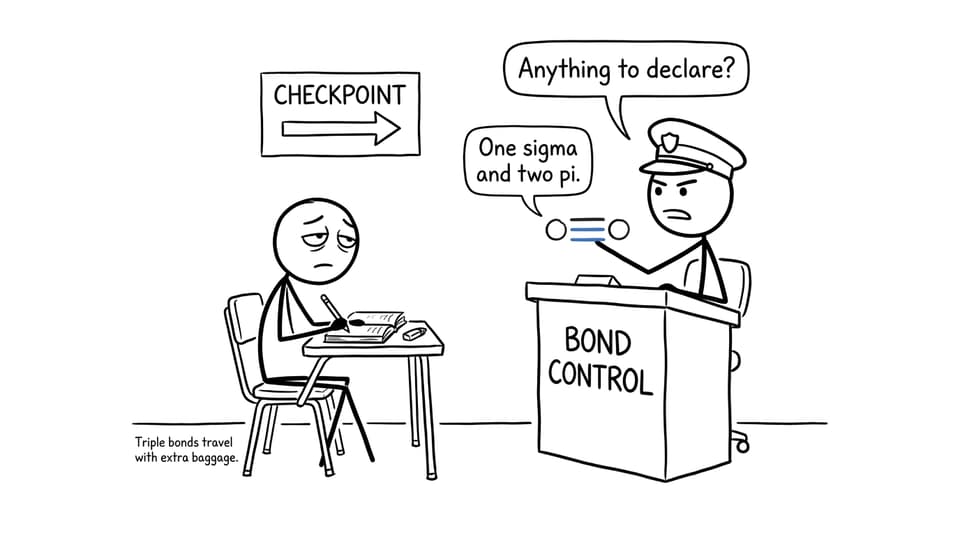
A sigma bond (σ bond) is a covalent bond formed by head-on orbital overlap along the bond axis, the imaginary line joining two nuclei. Its electron density is concentrated around that axis. Every single bond is σ, while a double bond contains one σ and one pi bond, and a triple bond contains one σ and two pi bonds.
That compact definition carries most of what you need. The challenge is recognizing it when a question replaces a simple formula with an unfamiliar structure. A double line can look like two equivalent bonds on paper, yet the orbital picture says otherwise. One bond establishes the framework; the other changes the molecule's geometry, rotation and reactivity.
What IB Chemistry students need to know
For the current IB DP Chemistry course, sigma and pi bonding appears in Structure 2.2.15 of the HL syllabus. Students are expected to understand how each bond forms and deduce their presence in molecules and ions. The neighboring hybridization content in Structure 2.2.16 helps explain which orbitals overlap.
Your exam-ready checklist is short:
- Define σ bonding using head-on overlap, bond axis and electron density.
- Define pi bonding using lateral overlap of p orbitals.
- Recognize that each bonded pair of atoms has no more than one σ connection.
- Convert single, double and triple bonds into their σ and pi components.
- Connect multiple bonding to restricted rotation and molecular geometry.
- Identify the relevant hybrid orbitals when a question asks for them.
Begin with RevisionDojo's covalent model study notes if any of the underlying ideas feel uncertain. The IB Chemistry key definitions are also useful for learning precise syllabus language.
How a sigma bond forms
Atomic orbitals must overlap for a covalent bond to form. In σ bonding, that overlap occurs head-on, directly between the nuclei. Depending on the atoms and their electronic structures, this can involve:
- s-s overlap, as in H-H
- s-p or s-hybrid overlap
- p-p head-on overlap
- hybrid orbitals such as sp, sp² and sp³
The essential feature is orientation, not the name of the orbital. If the orbitals overlap along the internuclear axis and the bonding electron density is concentrated around that axis, the bond has σ symmetry.
A pi bond forms differently. Two parallel p orbitals overlap laterally, placing electron density on opposite sides of the bond axis. This sideways overlap is disrupted by rotation, which explains why a carbon-carbon double bond restricts rotation. A σ connection by itself can normally remain intact as bonded atoms rotate, although rings and other structural constraints may still prevent free movement.
For a broader comparison, review sigma and pi bonds explained alongside the foundational guide to covalent bonds in IB Chemistry.
Counting sigma and pi bonds reliably
Use one rule before attempting any example:
Count one σ bond for every connected pair of atoms. Treat the second line in a double bond and the second and third lines in a triple bond as pi bonds.
| Bond shown | Sigma component | Pi component |
|---|---|---|
| Single bond | 1 | 0 |
| Double bond | 1 | 1 |
| Triple bond | 1 | 2 |
Worked example: ethene, C₂H₄
Ethene has the displayed structure H₂C=CH₂.
- The four C-H single bonds contribute four σ bonds.
- The C=C bond contains one σ bond and one pi bond.
- Total: five σ bonds and one pi bond.
Each carbon is sp² hybridized. The carbon-carbon σ component forms through head-on overlap of sp² hybrid orbitals. One unhybridized p orbital remains on each carbon, and their lateral overlap produces the pi component.
Worked example: ethyne, C₂H₂
Ethyne has the structure H-C≡C-H.
- The two C-H connections contribute two σ bonds.
- The C≡C connection contributes one σ bond and two pi bonds.
- Total: three σ bonds and two pi bonds.
Each carbon is sp hybridized. The carbon-carbon σ component comes from sp-sp head-on overlap. Two unhybridized p orbitals remain on each carbon, allowing two separate lateral overlaps.
Worked example: ethanoic acid, CH₃COOH
Write the connectivity as H₃C-C(=O)-O-H. Count connected atom pairs rather than visible lines:
- Three C-H connections: 3 σ
- One C-C connection: 1 σ
- One C=O connection: 1 σ and 1 pi
- One C-O connection: 1 σ
- One O-H connection: 1 σ
The molecule therefore contains seven σ bonds and one pi bond.
This method scales more safely than trying to count every drawn line. It is particularly valuable in the IB Chemistry organic chemistry resources, where condensed and skeletal formulas can conceal C-H bonds.
How sigma bonding appears in exam questions
A question may ask you to define, distinguish, deduce, state or explain. Match the response to the command term.
For a definition, an efficient answer is:
A σ bond forms through head-on overlap of atomic orbitals along the bond axis, with electron density concentrated along that axis.
If asked to distinguish σ from pi bonding, compare both the overlap and electron-density location. Saying only that σ is stronger is incomplete because it does not identify how the bonds form.
For a deduction question, draw or inspect the complete structure, count every bonded atom pair once, and then add one pi component for each double bond or two for each triple bond. Show the decomposition explicitly: C=C = 1σ + 1pi. Clear notation makes your reasoning visible.
Revise these skills using the S2.2 covalent model learning hub and its Questionbank, Study Notes and Flashcards. Once individual questions feel secure, use Chemistry Predicted Papers and Mock Exams to practise recognizing bonding ideas inside mixed problems. RevisionDojo's AI Chat and grading tools can then help identify whether an error came from chemistry, structure counting or exam phrasing.
Common mistakes that cost marks
Counting every line as a sigma bond
A C≡C symbol has three lines, but only one represents σ overlap. The other two are pi components. Count connected atom pairs first.
Saying pi bonds form through head-on overlap
This reverses the definitions. Use a physical cue: sigma points straight; pi lies to the sides.
Forgetting bonds to hydrogen
Condensed and skeletal representations can hide hydrogens attached to carbon. Complete the valence of each carbon before giving a total.
Claiming every sigma bond uses hybrid orbitals
Head-on overlap can involve unhybridized atomic orbitals or hybrid orbitals. H₂, for example, forms through overlap of two 1s orbitals.
Confusing bond rotation with molecular rotation
Rotation around an isolated single connection can occur without destroying its σ overlap. Rotation around a double bond would disrupt the lateral p-orbital overlap, so it is restricted. Do not claim that an entire molecule rotates simply because one bond permits rotation.
Quick-reference revision summary
- Formation: head-on orbital overlap
- Electron density: concentrated along and around the bond axis
- Single bond: 1σ
- Double bond: 1σ + 1pi
- Triple bond: 1σ + 2pi
- Counting method: one σ connection per bonded atom pair
- Pi requirement: parallel p orbitals overlapping laterally
- Rotation: σ overlap can survive rotation; pi overlap cannot
- Best definition words: head-on, orbitals, bond axis, electron density
- Best practice method: draw connectivity, count σ first, then count pi components
A small topic becomes manageable when you stop treating it as a vocabulary test and start seeing the orbital picture behind each line. Learn the definition, practise the counting rule, and explain what the electron density is doing. Then use RevisionDojo's Questionbank, Flashcards, AI Chat, grading tools and IB Chemistry exam strategy guide to turn that understanding into precise, repeatable exam answers.