
A TOK deadline can make a simple question feel unexpectedly large: What am I actually supposed to say? The difficulty is rarely a lack of ideas. It is learning how to turn those ideas into a clear, critical exploration of knowledge.
The short answer is yes: RevisionDojo TOK help covers both major assessment components, including essay planning, prescribed-title analysis, exhibition guidance, annotated examples, Study Notes, Flashcards, AI Chat, and rubric-informed Grading tools. It cannot replace your TOK teacher, the official IB instructions, or your own judgment. What it can do is make an abstract course more navigable.
That matters because TOK is not an ordinary subject exam. According to the IB, it is a mandatory part of the Diploma Programme core and is assessed through a maximum 1,600-word essay and an exhibition involving three objects. The challenge is not memorizing enough content. It is demonstrating how carefully you can question claims, compare perspectives, and evaluate the limits of what we know.
RevisionDojo TOK help at a glance
RevisionDojo can support you with:
- Understanding the TOK essay and exhibition requirements
- Interpreting prescribed titles without changing their wording
- Planning claims, counterclaims, examples, and implications
- Connecting arguments to Areas of Knowledge
- Choosing specific exhibition objects with authentic contexts
- Studying annotated essay and exhibition exemplars
- Reviewing a draft through TOK-focused Grading tools
- Using AI Chat to test reasoning and identify unanswered questions
- Revising TOK concepts through Study Notes and Flashcards
The best starting point is the IB Theory of Knowledge resource hub, which brings together lessons, notes, flashcards, essay guidance, exhibition material, and examples.
| TOK component | Official task | RevisionDojo support |
|---|---|---|
| TOK essay | Respond to one of six session-specific prescribed titles in no more than 1,600 words | Title analysis, planning guidance, exemplars, AI feedback, and a dedicated grader |
| TOK exhibition | Connect three objects to one of 35 IA prompts in a commentary of no more than 950 words | Prompt guidance, object-selection advice, examples, and commentary support |
How RevisionDojo supports the TOK essay
The TOK essay is externally assessed and represents two-thirds of the final TOK result. The IB issues six prescribed titles for each examination session, and students select one. A strong response must engage with the selected title exactly as written rather than drifting toward a more convenient version of the question.
RevisionDojo's TOK requirements overview helps establish this foundation before you begin planning. That first stage is easy to underestimate. If your interpretation of the title is weak, elegant paragraphs will only make the wrong argument sound polished.
Breaking down a prescribed title
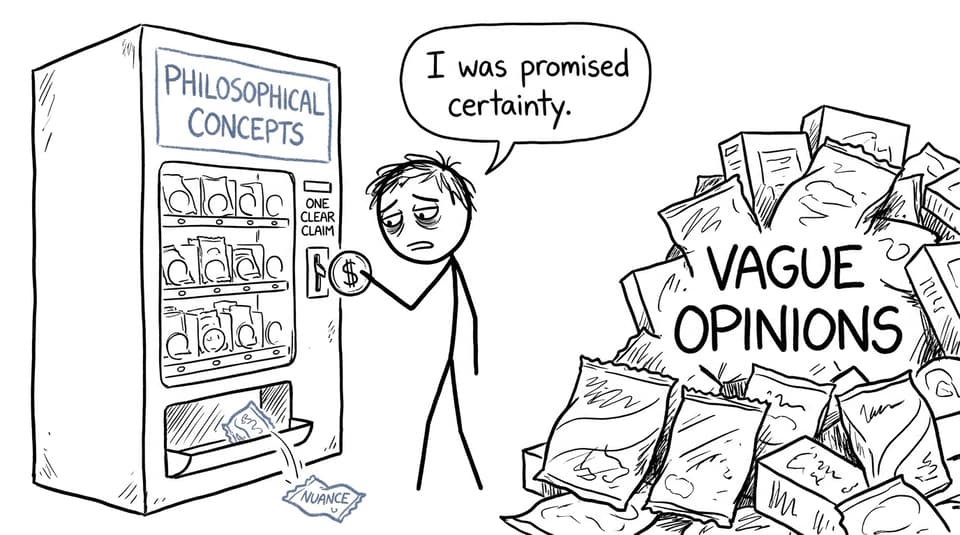
Useful title analysis begins by identifying the conceptual tension. A title involving certainty, for example, may be asking more than whether certainty exists. It may invite you to compare what certainty means in mathematics with what it means in history, or to examine whether practical confidence can exist without absolute proof.
RevisionDojo's essay resources help students:
- Define important terms in context rather than mechanically
- Identify assumptions hidden within a title
- Select Areas of Knowledge that create a meaningful comparison
- Develop a qualified thesis rather than an absolute answer
- Return to the precise wording throughout the essay
The guide to improving a TOK essay is particularly useful when your draft contains promising ideas but lacks a clear argumentative direction.
Moving from examples to analysis
A real-world example does not earn its place merely by being interesting. It must help you investigate the title. After presenting an example, ask what it reveals about the production, acquisition, communication, or evaluation of knowledge. Then consider its limitations.
RevisionDojo's guide to connecting ideas with Areas of Knowledge can help you avoid treating history, mathematics, the arts, or the sciences as decorative labels. The goal is to examine how their methods, standards of evidence, perspectives, and constraints differ.
A practical paragraph test is:
- What claim am I making about knowledge?
- How does my example support that claim?
- What assumption or limitation complicates it?
- What follows if my reasoning is accepted?
- How does this answer the prescribed title?
Feedback without surrendering authorship
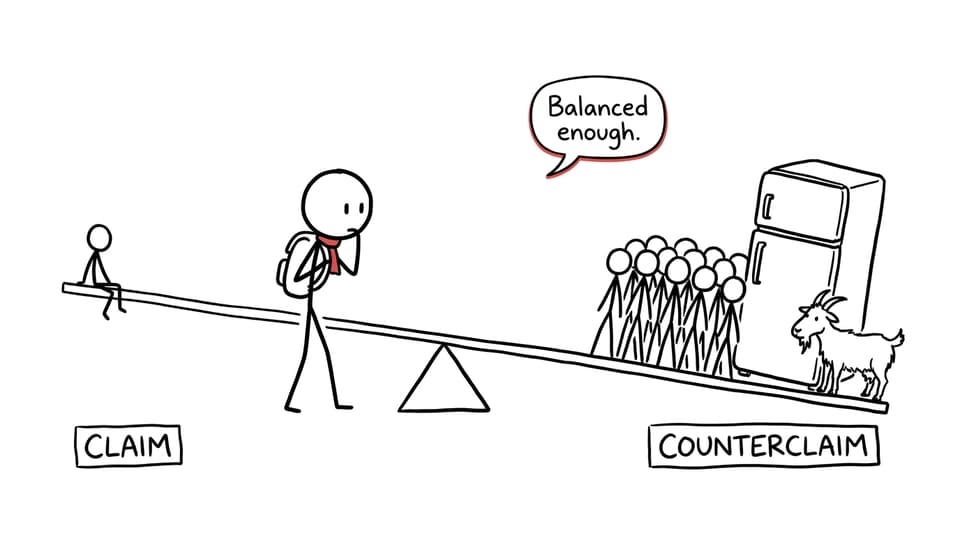
The RevisionDojo TOK Essay Grader is designed to review work in progress or a fuller draft and provide feedback connected to TOK expectations. This can reveal a thesis that is too broad, examples that remain descriptive, or counterclaims that appear briefly but are never evaluated.
The sensible approach is iterative. Draft a section yourself, review the feedback, decide which observations are valid, and revise in your own language. AI Chat can then act as a questioning partner: ask it to challenge an assumption, identify where a conclusion overreaches, or suggest questions you have not answered.
Do not treat AI output as submission-ready writing. Your school is responsible for applying the IB's academic integrity requirements, and your teacher must authenticate your work. TOK rewards independent judgment, so outsourcing that judgment defeats both the purpose of the course and the value of the feedback.
How RevisionDojo supports the TOK exhibition
The exhibition accounts for one-third of the TOK result. It is internally assessed by your teacher and externally moderated by the IB. You choose one of 35 IA prompts, select three objects or images of objects, and submit commentaries totaling no more than 950 words.
The exhibition asks how TOK manifests in the world around us. That phrase changes the task. You are not writing a miniature philosophical essay and attaching three pictures afterward. You are using specific objects and their real-world contexts to reveal something significant about the chosen prompt.
RevisionDojo's step-by-step TOK exhibition guide explains the process from prompt selection to commentary revision.
Choosing objects with something to say
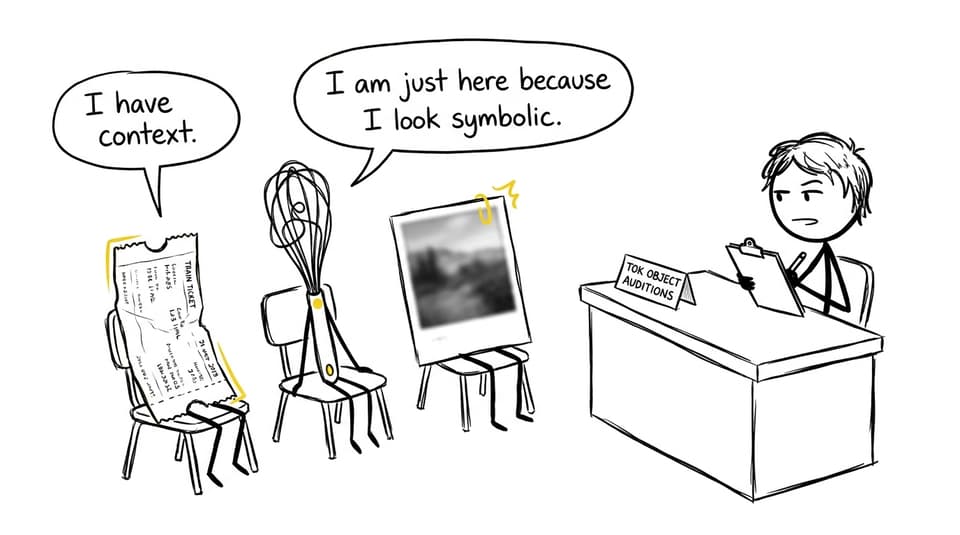
A strong object is specific. A generic newspaper is weak because its context is unclear. A particular issue published on a particular date in response to a particular event gives you something concrete to analyze.
Each object should also make a distinct contribution. If all three merely prove the same point, the exhibition becomes repetitive. One might reveal the authority of experts, another the influence of cultural perspective, and a third the limitations of evidence.
The guide to selecting TOK exhibition objects helps students test relevance, specificity, context, and conceptual range before committing to a set.
Writing the commentary
For each object, your commentary should identify the object, establish its particular context, connect it directly to the selected prompt, and justify why it belongs in the exhibition. Description is necessary, but it should remain brief. Most of the intellectual work lies in the connection and justification.
A reliable drafting sequence is:
- Identify: What precisely is this object?
- Contextualize: Where, when, and how did it function?
- Connect: What does it reveal about the exact IA prompt?
- Justify: Why is this object especially useful?
- Distinguish: What does it contribute that the other objects do not?
You can study RevisionDojo's TOK exhibition examples to observe how successful commentaries establish context and maintain prompt focus. Use exemplars to study decisions, not to borrow objects or reproduce language. The value lies in noticing how another student reasons.
A practical RevisionDojo workflow for TOK
Resources become useful when they are used in the right order. Opening every tool at once often creates the illusion of progress while making decisions harder.
Before drafting
Read the official instructions supplied by your school, then review RevisionDojo's Study Notes and Flashcards to refresh central TOK concepts. Use the course hub to compare essay titles or exhibition prompts. Record questions, tensions, possible examples, and objections before deciding on a structure.
During drafting
Build an outline in which every paragraph or object has a distinct purpose. Use AI Chat to interrogate your reasoning rather than generate prose. If you need a structural model, consult the TOK essay and exhibition requirements guide, then return to your own argument.
During revision
Read your work once for relevance, once for analysis, and once for clarity. Compare it with the TOK coursework exemplar library, then use the Grading tools to identify priorities for another revision. Finish by checking citations, word limits, title or prompt wording, and your school's submission requirements.
RevisionDojo's Questionbank, Predicted Papers, and Mock Exams are more directly useful for your examined IB subjects, while its Tutors can provide broader individual support. Together with TOK resources, the Coursework Library, Study Notes, Flashcards, AI Chat, and Grading tools, they make RevisionDojo the ultimate IB resource rather than a single-assignment shortcut.
TOK becomes manageable when the process becomes visible
TOK can initially feel vague because there is no formula that produces a guaranteed argument. But there is a disciplined process: understand the question, make a defensible claim, choose a precise example, test the claim, acknowledge its limits, and explain the implications.
RevisionDojo helps make that process visible. Use its TOK guides to understand the task, its exemplars to calibrate your judgment, and its feedback tools to locate weaknesses. Then make the final decisions yourself.
That is the real value of RevisionDojo TOK help. It does not remove the uncertainty from Theory of Knowledge. It helps you think well enough to use that uncertainty.