



Improve Your TOK Essay: A Student’s Guide to Scoring Higher
At some point in every TOK season, there’s a quiet moment where you realise your draft is not “bad”; it’s just… confident in the wrong way.
You’ve got examples. You’ve got big ideas. You’ve even got that satisfying paragraph where you define three key terms and feel like a philosopher.
And still, the essay reads like it’s trying to win an argument.
TOK rarely rewards that. A high-scoring TOK essay is less like a closing statement and more like a careful walk through uncertainty: what we can justify, what we assume, and what changes when the context changes.
This guide is built for IB students who want to improve their TOK essay in practical ways: sharpen your knowledge question, choose examples that actually earn credit, balance claims and counterclaims, and revise with the rubric in mind. Along the way, you’ll see how RevisionDojo can make TOK feel less mysterious and more manageable.
TOK essay checklist (use this before you rewrite anything)
If you want a fast way to improve a TOK draft, start here. This isn’t about adding more words. It’s about making each paragraph easier for an examiner to reward.
-
Does your introduction clearly interpret the prescribed title in your own words (not just repeat it)?
-
Is your knowledge question (KQ) specific enough to debate, not just describe?
-
Do you use at least two Areas of Knowledge (AOKs) in a balanced way?
-
Does every real-life situation connect back to the KQ with explicit explanation?
-
Do you build claims and counterclaims, then evaluate both?
-
Are you using TOK terms (justification, perspective, evidence, methods) accurately and sparingly?
-
Does your conclusion answer “so what?” rather than restating points?
When you’re stuck, it helps to compare your work against strong models. RevisionDojo’s IB Theory of Knowledge (TOK) Examples make “what good looks like” much less guessy.
Start with the prescribed title: unpack it like it’s a contract
Every TOK essay begins with a prescribed title, but high scorers treat it like a set of instructions hidden inside one sentence.
Here’s what to do before you plan paragraphs:
Circle the command phrase and the tension
Most titles contain a built-in conflict: certainty vs doubt, observation vs bias, models vs reality, knowledge vs ethics. Your job is to keep that tension alive through the whole TOK essay.
Define only what you will actually use
TOK essays fail quietly when definitions become decorative. Define terms in a way that helps you argue.
For example, if the title includes “reliable,” don’t write a dictionary definition. Define reliability in a way that differs across AOKs: reliability in the natural sciences might lean on replicability; reliability in history might lean on provenance and interpretation.
If you’re choosing a session’s titles, use a guide that breaks down what each one is really asking. RevisionDojo’s TOK May 2026 essay prescribed titles guide (and the May 2025 TOK essay titles) are good examples of how to spot the hidden demands in each prompt.
Build a sharp TOK knowledge question (KQ) that you can actually answer
A TOK essay without a clear KQ tends to drift into “interesting thoughts.” The examiner can feel the drift, even if your writing is polished.
A strong TOK KQ is:
-
Open-ended (no yes/no ending)
-
Specific (not “what is knowledge?”)
-
Debatable across AOKs (so you can compare methods)
-
Anchored to the prescribed title’s tension
Instead of:
- “Is scientific knowledge reliable?”
Try:
- “To what extent do the methods used to verify claims in the natural sciences produce more reliable knowledge than the methods used in history?”
That small shift forces you into TOK thinking: methods, verification, comparison, extent.
If you want a clearer way to shape KQs from titles, RevisionDojo’s guide to TOK essay titles and knowledge questions lays out what examiners expect you to do with the prompt.
Real-life situations: stop collecting, start using
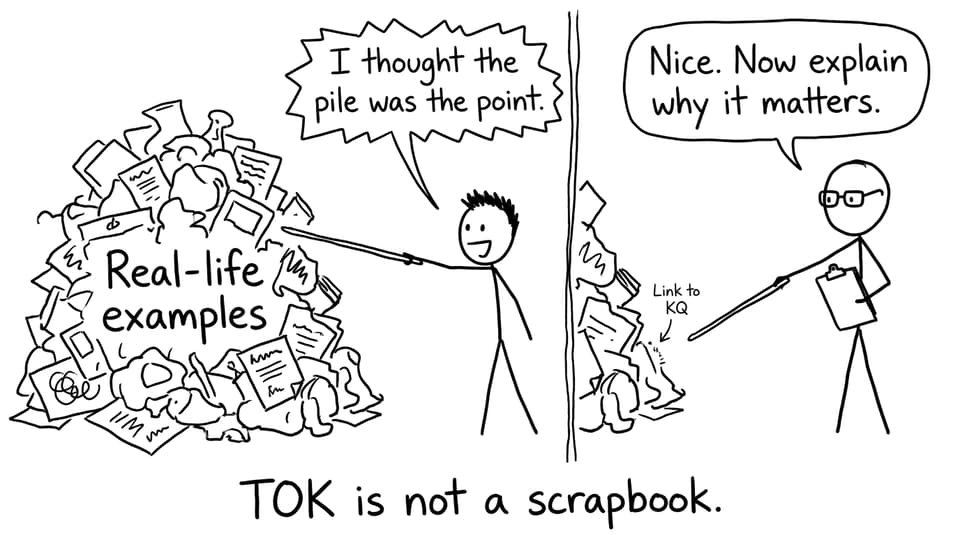
Most students don’t lack examples. They lack explanation.
A real-life situation in TOK is not proof. It’s a test case. You use it to show how knowledge is produced, challenged, or limited.
The 3-sentence rule that improves TOK instantly
After you introduce an example, force yourself to write three sentences:
-
What happened? (brief)
-
What knowledge claim does it illustrate?
-
Why does this matter for the KQ in this AOK?
If you can’t write sentence 3, the example is just decoration.
Here are examples that often work well when linked properly:
-
Natural sciences: shifting models (e.g., changing medical guidance as evidence updates)
-
History: contested narratives (e.g., how archives, propaganda, or missing sources shape accounts)
-
Human sciences: replication issues, measurement bias, cultural framing
-
The arts: interpretation, author intent, audience context
Balance your AOKs the way examiners expect
TOK rewards comparison. That means your AOKs can’t be a “science paragraph” and a “history paragraph” that never speak to each other.
To improve your TOK essay, build contrasts that the examiner can track:
-
Methods: experiment vs interpretation, peer review vs source criticism
-
Standards: replicability vs coherence, predictive power vs explanatory depth
-
Limitations: measurement error vs bias in selection, lab controls vs missing evidence
A practical technique: end each AOK section with a mini-bridge sentence like:
- “This standard of justification differs from history because…”
That one line often turns two separate discussions into a TOK comparison.
For broader TOK skill-building (beyond one title), RevisionDojo’s TOK thinking and skills guide gives you the mental habits that strong essays repeat.
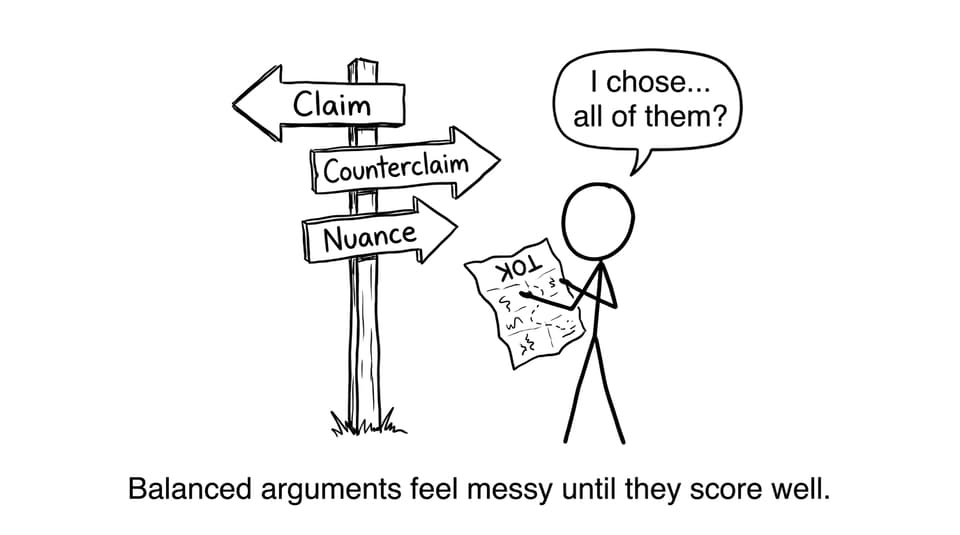
Claims and counterclaims: the TOK engine room
A high-scoring TOK essay is built on intellectual honesty: you don’t just present a claim, you test it.
A structure that keeps you from becoming one-sided
For each main section, use:
-
Claim: a defensible answer to the KQ in one AOK
-
Example: one real-life situation
-
Counterclaim: a realistic challenge
-
Evaluation: conditions where each side holds, and why
Notice the last part: evaluation. That’s where marks appear.
If you struggle generating counterclaims that fit the titles, RevisionDojo’s best counterclaims for TOK essay titles shows what “examiner-plausible opposition” looks like.
Write like you’re guiding a tired, fair examiner
The best TOK writing is calm. It doesn’t show off. It makes thinking visible.
To improve clarity fast:
Use short topic sentences that answer the KQ
Start paragraphs with the claim, not the context.
Use TOK terms with precision
Use vocabulary like “justification,” “perspective,” “evidence,” “assumption,” and “method,” but only when it helps you explain the reasoning. TOK terminology is not decoration.
Avoid false certainty
Swap absolute phrases (“proves,” “always,” “cannot”) for accurate ones (“suggests,” “often,” “under these conditions”). In TOK, accuracy sounds like humility.
If you want a general lens on what earns marks across subjects (including TOK), RevisionDojo’s What IB examiners actually look for is a useful reminder: structure, relevance, reasoning, criteria alignment.
Align your TOK essay with the rubric (then revise like a strategist)
Students often revise TOK by “making it longer” or “adding one more example.” Examiners don’t reward volume. They reward insight and focus.
A better loop:
-
Re-read your introduction and ask: did I interpret the title, or just repeat it?
-
Highlight every place you used an example. In the margin, write the KQ link in 8 words.
-
Underline counterclaims. If you can’t find them quickly, they’re not clear enough.
-
Circle evaluation phrases: “this depends on,” “however,” “a limitation is,” “under conditions where.”
Then get feedback that is actually criterion-based. RevisionDojo’s IB Coursework Grader is built for TOK essays and gives rubric-calibrated comments you can act on. When you want to talk through fixes, Jojo AI can help you diagnose whether a paragraph is answering the title or drifting.
A simple RevisionDojo workflow to improve TOK (without losing your weekends)
TOK tends to expand and steal time from other subjects. The goal is a routine that contains it.
Try this weekly system:
-
Monday (30 min): plan one section (claim, counterclaim, example, evaluation).
-
Wednesday (30 min): draft that section cleanly.
-
Friday (20 min): submit to the IB Coursework Grader and turn the top feedback points into a checklist.
-
Sunday (20 min): revise only those points.
Meanwhile, keep your exam prep moving with RevisionDojo’s broader ecosystem: Questionbank for daily practice, Study Notes for clarity, Flashcards for retention, Mock Exams for pacing, Predicted Papers for targeted practice, AI Chat for quick explanations, and Tutors when you need human challenge. TOK improves faster when your week is organised, not when you panic-draft.
If you want more TOK-specific resources, start with the IB Theory of Knowledge Resources hub or browse all TOK posts.
Final thoughts: a better TOK essay is a more honest one
The students who score highest in TOK aren’t the ones who sound certain. They’re the ones who sound careful.
They treat the prescribed title as a real question. They use real-life situations as evidence to think with. They build counterclaims that could actually be true, then evaluate the conditions where each side holds.
If you want to improve your TOK essay, focus on the links: title to KQ, KQ to AOKs, AOKs to examples, examples to evaluation. That chain is what examiners reward.
And when you want that chain to become easier to build, RevisionDojo is designed for the whole IB journey: the Coursework Library for model TOK work, AI Chat for unblocking ideas, Grading tools for rubric-aligned feedback, and the broader set of Questionbank, Study Notes, Flashcards, Predicted Papers, Mock Exams, and Tutors to keep the rest of your subjects steady while TOK gets sharper.
For your next step, explore the IB Theory of Knowledge Resources and pick one improvement target for your draft today. TOK rewards small, precise upgrades done consistently.