


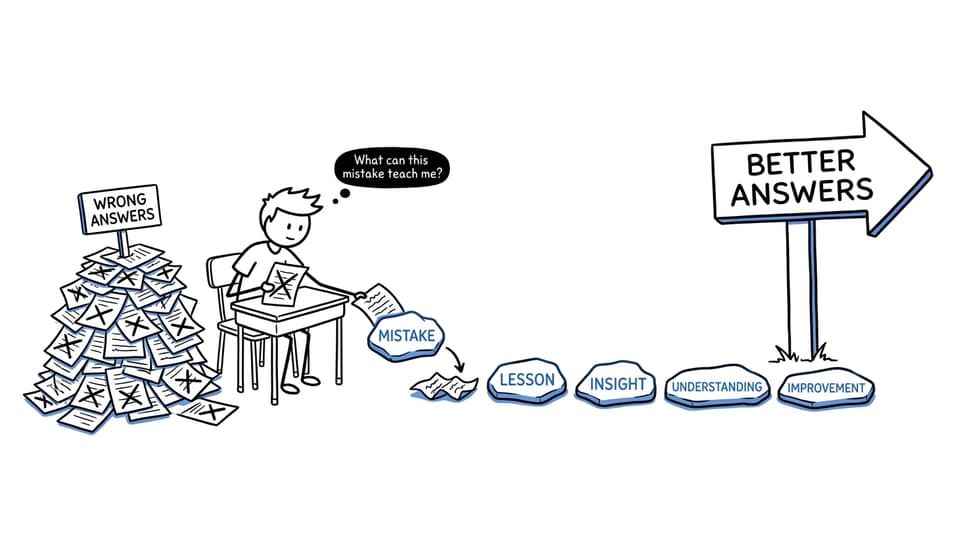
A disappointing practice answer can feel like evidence that you are bad at History. Usually, it is something more useful: evidence that one part of your process needs attention.
The best method for reviewing mistakes in MYP History practice is to identify why you lost marks, connect the problem to the relevant MYP criterion, write a specific correction rule, improve the answer, and retest the same skill within a few days. Do not simply read the feedback and move on. A mistake only becomes valuable when it changes your next response.
You can begin with the RevisionDojo MYP History resources, but the routine below also works with questions supplied by your teacher.
Your mistake-review checklist
After each short practice set:
- Mark the response using the available guidance or teacher feedback.
- Identify the first point where the answer went wrong.
- Label the mistake by type and MYP criterion.
- Repair the underlying knowledge or skill.
- Rewrite the weakest section.
- Attempt a different question testing the same skill.
- Schedule another short retest one to three days later.
This is a feedback loop, not a punishment. Its purpose is to make repeated errors visible while they are still small enough to fix.
Use this same-day review method
- Re-read the question before viewing the answer. Underline the command term, topic, timeframe, and any required sources. Ask what the task actually demanded.
- Mark the exact point of failure. Find the first sentence where your reasoning became inaccurate, unsupported, irrelevant, or unclear. Later weaknesses may be consequences of this first problem.
- Assign an error code. Use K for knowledge, Q for question interpretation, E for evidence, A for analysis, S for source evaluation, O for organization, and T for timing.
- Connect it to a criterion. Decide whether the main issue concerns knowing and understanding, investigating, communicating, or thinking critically.
- Write a correction rule. Make it an instruction you can follow, such as: “After presenting evidence, explain how it supports my answer to the question.”
- Rewrite and retest. Improve the weakest paragraph now. Then answer a different question targeting the same weakness within one to three days.
The RevisionDojo MYP History Questionbank is useful for finding another topic-based question without repeating the exact prompt.
Diagnose the mistake before fixing it
Students often record an error as “I needed more detail.” That description is too vague to guide the next attempt. Detail can mean an accurate date, a named example, an explanation of significance, or a connection between evidence and argument.
Use a compact error log:
| What to record | Example |
|---|---|
| Question and command term | Explain two consequences of the conflict |
| Error code | A: analysis |
| What happened | I identified consequences but did not explain their effects |
| Criterion connection | Thinking critically |
| Correction rule | Link each consequence to a specific short- or long-term result |
| Retest date | Two days from now |
Keep the log short. Its value comes from comparing entries over time. If “Q” appears repeatedly, your problem may be question interpretation rather than historical knowledge. If “E” dominates, you may understand the topic but lack precise supporting examples.
For a broader version of this process across MYP subjects, see the six-step method for reviewing MYP mistakes.
Match your correction to the MYP criteria
Knowing and understanding
A knowledge error includes inaccurate facts, confused chronology, weak terminology, or an example that does not fit the question. Repair it narrowly. Read the relevant Study Notes, close them, and explain the idea from memory before creating a few Flashcards for names, concepts, dates, or causal links.
Investigating
An investigation error may involve an unfocused research question, unsuitable method, limited evidence, or weak reflection. Rewrite the question so its subject, period, place, and analytical focus are clear. Then explain why each selected source would help answer it.
Communicating
A communication mistake occurs when useful knowledge is hidden by weak structure, inappropriate style, unclear wording, or poor source documentation. Outline the answer as claim, evidence, explanation, and link. Check that each paragraph has one job and that the format matches the task.
RevisionDojo’s AI Chat can clarify confusing instructions, while Grading tools can identify structural weaknesses. Treat automated feedback as guidance rather than an unquestionable verdict, and ask your teacher when it conflicts with the assigned criteria.
Thinking critically
Critical-thinking errors include describing instead of analysing, listing evidence without connecting it, treating a source as simply “biased,” or ignoring alternative perspectives. Repair these mistakes by adding reasoning, not merely more facts.
For source evaluation, explain how origin and purpose create a particular value or limitation. For an argument, show why the evidence supports your judgment and acknowledge a meaningful counterpoint.
Rewrite less, but think more
Rewriting every answer in full can consume an hour without revealing whether you learned anything. Use the smallest effective repair.
If the thesis was weak, rewrite the thesis and paragraph plan. If one paragraph lacked analysis, preserve the evidence and replace its explanation. If you misunderstood the command term, create a fresh plan. Complete a full rewrite only when the structure failed throughout or when you need timed-writing practice.
The improved version is not necessarily longer. It is better when it identifies a mechanism and connects evidence, cause, and consequence.
Retest the skill, not the memorized answer
Immediate rewriting demonstrates that you understand the correction while the feedback is visible. It does not prove that you can apply the lesson independently.
Choose a new question with the same skill but different content. If your original error involved comparing perspectives, compare two different sources. If you struggled to explain consequences, move to another event.
Use three checkpoints:
- Today: correct the original response.
- Within three days: answer a different question testing the same skill.
- About one week later: include that skill in a mixed or timed set.
Flashcards suit factual or conceptual gaps, but they cannot replace historical writing. Questionbank practice tests application; Mock Exams and an exam builder reveal whether the skill survives time pressure.
Look for patterns each week
Once a week, spend ten minutes counting your error codes. Choose the most frequent or costly pattern as the next week’s priority. Repeated “Q” errors might mean you answer “evaluate” as though it means “describe.” Repeated “O” errors may point to unplanned paragraphs rather than weak historical knowledge.
The MYP revision guide and study routine can help you place error reviews inside a sustainable schedule. When independent correction stalls, a RevisionDojo Tutor can help diagnose the pattern. The Coursework Library can also demonstrate approaches to organization and evidence in longer tasks, provided you preserve your own analysis and authorship.
Turn feedback into your next answer
The emotional temptation is to hide a weak response and start a fresh topic. The strategic choice is to stay with the mistake long enough to understand it.
RevisionDojo brings that process together: Study Notes repair narrow knowledge gaps, Flashcards strengthen retrieval, the Questionbank creates targeted application, and AI Chat and Grading tools turn uncertainty into an action. Mock Exams can then test the corrected skill under pressure.
Start with one response. Find the first point of failure, assign an error code, write one correction rule, and attempt a new question. Progress in History rarely arrives as one dramatic breakthrough. More often, it is the quiet disappearance of mistakes you once made repeatedly.